
Free Pre-Start Checklist (Air Arc) Template
Formalise safety checks for air arc gouging with our free Pre-Start Checklist (Air Arc) template. Aligned with Australian WHS practice.
Free Pre-Start Checklist (Air Arc) Template
DOCX • 125 KB + PDF
Updated Oct 2026
No signup required
Purpose of the Free Pre-Start Checklist (Air Arc) Template
Air arc gouging is a high-energy thermal cutting process that uses a carbon electrode and compressed air to melt and remove metal. It generates significant hazards, including intense heat, ultraviolet (UV) radiation, high noise levels, and hazardous fumes and spatter.
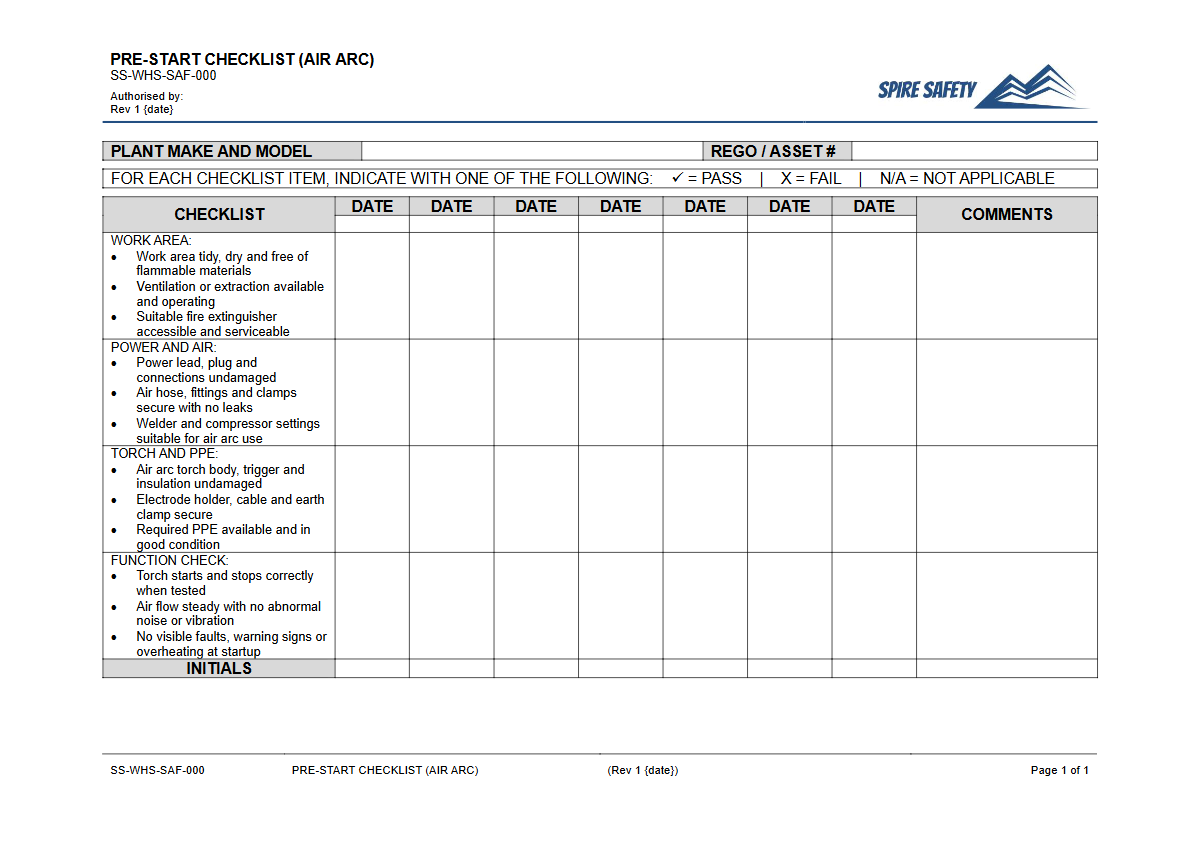
This Free Pre-Start Checklist (Air Arc) Template provides a structured framework for operators to conduct thorough inspections of their equipment before each use. Systematically checking key components helps identify potential faults or defects that could lead to equipment failure, property damage, or serious injury. Using a checklist is a practical way to manage risks, maintain equipment in safe working order, and form a key part of a robust WHS management system.
Video walkthrough
How to use the Free Pre-Start Checklist (Air Arc) Template
To implement this pre-start checklist, first download the template in your preferred format (DOCX or PDF). The next critical step is customisation.
This document provides a solid foundation, but it must be adapted to reflect the specific make and model of your air arc equipment, the unique environment of your workplace, and your organisation's safe work procedures. We recommend involving experienced operators and maintenance personnel in this customisation process to ensure the checklist is practical and comprehensive.
Once finalised, integrate the checklist into your daily operational workflow, ensuring all operators are trained on how to complete it correctly. For comparison, you can see how a similar process is applied in our bench grinder pre-start checklist for other workshop equipment.
Key Inspection Points
A thorough pre-start inspection for air arc gouging equipment should cover several critical areas. These checks ensure the system can operate safely and effectively. The checklist prompts the user to inspect:
- Power Source: Check for any damage to the casing, ensure controls are clearly labelled and functional, and verify that cooling fans are unobstructed.
- Cables & Connections: Inspect all power, work, and control cables for cuts, abrasions, or exposed wiring. Ensure all connections are tight and free from corrosion.
- Electrode Holder (Torch): Check the torch for cracks, heat damage, or loose parts. Ensure the air jet orifices are clear and the electrode clamping mechanism works correctly.
- Air Supply System: Inspect air hoses for leaks, cracks, or damage. Check that the pressure regulator is functioning correctly and set to the manufacturer's recommended pressure.
- Personal Protective Equipment (PPE): Verify that all necessary PPE is available, in good condition, and appropriate for the task. This includes a welding helmet, hearing protection, and flame-resistant clothing.
- Work Area: Ensure the area is well-ventilated to control exposure to fumes. Given the fumes produced, processes like this are why a fume cabinet pre-start checklist is so important in laboratory settings. Also, confirm the work area is clear of flammable materials and that fire-fighting equipment is accessible.
When to use it
The pre-start checklist should be completed before the first use of the air arc gouging equipment on any shift. It should also be completed if the equipment has been idle for an extended period, has been moved to a new location, or after any maintenance or repair work has been performed.
This frequency ensures that any changes in the equipment's condition are identified as early as is reasonably practicable, preventing minor issues from escalating into major safety incidents.
Who should use it
This checklist is designed for use by operators who have been trained and deemed competent in the safe use of air arc gouging equipment. Supervisors should also use the checklist to verify that safety checks are being consistently performed and documented.
Establishing clear competency requirements and training frameworks is a core WHS duty, and if your organisation requires assistance, our general WHS consulting services can provide expert guidance. Maintenance personnel may also use the checklist as part of their diagnostic or post-repair verification processes.
Addressing Identified Issues
If any item on the checklist fails inspection, the equipment must not be used. It should be immediately removed from service using a lock-out/tag-out procedure, with a clear 'Do Not Operate' or 'Out of Service' tag affixed to the power source.
The defect must be reported to a supervisor or the maintenance department according to your workplace's reporting procedure. Regular WHS compliance audits can help verify that these crucial defect reporting and rectification procedures are being followed effectively.
Common mistakes
Common mistakes to avoid
- Failing to check the condition of all cables for frays, cracks, or exposed wires.
- Neglecting to verify proper ventilation and the absence of flammable materials in the work area.
- Using an incorrect air pressure, which can lead to poor gouge quality and increased spatter.
- Skipping the PPE check or using inadequate PPE for the intense heat, noise, and UV radiation produced.
Legal references
Legal considerations
The following legal requirements may be relevant to this type of work.
- Work Health and Safety Act (Harmonised) — Provides the primary duties for protecting workers and other people from work health and safety risks.
- Work Health and Safety Regulations (Harmonised) — Sets out requirements supporting the management of workplace hazards and risks.
The following codes may be relevant to this type of work.
- Managing WHS Risks Code of Practice — Provides practical guidance on identifying hazards, assessing risks and applying effective controls.
- Work Health and Safety Consultation, Cooperation and Coordination Code of Practice — Provides practical guidance on consulting workers and coordinating with other duty holders.
- Managing the Work Environment and Facilities Code of Practice — Provides practical guidance on safe work environments, workplace facilities and related controls.
Did you know
Intense Noise Levels
Air arc gouging can produce noise levels well over 115 dB(A). This requires mandatory hearing protection and can pose a significant risk of permanent hearing damage with repeated or prolonged exposure.
High Metal Removal Rate
Compared to grinding or chipping, air arc gouging is one of the fastest methods for removing large amounts of metal, which is why it is favoured in heavy fabrication and repair work.
FAQ
Frequently asked questions
01What is air arc gouging?
02Is a pre-start checklist a legal requirement in Australia?
03What happens if a fault is found during the check?
04What Personal Protective Equipment (PPE) is needed for air arc gouging?
Share this resource
Free Pre-Start Checklist (Air Arc) Template
Browse Categories
How To Use It
- 1Download and open in Word or PDF.
- 2Replace the placeholders with your business details.
- 3Get it reviewed by a WHS specialist before rollout.
Need it customised?
Our WHS consultants can adapt this template to your site, run a gap analysis, or audit what you already have in place.
Book a Free Consultation WHS consulting servicesor call 1300 156 382