
Free Pre-Start Checklist (Air Compressor) Template
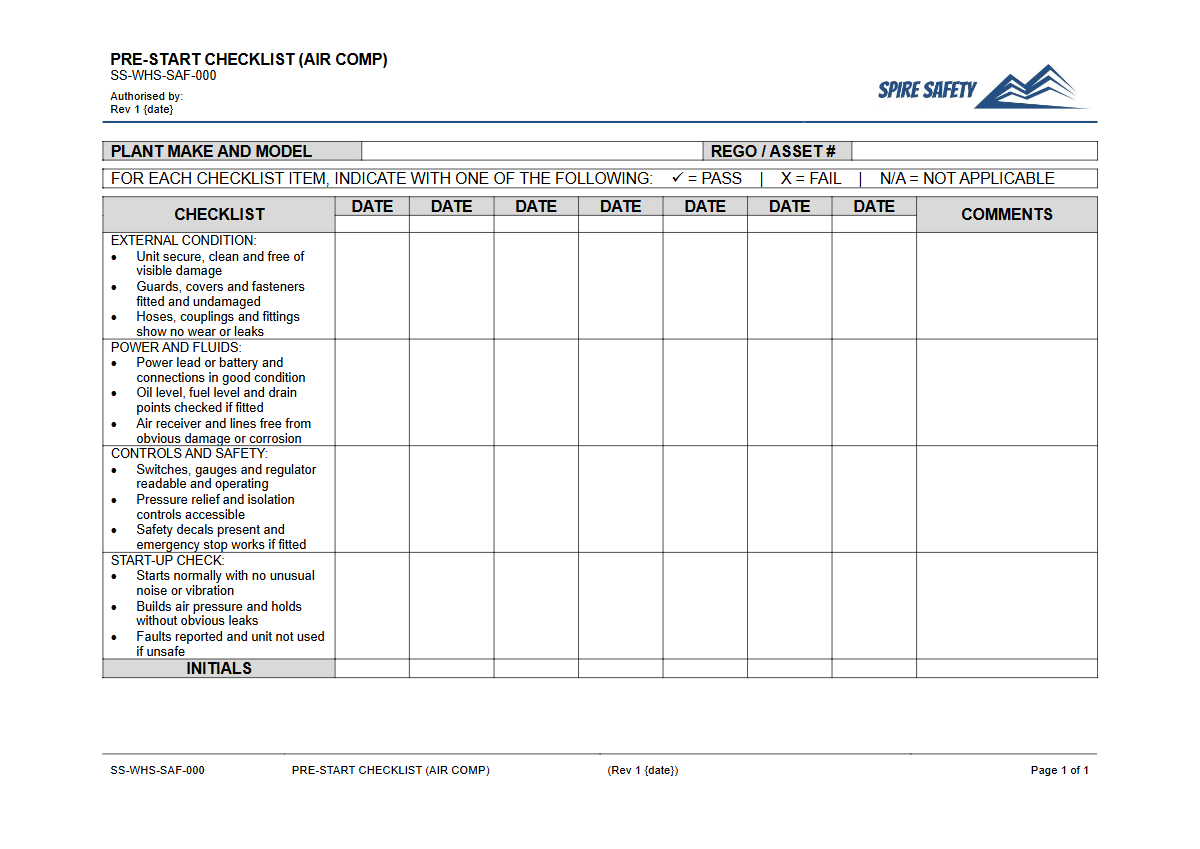
Formalise your daily air compressor safety checks with our free pre-start checklist template. Structured for Australian workplaces. Download your DOCX & PDF.
Free Pre-Start Checklist (Air Compressor) Template
DOCX • 125 KB + PDF
Updated Oct 2026
No signup required
Purpose of the Free Pre-Start Checklist (Air Compressor) Template
An air compressor is a common but potentially hazardous piece of equipment found in many Australian workplaces. Using our Free Pre-Start Checklist (Air Compressor) Template provides a structured method to formalise daily safety inspections before operation.
This process helps your team identify potential faults, leaks, or damage that could lead to equipment failure, serious injury, or property damage. Consistent checks are a fundamental part of a proactive safety culture and create a documented record of equipment condition over time.
This pre-start checklist is designed as a practical tool to support your risk management process for plant and equipment. By systematically verifying safety-critical components—such as pressure gauges, relief valves, hoses, and emergency stops—operators can ensure the compressor is fit for service.
Integrating this check into your daily operations is a key component of effective WHS management systems, helping your organisation meet its duty of care.
Video walkthrough
How to use the Free Pre-Start Checklist (Air Compressor) Template
This resource is available for immediate download in both DOCX and PDF formats. The DOCX version is fully editable, allowing you to tailor the checklist to your specific operational needs.
A well-designed Pre-Start Checklist for an Air Compressor must reflect the unique characteristics of your workplace and the equipment in use to be effective.
Important: This template is a starting point, not a final document. You must customise it to suit your specific air compressor model, its operating environment, and the tasks it is used for.
We have designed this template to be comprehensive, but only your team can identify and add the unique risks and controls relevant to your site. Consider adding checks for specific attachments, local site hazards (e.g., ventilation, trip hazards from hoses), or company-specific procedures.
Just as you would adapt a Pre-Start Checklist (Bench Grinder) Template for different workshop tools, this document requires your input to be effective. Once customised, ensure all relevant workers are trained on how to complete the checklist correctly.
When to use the Pre-Start Checklist
The air compressor pre-start check should be completed before the first use of the equipment on any given day or shift. If the compressor is used by multiple operators during a single shift, a handover check is also good practice.
The goal is to identify any faults or issues that may have developed since its last use or overnight.
This daily inspection does not replace the need for regular, scheduled maintenance by a competent person as specified by the manufacturer. Instead, it complements the maintenance schedule by providing a daily snapshot of the equipment's operational safety. Consistently performing these checks can flag developing issues before they escalate into major failures, a principle that applies to all plant, including items covered by our Pre-Start Checklist for Floor Saws.
Who should use the checklist
The pre-start check should be conducted by a worker who is trained, competent, and authorised to operate the specific air compressor. This person must understand the equipment's functions, be able to recognise potential hazards, and know the correct procedure to follow if a defect is found.
This may include isolating the equipment from its power source (tagging out) and reporting the fault to a supervisor.
Supervisors and managers also have a role in the process. They are responsible for ensuring that the checklists are being completed correctly and that any reported issues are addressed promptly before the equipment is returned to service.
Periodically reviewing completed checklists is a valuable exercise that can be incorporated into broader WHS compliance auditing activities to verify that safety procedures are being followed.
For more examples of equipment-specific safety documents and other useful tools to support your WHS framework, browse our complete free WHS resources library.
Common mistakes
Common mistakes to avoid
- "Pencil-whipping" the checklist without physically inspecting each item.
- Failing to isolate the compressor from its power source before checking components like belts and fans.
- Ignoring minor issues like small air leaks or unusual noises, which can be indicators of a larger developing problem.
- Using a generic checklist that hasn't been customised for the specific make, model, and condition of the compressor in use.
Legal references
Legal considerations
The following legal requirements may be relevant to this type of work.
- Work Health and Safety Act (Harmonised) — Provides the primary duties for protecting workers and other people from work health and safety risks.
- Work Health and Safety Regulations (Harmonised) — Sets out requirements supporting the management of workplace hazards and risks.
The following codes may be relevant to this type of work.
- Managing WHS Risks Code of Practice — Provides practical guidance on identifying hazards, assessing risks and applying effective controls.
- Work Health and Safety Consultation, Cooperation and Coordination Code of Practice — Provides practical guidance on consulting workers and coordinating with other duty holders.
- Managing the Work Environment and Facilities Code of Practice — Provides practical guidance on safe work environments, workplace facilities and related controls.
Did you know
Pressure Hazard
Air receivers (tanks) on compressors are pressurised vessels that can fail explosively if they are corroded or damaged. The stored energy in a 200-litre tank at 8 bar is equivalent to approximately 45 grams of TNT.
Noise Exposure
Many industrial air compressors operate at noise levels above 85 dB(A), the exposure standard where hearing protection is required. Prolonged exposure without proper controls can lead to permanent hearing loss.
FAQ
Frequently asked questions
01Why is a pre-start check for an air compressor so important?
02Is this template suitable for all types of air compressors?
03How often should an air compressor pre-start check be done?
04What should happen if a fault is found during the check?
Share this resource
Free Pre-Start Checklist (Air Compressor) Template
Browse Categories
How To Use It
- 1Download and open in Word or PDF.
- 2Replace the placeholders with your business details.
- 3Get it reviewed by a WHS specialist before rollout.
Need it customised?
Our WHS consultants can adapt this template to your site, run a gap analysis, or audit what you already have in place.
Book a Free Consultation WHS consulting servicesor call 1300 156 382