
Free Pre-Start Checklist (Air Receiver) Template
Download our free Pre-Start Checklist (Air Receiver) Template. This structured DOCX & PDF resource helps formalise safety checks for pressure vessels.
Free Pre-Start Checklist (Air Receiver) Template
DOCX • 125 KB + PDF
Updated Oct 2026
No signup required
Purpose of the Free Pre-Start Checklist (Air Receiver) Template
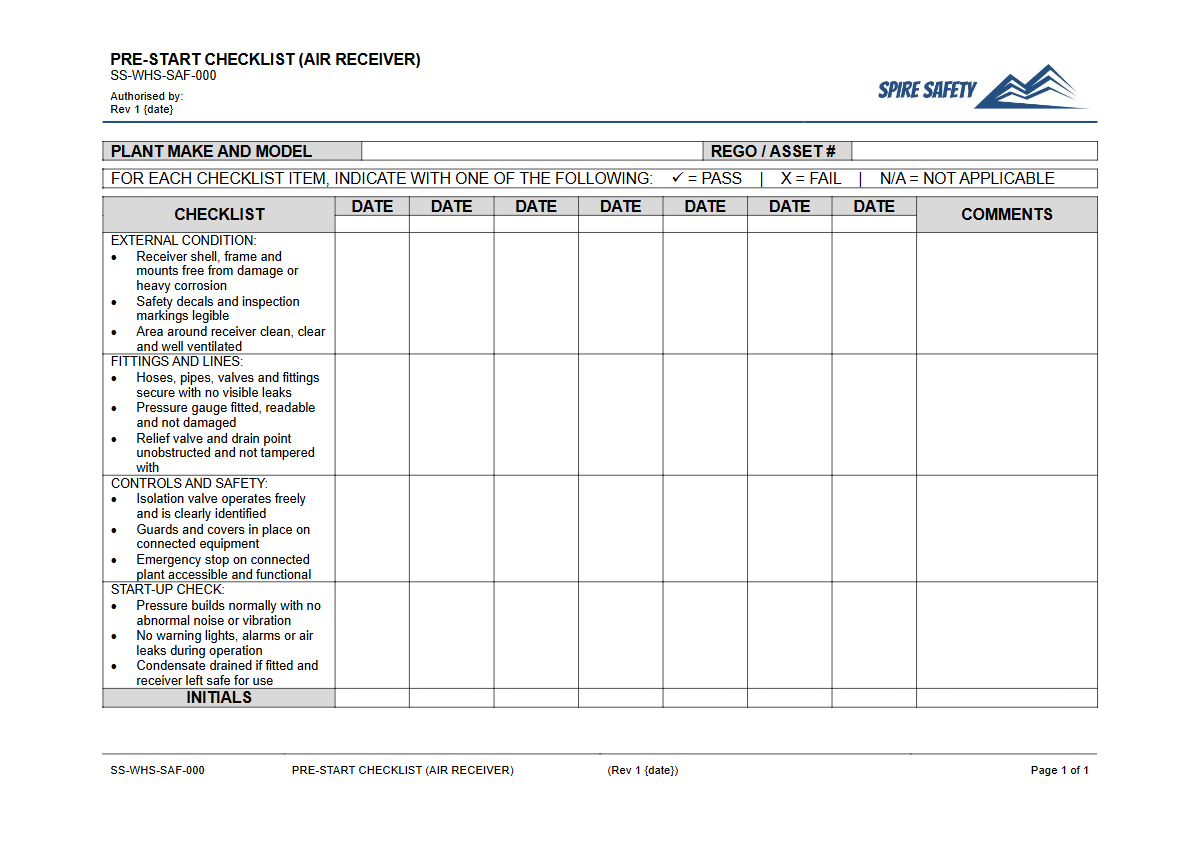
This Free Pre-Start Checklist (Air Receiver) Template provides a structured framework for conducting essential safety inspections on pressure vessels before use. Air receivers, which store compressed air, pose significant risks if not properly maintained.
A systematic pre-start check helps operators identify potential hazards such as corrosion, leaks, faulty gauges, or damaged safety valves early, mitigating the risk of catastrophic failure, explosions, or serious injuries. Formalising this process ensures consistency in safety standards and creates a verifiable record of due diligence.
Using a documented checklist helps embed safety into daily operations, reinforcing the importance of proactive maintenance. It serves as a critical control measure, ensuring the equipment is fit for service at the start of every shift.
Consistent checks are just as vital for workshop machinery; our bench grinder pre-start checklist provides a similar structure for that type of equipment.
Video walkthrough
How to use the Free Pre-Start Checklist (Air Receiver) Template
To effectively use this Pre-Start Checklist, operators should follow a systematic process. Begin by downloading the template in your preferred format (DOCX or PDF).
The checklist is organised into logical sections covering the main components of a typical air receiver, such as the vessel itself, gauges, valves, and drainage systems. Operators should visually inspect each item listed, ticking it off as they confirm its safe condition.
Any identified faults, damage, or concerns must be recorded in the comments section and immediately reported to a supervisor as per your organisation's procedures.
Important: This document provides a solid starting point aligned with Australian WHS practice. However, it must be customised to your specific workplace.
We recommend you review and adapt the checklist to reflect the exact make and model of your air receiver, its operating environment, and the specific risks identified in your workplace risk assessment. Integrating this checklist into your broader comprehensive WHS management systems is key to maintaining a safe work environment.
Key Inspection Points
While the template is comprehensive, key areas demand particular attention during any air receiver inspection:
- Pressure Relief Valve: Ensure the valve is unobstructed, free from corrosion or paint, and that any manual testing lever moves freely. This is the most critical safety device on the vessel.
- Pressure Gauge: Check that the gauge reads zero when the tank is empty and that the needle moves smoothly during pressurisation. Ensure the maximum allowable working pressure (MAWP) is clearly marked.
- Drain Valve: At the start of the day (before pressurisation), open the drain valve to release any accumulated moisture. Water inside the tank accelerates internal corrosion.
- Vessel Exterior: Look for signs of impact damage, dents, deep scratches, corrosion, or blistering paint, which can indicate underlying corrosion.
- Hoses and Fittings: Inspect all connected hoses and fittings for wear, cracks, or leaks, which can lead to sudden failure or uncontrolled release of pressure. The principles of checking for system integrity are also critical for other specialised equipment, as outlined in our pre-start checklist for fume cabinets.
When to use it
The Pre-Start Checklist for an Air Receiver should be completed before the equipment is used for the first time each day or at the beginning of each shift. This frequency ensures that any issues that may have developed overnight or during a previous shift are identified before the equipment is placed under pressure.
Completed checklists should be filed and retained as part of your safety records, providing valuable data for maintenance scheduling and safety audits. In workplaces with multiple pieces of plant, integrating daily checks for all equipment, such as with our free bin lifter checklist, helps build a consistent safety culture.
Who should use it
This checklist should be used by trained and competent personnel who are authorised to operate the air receiver. This typically includes machine operators, workshop staff, or maintenance technicians.
Supervisors have a responsibility to ensure that operators are not only provided with the checklist but are also trained on how to complete it correctly and understand the significance of each check point. It's crucial that users feel empowered to tag the equipment out of service if they identify a fault. Verifying that these processes are followed is a key outcome of routine WHS compliance auditing.
By implementing a robust pre-start inspection process with this template, your organisation can significantly improve plant safety and demonstrate a proactive approach to risk management. Explore our entire free WHS resources library for more templates to support your safety management system.
Common mistakes
Common mistakes to avoid
- Forgetting to drain accumulated water from the tank via the drain valve before each use.
- Ignoring bubbling paint or surface rust, which can be signs of significant underlying corrosion.
- Failing to check that the pressure relief valve is free from obstruction and appears functional.
- Continuing to use the equipment when the pressure gauge is broken, stuck, or not returning to zero.
Legal references
Legal considerations
The following legal requirements may be relevant to this type of work.
- Work Health and Safety Act (Harmonised) — Provides the primary duties for protecting workers and other people from work health and safety risks.
- Work Health and Safety Regulations (Harmonised) — Sets out requirements supporting the management of workplace hazards and risks.
The following codes may be relevant to this type of work.
- Managing WHS Risks Code of Practice — Provides practical guidance on identifying hazards, assessing risks and applying effective controls.
- Work Health and Safety Consultation, Cooperation and Coordination Code of Practice — Provides practical guidance on consulting workers and coordinating with other duty holders.
- Managing the Work Environment and Facilities Code of Practice — Provides practical guidance on safe work environments, workplace facilities and related controls.
Did you know
Corrosion is the Enemy
The most common cause of air receiver failure is internal corrosion caused by condensed moisture (water) sitting in the bottom of the tank. Daily draining is the single most important preventative maintenance task.
Pneumatic Power
A small pinhole leak in a hose carrying air at just 100 psi can create an air stream powerful enough to penetrate skin and cause a serious embolism, which can be fatal.
FAQ
Frequently asked questions
01What is an air receiver and why does it need a pre-start check?
02How often should an air receiver pre-start inspection be conducted?
03Who is responsible for completing the air receiver pre-start checklist?
04What should happen if a fault is found during an air receiver pre-start check?
Share this resource
Free Pre-Start Checklist (Air Receiver) Template
Browse Categories
How To Use It
- 1Download and open in Word or PDF.
- 2Replace the placeholders with your business details.
- 3Get it reviewed by a WHS specialist before rollout.
Need it customised?
Our WHS consultants can adapt this template to your site, run a gap analysis, or audit what you already have in place.
Book a Free Consultation WHS consulting servicesor call 1300 156 382