
Free Pre-Start Checklist (ATV) Template
Download our free Pre-Start Checklist (ATV) Template (DOCX/PDF). Formalise daily equipment checks, manage risks, and improve safety for all-terrain vehicles.
Free Pre-Start Checklist (ATV) Template
DOCX • 125 KB + PDF
Updated Oct 2026
No signup required
Purpose of the Free Pre-Start Checklist (ATV) Template
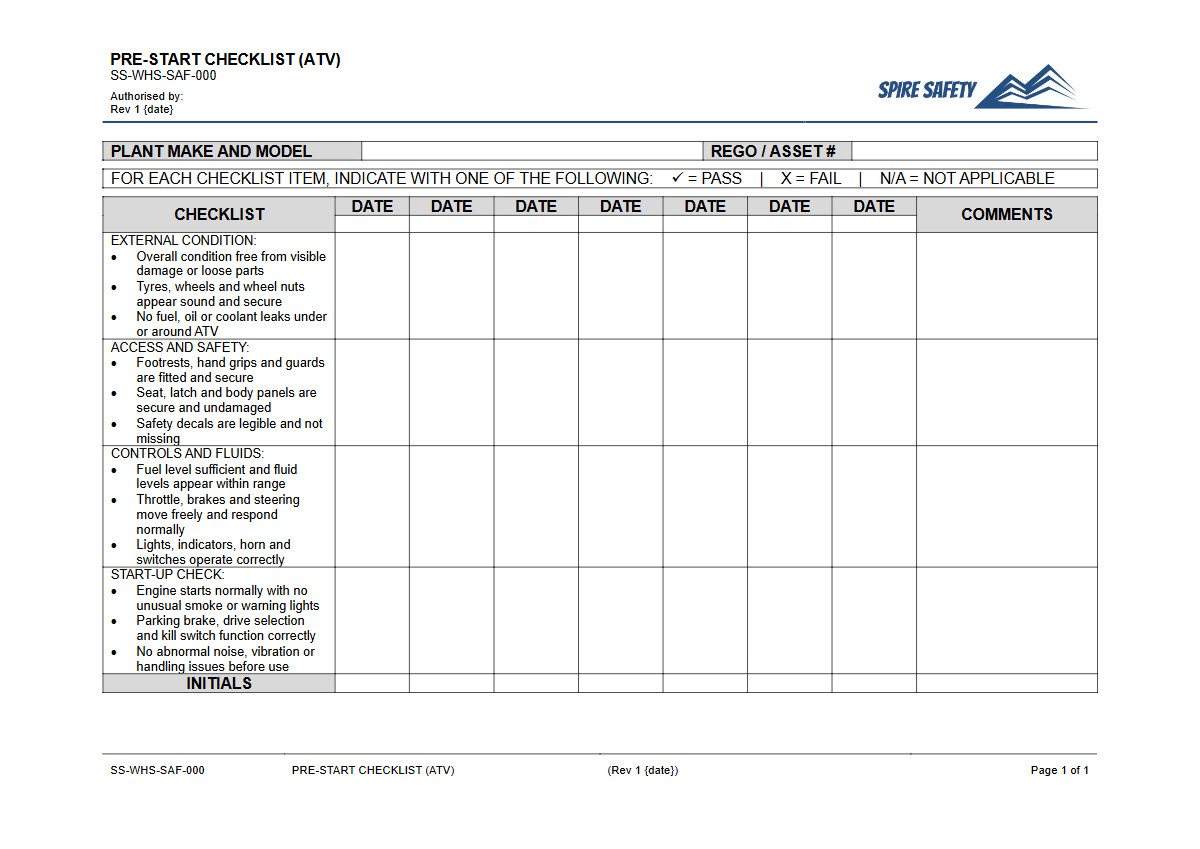
Using an all-terrain vehicle (ATV) without a proper safety check exposes operators and others to significant risks, including rollovers, mechanical failures, and loss of control. This free Pre-Start Checklist (ATV) Template provides a structured framework for conducting these essential inspections before each use.
Its primary purpose is to help your organisation identify and control hazards associated with ATV operation, ensuring the vehicle is in a safe condition before work commences. By formalising this process, you create a consistent record of due diligence, which is a fundamental part of any comprehensive WHS management system.
The checklist prompts operators to systematically inspect critical components such as brakes, steering, tyres, lights, and emergency controls. This proactive approach helps prevent incidents caused by equipment faults, supports preventative maintenance scheduling, and reinforces a positive safety culture where operators take ownership of their equipment's condition.
Implementing this check helps meet duties under WHS legislation to ensure, so far as is reasonably practicable, that plant is safe to use.
Video walkthrough
How to use the Free Pre-Start Checklist (ATV) Template
This resource is available as a DOCX file for easy editing and a PDF for straightforward printing. To use it effectively, first download the template and integrate it into your organisation's safety procedures.
The most critical step is customisation. While the checklist covers common inspection points for a standard ATV, your specific models, attachments (like sprayers or trailers), and operating environments may require additional checks. For example, the checks for an ATV used in agriculture will differ from those needed for other mobile plant, such as our pre-start checklist for lawn tractors.
Important: We have provided this template as a starting point based on common Australian WHS practice. You must adapt it to the unique hazards and requirements of your specific workplace, equipment, and tasks.
A generic checklist that doesn't account for your operational context may not be sufficient to manage all risks. Once customised, ensure all operators are trained on how to complete the checklist correctly and what actions to take if a fault is discovered.
When to use it
A pre-start checklist for an ATV should be completed by the operator before the vehicle is used for the first time on each shift or day. This frequency ensures that any damage or faults that may have occurred during previous use, overnight, or during transport are identified before the vehicle becomes operational.
If multiple operators use the same ATV during a single shift, a handover process should include a review of the initial check and a supplementary inspection to confirm its ongoing safe condition. This routine is just as important for large forestry equipment, as covered in our forwarder pre-start checklist.
Completed checklists should be collected and reviewed by a supervisor or manager regularly. These records serve as valuable data for maintenance planning, identifying recurring faults, and demonstrating procedural compliance during WHS compliance audits. They form a critical part of the vehicle's operational history, alongside formal maintenance and repair logs.
Who should use it
The ATV pre-start checklist must be completed by a worker who is trained, competent, and authorised to operate the specific make and model of the vehicle. Competency isn't just about driving; it includes the ability to accurately identify the components listed on the checklist and recognise the signs of wear, damage, or malfunction.
Simply 'ticking and flicking' without genuine inspection defeats the purpose of the check and creates a false sense of security. Defining these competencies can be a key outcome of tailored WHS consulting services.
Supervisors and managers also have a key role. They are responsible for ensuring that operators are conducting the checks correctly, reviewing the completed forms, and taking prompt action on any reported faults.
This includes implementing 'tag out' procedures to prevent a faulty ATV from being used until it is repaired and deemed safe by a competent person. This principle of operator checks applies to all workplace equipment, from vehicles to fixed plant like that covered in our bench grinder pre-start checklist. You can find more templates covering a wide range of plant and equipment in our free resources library.
Common mistakes
Common mistakes to avoid
- Failing to customise the template for the specific ATV model and its attachments.
- Operators 'pencil-whipping' the form without physically conducting the checks.
- Not training operators on how to identify faults or what they are looking for.
- Ignoring 'minor' issues like low tyre pressure or a dirty headlight, which can contribute to a serious incident.
Legal references
Legal considerations
The following legal requirements may be relevant to this type of work.
- Work Health and Safety Act (Harmonised) — Provides the primary duties for protecting workers and other people from work health and safety risks.
- Work Health and Safety Regulations (Harmonised) — Sets out requirements supporting the management of workplace hazards and risks.
The following codes may be relevant to this type of work.
- Managing WHS Risks Code of Practice — Provides practical guidance on identifying hazards, assessing risks and applying effective controls.
- Work Health and Safety Consultation, Cooperation and Coordination Code of Practice — Provides practical guidance on consulting workers and coordinating with other duty holders.
- Managing the Work Environment and Facilities Code of Practice — Provides practical guidance on safe work environments, workplace facilities and related controls.
Did you know
Leading Cause of Fatalities
According to Safe Work Australia, quad bike incidents are a leading cause of death on Australian farms, with rollovers being the most common cause of fatalities.
Operator Protection Devices (OPDs)
Many jurisdictions now have specific requirements or strong recommendations for fitting Operator Protection Devices (OPDs), also known as rollover protection, to ATVs used for work.
FAQ
Frequently asked questions
01Are ATVs and quad bikes considered 'plant' under WHS law?
02How often should an ATV pre-start inspection be completed?
03What should an operator do if a fault is found during the check?
04Does this template cover specific attachments like trailers or spray tanks?
Share this resource
Free Pre-Start Checklist (ATV) Template
Browse Categories
How To Use It
- 1Download and open in Word or PDF.
- 2Replace the placeholders with your business details.
- 3Get it reviewed by a WHS specialist before rollout.
Need it customised?
Our WHS consultants can adapt this template to your site, run a gap analysis, or audit what you already have in place.
Book a Free Consultation WHS consulting servicesor call 1300 156 382