
Free Pre-Start Checklist (Automatic Door) Template
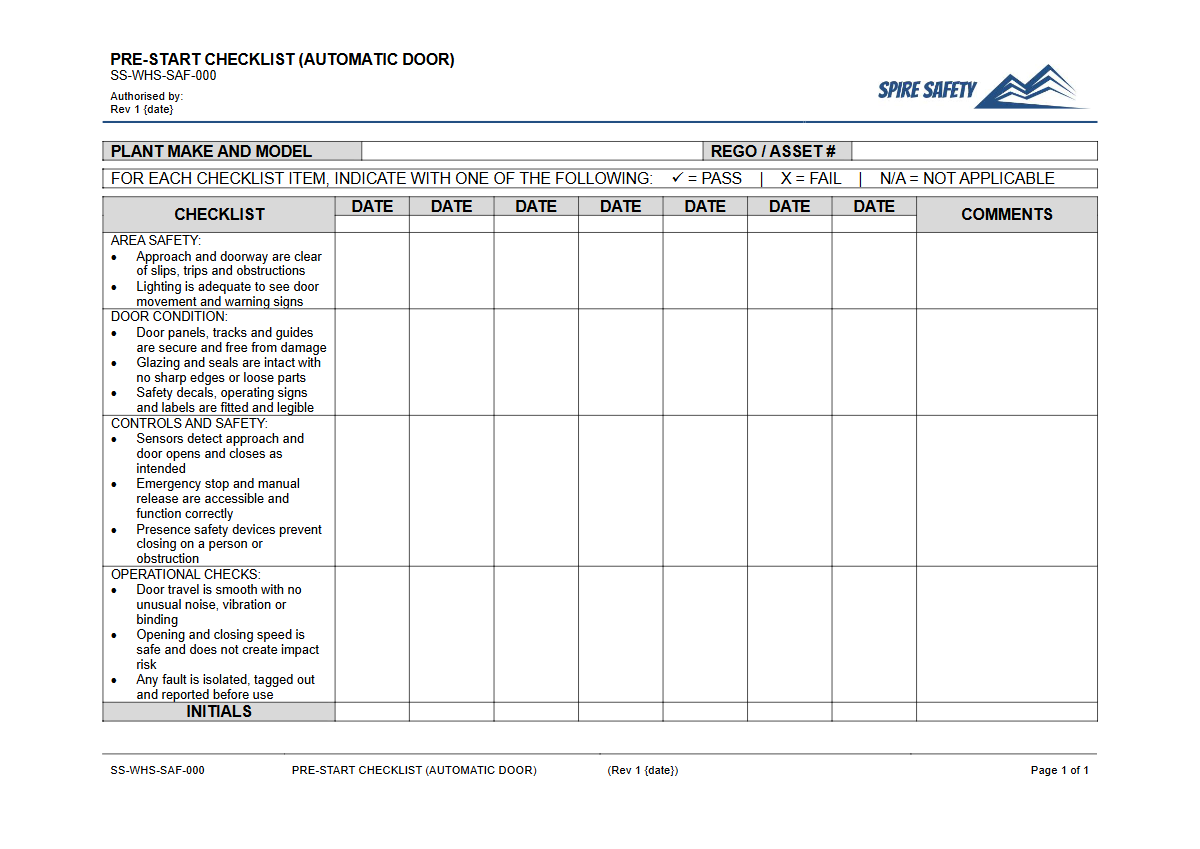
Download our free Pre-Start Checklist (Automatic Door) Template. This structured Word & PDF document helps formalise daily safety checks. Customise it today.
Free Pre-Start Checklist (Automatic Door) Template
DOCX • 125 KB + PDF
Updated Oct 2026
No signup required
Purpose of the Free Pre-Start Checklist (Automatic Door) Template
Ensuring the safe operation of automatic doors is a critical but often overlooked aspect of facility management. This free Pre-Start Checklist (Automatic Door) Template provides a structured framework for conducting daily inspections before your premises open to staff, customers, or the public.
Consistent use helps identify potential faults, prevent incidents, and demonstrate due diligence in maintaining a safe environment. Regular pre-start inspections are fundamental to a proactive safety culture, forming a key part of any organisation's approach to plant and equipment safety.
By formalising this process, you create a verifiable record that equipment was in safe working order at the beginning of each day. This is particularly important in high-traffic environments like shopping centres, hospitals, aged care facilities, and office buildings where malfunctions can pose a significant risk to pedestrians.
Integrating these checks can be reinforced with practical training, such as using a Pre-Start Checks and Plant Maintenance Toolbox Talk to brief your team on procedures and responsibilities.
Video walkthrough
How to use the Free Pre-Start Checklist (Automatic Door) Template
Using this template is straightforward. First, download the document in your preferred format (DOCX for easy editing or PDF).
Next, and most importantly, review and adapt the checklist to suit the specific make, model, and operational context of the automatic doors at your workplace. Different systems have unique features, sensors, and failure points that a generic checklist may not cover.
Once customised, this document becomes an essential part of your daily opening procedures.
Train the designated personnel on how to conduct each check thoroughly and what actions to take if a non-conformance is identified, such as isolating the door and reporting the fault to maintenance. It is vital that the checklist is not just a paper-filling exercise.
If customising the document to meet your specific operational needs seems complex, our WHS consulting services can provide expert guidance to ensure your safety documentation is robust and practical.
Please note: This template is a starting point. We have developed it to be customised to reflect the specific automatic door models, operational environment, and unique risks present at your site.
When to use it
This Pre-Start Checklist should be completed daily before the building is opened to the public or at the beginning of a shift in a 24/7 facility. The goal is to verify the door's safe functionality before it experiences high traffic.
Additionally, it is good practice to use the checklist after any maintenance, repairs, or power outages to confirm that the system has been restored to a safe operational state. Documenting these checks creates a historical record that can be invaluable for maintenance planning and incident investigations.
Who should use it
The checklist should be completed by a competent person who has been trained on the specific functions of the automatic doors and the inspection procedure. This could be a facilities manager, a building supervisor, a maintenance team member, or a designated member of the opening staff.
The ultimate responsibility lies with the Person Conducting a Business or Undertaking (PCBU) to ensure that the process is implemented and that the individuals performing the checks are adequately trained and equipped to do so safely. In settings like healthcare, automatic doors are a key control measure, reducing the need for staff and residents to touch surfaces and removing risks associated with manually opening heavy doors, a topic covered in our Aged Care Manual Handling Toolbox Talk.
Integrating Checklists into Your Safety System
A checklist on its own is not a complete safety solution. To be effective, it must be integrated into your organisation's broader safety framework.
This involves proper record-keeping, procedures for reporting and rectifying faults, and periodic reviews of the checklist's effectiveness. By incorporating this simple tool into your daily operations, you strengthen your overall risk management process.
This approach is a core component of building comprehensive WHS management systems that protect people and ensure operational continuity.
Verifying Checklist Effectiveness
To ensure your pre-start check process remains effective, it requires periodic verification. This involves more than just filing away completed forms.
Supervisors or managers should occasionally observe the checks being performed to ensure they are being done correctly and not just 'pencil-whipped'. Furthermore, reviewing completed checklists for recurring faults can help identify deeper maintenance issues.
Formalised WHS compliance auditing can provide an independent assessment of whether your documented procedures are being followed in practice, closing the loop on your safety management efforts.
This template is just one of many tools available to help you manage workplace safety. For more templates, guides, and checklists covering a wide range of tasks and equipment, browse our complete free WHS resources library.
Common mistakes
Common mistakes to avoid
- Using a generic checklist without customising it for specific door models and site risks.
- Failing to train staff on how to properly complete the checklist and what to do if a fault is found.
- 'Pencil-whipping' the form without physically performing each check.
- Poor record-keeping, making it difficult to track maintenance trends or prove due diligence.
Legal references
Legal considerations
The following legal requirements may be relevant to this type of work.
- Work Health and Safety Act (Harmonised) — Provides the primary duties for protecting workers and other people from work health and safety risks.
- Work Health and Safety Regulations (Harmonised) — Sets out requirements supporting the management of workplace hazards and risks.
The following codes may be relevant to this type of work.
- Managing WHS Risks Code of Practice — Provides practical guidance on identifying hazards, assessing risks and applying effective controls.
- Work Health and Safety Consultation, Cooperation and Coordination Code of Practice — Provides practical guidance on consulting workers and coordinating with other duty holders.
- Managing the Work Environment and Facilities Code of Practice — Provides practical guidance on safe work environments, workplace facilities and related controls.
Did you know
The Australian Standard
Australian Standard AS 5007 sets out the minimum safety requirements for the design, installation, and maintenance of powered pedestrian doors in Australia.
Sensor Technology
Modern automatic doors often use a combination of microwave sensors to detect motion for activation and infrared safety sensors to detect presence, preventing the door from closing on a person or object in the doorway.
FAQ
Frequently asked questions
01What should an automatic door pre-start checklist include?
02How often should automatic doors be inspected?
03Are daily pre-start checks a legal requirement in Australia?
04Who is responsible for checking automatic doors?
Share this resource
Free Pre-Start Checklist (Automatic Door) Template
Browse Categories
How To Use It
- 1Download and open in Word or PDF.
- 2Replace the placeholders with your business details.
- 3Get it reviewed by a WHS specialist before rollout.
Need it customised?
Our WHS consultants can adapt this template to your site, run a gap analysis, or audit what you already have in place.
Book a Free Consultation WHS consulting servicesor call 1300 156 382