
Free Pre-Start Checklist (Bain Marie) Template
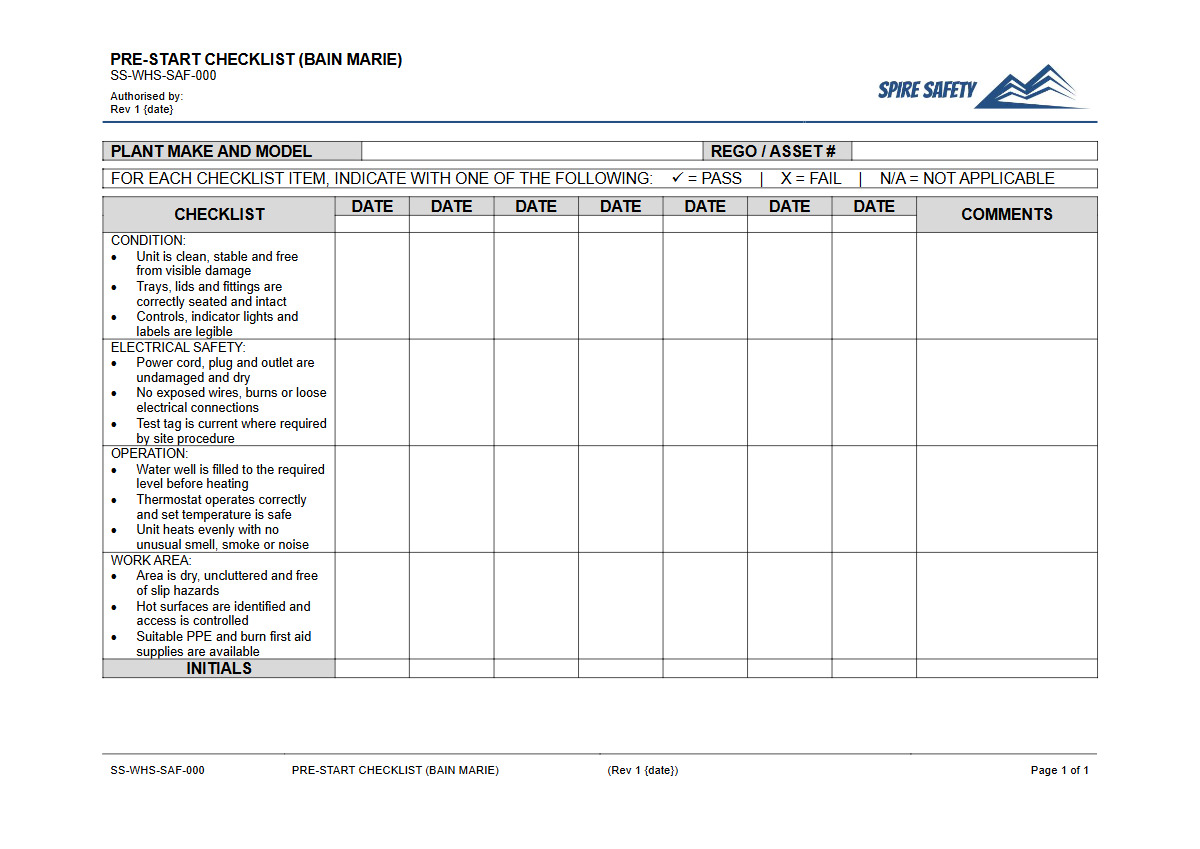
Download our free Pre-Start Checklist for bain maries. This customisable template helps hospitality businesses verify equipment safety before use.
Free Pre-Start Checklist (Bain Marie) Template
DOCX • 125 KB + PDF
Updated Oct 2026
No signup required
Purpose of the Free Pre-Start Checklist (Bain Marie) Template
A bain marie is an essential piece of equipment in many commercial kitchens, hospitals, and aged care facilities, but it also presents significant WHS risks if not managed correctly. This Free Pre-Start Checklist (Bain Marie) Template provides a structured starting point for identifying and controlling hazards before the equipment is used.
Regular pre-start checks help prevent incidents such as electrical shocks from faulty wiring, burns from hot surfaces and steam, and slips from water spills. By formalising this process, organisations can demonstrate due diligence, promote a proactive safety culture, and ensure the equipment is safe for operation.
Implementing this checklist is a practical step in fulfilling your duty of care under Australian WHS legislation. It serves as a critical component within broader WHS management systems, helping to systematically manage risks associated with workplace plant and equipment.
Documenting these checks creates a valuable record for safety audits and incident investigations, showing that control measures are in place and being actively monitored.
Video walkthrough
How to use the Free Pre-Start Checklist (Bain Marie) Template
This template is designed for ease of use and customisation. After downloading the DOCX or PDF file, you should adapt it to suit the specific needs of your workplace. The process involves several key steps:
- Customise: Modify the checklist to include specific checks relevant to the make and model of the bain maries used in your facility. Always consult the manufacturer’s operating manual for specific safety instructions and maintenance requirements.
- Train: Ensure all workers responsible for using or supervising the use of the bain marie are trained on how to conduct the pre-start check thoroughly. Explain the 'why' behind each checkpoint to reinforce its importance.
- Implement: Integrate the checklist into your daily opening procedures. Make it a non-negotiable step before the equipment is powered on for any shift.
- Review: Periodically review the checklist's effectiveness and update it as needed, especially if new equipment is introduced or an incident occurs.
A pre-start check is more than a paperwork exercise; it's a vital safety habit. Reinforce this message with your team through regular safety discussions, such as with a Pre-Start Checks and Plant Maintenance Toolbox Talk, to keep safety front of mind.
A Note on Customisation
It is crucial to adapt this template to the specific make and model of the bain marie used in your workplace, as well as your operational context. We provide this as a starting point, but your organisation is responsible for ensuring the final document is fit for purpose and addresses all relevant hazards.
When to use it
The bain marie pre-start checklist should be completed before the first use of the equipment each day or at the beginning of every shift where it will be operated. This ensures that any faults or damage that may have occurred overnight, during cleaning, or from previous use are identified before the equipment becomes operational and potentially hazardous.
Conducting the check before the morning rush in a café or before meal service begins in a hospital ensures that if a fault is found, there is time to implement alternative arrangements or have the unit repaired without compromising service or safety. Consistency is key; making the pre-start check a routine part of the day reinforces its importance and builds a stronger safety culture.
Who should use it
The pre-start check should be conducted by a competent person who is tasked with operating the bain marie. This typically includes chefs, cooks, kitchen hands, or catering assistants who have been trained on the equipment's safe operation and the procedure for completing the checklist.
It is the responsibility of the Person Conducting a Business or Undertaking (PCBU) to provide this training.
Supervisors and kitchen managers have a role in ensuring the checks are being completed correctly and that any reported faults are addressed promptly. This includes taking faulty equipment out of service, tagging it, and arranging for repairs.
In complex environments like large catering operations or healthcare facilities, seeking specialist WHS consulting can help establish clear roles and responsibilities for equipment safety. This is particularly relevant in settings like aged care, where equipment safety is paramount for both staff and resident wellbeing, complementing procedures like those in an Aged Care Manual Handling Toolbox Talk.
Beyond the Checklist: Ongoing Safety Management
While this pre-start checklist is a vital tool, it is only one part of a comprehensive safety strategy for workplace equipment. It should be supported by a regular maintenance schedule carried out by qualified technicians, including periodic electrical testing and tagging.
Records of these checks, maintenance activities, and any repairs should be diligently maintained.
Consider integrating the results of your pre-start checks into your regular safety reporting and meeting cycles. This allows you to spot trends, such as recurring faults with a specific unit, and make informed decisions about repair or replacement.
Periodically verifying that your safety procedures are being followed effectively, perhaps through independent WHS compliance auditing, ensures your systems remain robust and effective over time. You can also explore our full library of free WHS resources for more tools to support your safety management system.
Common mistakes
Common mistakes to avoid
- Starting the unit without checking if the water wells are filled to the correct level, which can damage the heating elements.
- Ignoring small signs of wear and tear, like a frayed cord or a cracked knob, until they become a major failure.
- Using the checklist as a 'tick-and-flick' exercise without physically inspecting each item.
- Failing to immediately tag out and report faulty equipment, leaving it available for others to use unknowingly.
Legal references
Legal considerations
The following legal requirements may be relevant to this type of work.
- Work Health and Safety Act (Harmonised) — Provides the primary duties for protecting workers and other people from work health and safety risks.
- Work Health and Safety Regulations (Harmonised) — Sets out requirements supporting the management of workplace hazards and risks.
The following codes may be relevant to this type of work.
- Managing WHS Risks Code of Practice — Provides practical guidance on identifying hazards, assessing risks and applying effective controls.
- Work Health and Safety Consultation, Cooperation and Coordination Code of Practice — Provides practical guidance on consulting workers and coordinating with other duty holders.
- Managing the Work Environment and Facilities Code of Practice — Provides practical guidance on safe work environments, workplace facilities and related controls.
Did you know
The Temperature Danger Zone
Bain maries are designed to keep food hot and outside the 'temperature danger zone' (5°C to 60°C), where bacteria can multiply rapidly. A faulty thermostat can compromise food safety.
Electrical Risk
In commercial kitchens, the combination of electricity, water, and heat makes equipment like bain maries a high-risk item. Electrical faults are a leading cause of kitchen fires and injuries.
FAQ
Frequently asked questions
01Why is a pre-start check for a bain marie important?
02What are the key electrical safety checks for a bain marie?
03How often should a bain marie pre-start check be performed?
04Who is responsible for conducting a bain marie pre-start check?
Share this resource
Free Pre-Start Checklist (Bain Marie) Template
Browse Categories
How To Use It
- 1Download and open in Word or PDF.
- 2Replace the placeholders with your business details.
- 3Get it reviewed by a WHS specialist before rollout.
Need it customised?
Our WHS consultants can adapt this template to your site, run a gap analysis, or audit what you already have in place.
Book a Free Consultation WHS consulting servicesor call 1300 156 382