
Free Pre-Start Checklist (Band Saw) Template
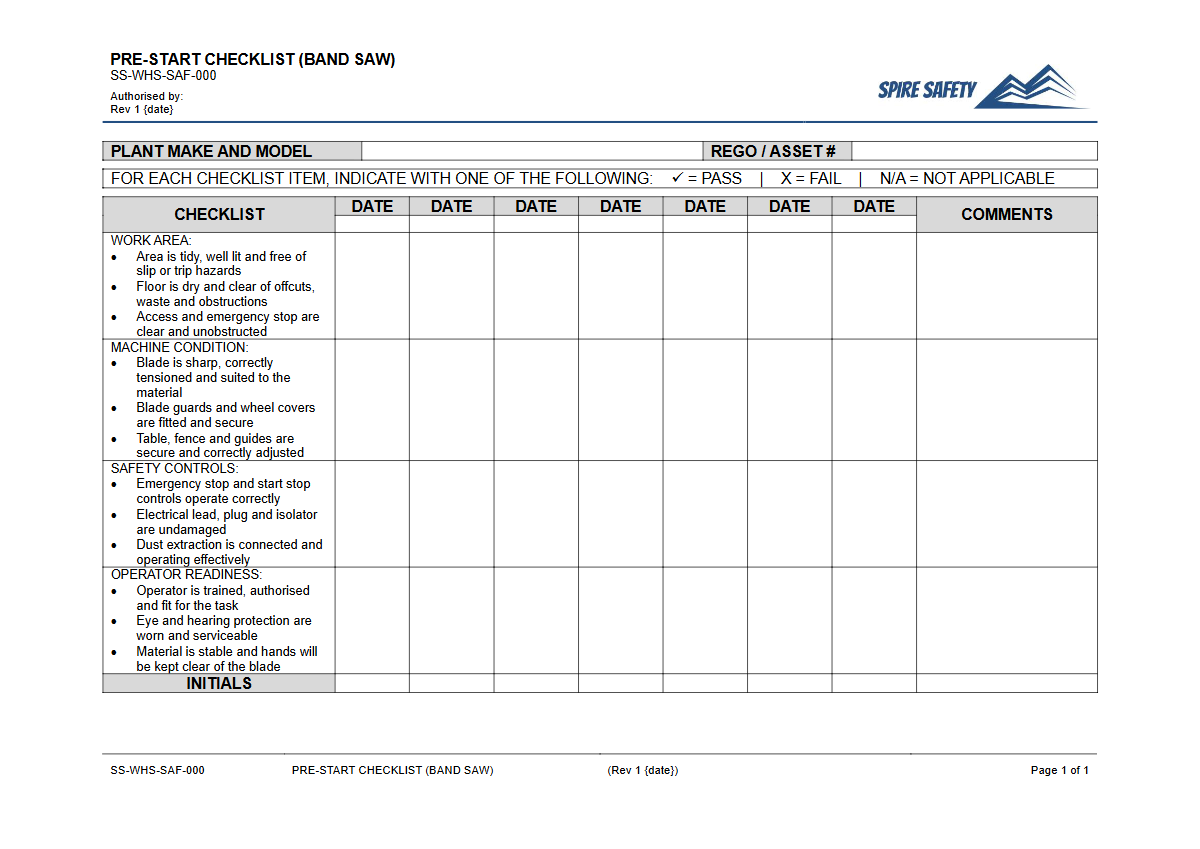
Download our free Pre-Start Checklist for Band Saws. This DOCX and PDF template helps formalise safety checks and manage WHS risks in your workshop.
Free Pre-Start Checklist (Band Saw) Template
DOCX • 125 KB + PDF
Updated Oct 2026
No signup required
Purpose of the Free Pre-Start Checklist (Band Saw) Template
Integrating a formal inspection process is a critical step in managing the risks associated with workshop machinery. This Free Pre-Start Checklist (Band Saw) Template provides a structured starting point for Australian businesses to formalise their daily safety checks.
Using a band saw pre-start checklist helps operators systematically inspect the equipment before use, identifying potential faults or hazards that could lead to injury or equipment failure. It's a key document that supports a proactive approach to workshop safety, ensuring the machine's guards, blades, and emergency stops are in proper working order before any cutting begins.
This checklist serves as more than a simple tick-and-flick exercise; it is a practical tool for hazard identification and risk control at the source. By documenting these checks, organisations create a verifiable record of their safety diligence.
This process should be integrated with your overarching procedures for plant safety, such as the instructions outlined in a Band Saw Safe Operating Procedure (SOP), to ensure a consistent approach to safe operation.
Video walkthrough
How to use the Free Pre-Start Checklist (Band Saw) Template
Our template is available for immediate download in both DOCX for easy editing and PDF for straightforward printing. The primary goal is to provide a solid foundation that you can adapt to your specific operational context.
Important: It is crucial to customise this template for your specific workplace. You must review and adapt the checklist to include the unique makes, models, and configurations of your band saws, as well as the specific tasks they are used for and the environment they are in.
We provide this as a starting point, but your organisation is responsible for ensuring its suitability and adequacy.
Once customised, the checklist should be completed by the operator before commencing work. Any identified defects or issues must be reported to a supervisor immediately, and the machine should be tagged out of service until it is repaired and deemed safe. Ensuring operators are competent to not only use the saw but also conduct these checks effectively is vital, a process which can be formalised using a Band Saw Verification of Competency (VOC).
Key Elements of a Band Saw Pre-Start Check
While your customised checklist will vary, a comprehensive band saw inspection should cover several critical areas. Our template prompts the user to inspect the following elements:
- Guards: All guards, including blade and wheel guards, are in place, secure, and function correctly.
- Blade Condition: The blade is free from cracks, has no missing teeth, is correctly tensioned, and is appropriate for the material being cut.
- Blade Guides: Upper and lower blade guides and support bearings are set correctly, close to the workpiece, and are not damaged.
- Emergency Stop: The emergency stop button or switch is accessible, clearly marked, and functions correctly when tested.
- Work Area: The area around the band saw is clear of obstructions, slip hazards, and combustible materials.
- Dust Extraction: If fitted, the dust or swarf extraction system is connected and operating effectively.
- Power & Cords: Electrical cords, plugs, and switches are in good condition with no signs of damage or fraying.
When to use a Pre-Start Checklist
Consistency is key to the effectiveness of any pre-start inspection process. The checklist for a band saw should be completed at the following times:
- Before the start of every shift.
- Before the equipment is used for the first time on a given day.
- After a change of operator during a shift.
- Following any maintenance, cleaning, or blade change.
Regularly discussing the importance of these checks can reinforce safe behaviour. You can use a Pre-Start Checks and Plant Maintenance Toolbox Talk to facilitate these conversations and embed the process into your team's daily routine.
Who should use it
The responsibility for plant safety is shared. While the primary user of the checklist is the operator, other personnel play a key role.
- Operators: As the person directly using the equipment, the operator is responsible for physically conducting the check and documenting their findings before each use.
- Supervisors & Managers: They are responsible for ensuring operators are trained and competent to perform the checks, verifying that the checks are being completed correctly, and taking prompt action on any reported defects.
- WHS Personnel: Safety officers or managers use the completed records to monitor compliance, identify recurring issues, analyse trends, and inform risk assessments and maintenance schedules.
Integrating Pre-Start Checks into Your WHS System
A pre-start checklist is not a standalone document; it is an essential part of your broader safety framework. The information gathered should feed into comprehensive WHS management systems to drive continuous improvement.
For instance, a recurring fault noted on checklists might trigger a review of the machine's maintenance schedule or a reassessment of its suitability for the task.
Properly maintained records of these checks are also a fundamental part of demonstrating due diligence. During internal or external safety evaluations, such as a formal WHS compliance auditing process, these documents provide clear evidence that your organisation is proactively managing plant safety. For more templates and safety documents, explore our complete free WHS resources library.
Common mistakes
Common mistakes to avoid
- Failing to customise the generic template for the specific band saw model and workplace conditions.
- Operators 'pencil-whipping' the form without physically conducting each check.
- Not immediately reporting identified defects or removing faulty equipment from service.
- Neglecting to train workers on how to properly inspect each item on the checklist.
Legal references
Legal considerations
The following legal requirements may be relevant to this type of work.
- Work Health and Safety Act (Harmonised) — Provides the primary duties for protecting workers and other people from work health and safety risks.
- Work Health and Safety Regulations (Harmonised) — Sets out requirements supporting the management of workplace hazards and risks.
The following codes may be relevant to this type of work.
- Managing WHS Risks Code of Practice — Provides practical guidance on identifying hazards, assessing risks and applying effective controls.
- Work Health and Safety Consultation, Cooperation and Coordination Code of Practice — Provides practical guidance on consulting workers and coordinating with other duty holders.
- Managing the Work Environment and Facilities Code of Practice — Provides practical guidance on safe work environments, workplace facilities and related controls.
Did you know
A Tangled History
The band saw was first patented in England in 1809 by William Newberry, but the technology to create reliable and durable blades didn't exist, so the invention remained impractical for decades.
High-Risk Machinery
According to Safe Work Australia data, machinery-related incidents, including those involving saws, are a leading cause of serious injury claims, frequently resulting in amputations and fractures.
FAQ
Frequently asked questions
01Why are pre-start checks for band saws important?
02What are the most critical items to check on a band saw?
03Who is responsible for ensuring band saw pre-start checks are done?
04Can this template be used for all types of band saws (vertical, horizontal, meat)?
Share this resource
Free Pre-Start Checklist (Band Saw) Template
Browse Categories
How To Use It
- 1Download and open in Word or PDF.
- 2Replace the placeholders with your business details.
- 3Get it reviewed by a WHS specialist before rollout.
Need it customised?
Our WHS consultants can adapt this template to your site, run a gap analysis, or audit what you already have in place.
Book a Free Consultation WHS consulting servicesor call 1300 156 382