
Free Pre-Start Checklist (Battery Bank) Template
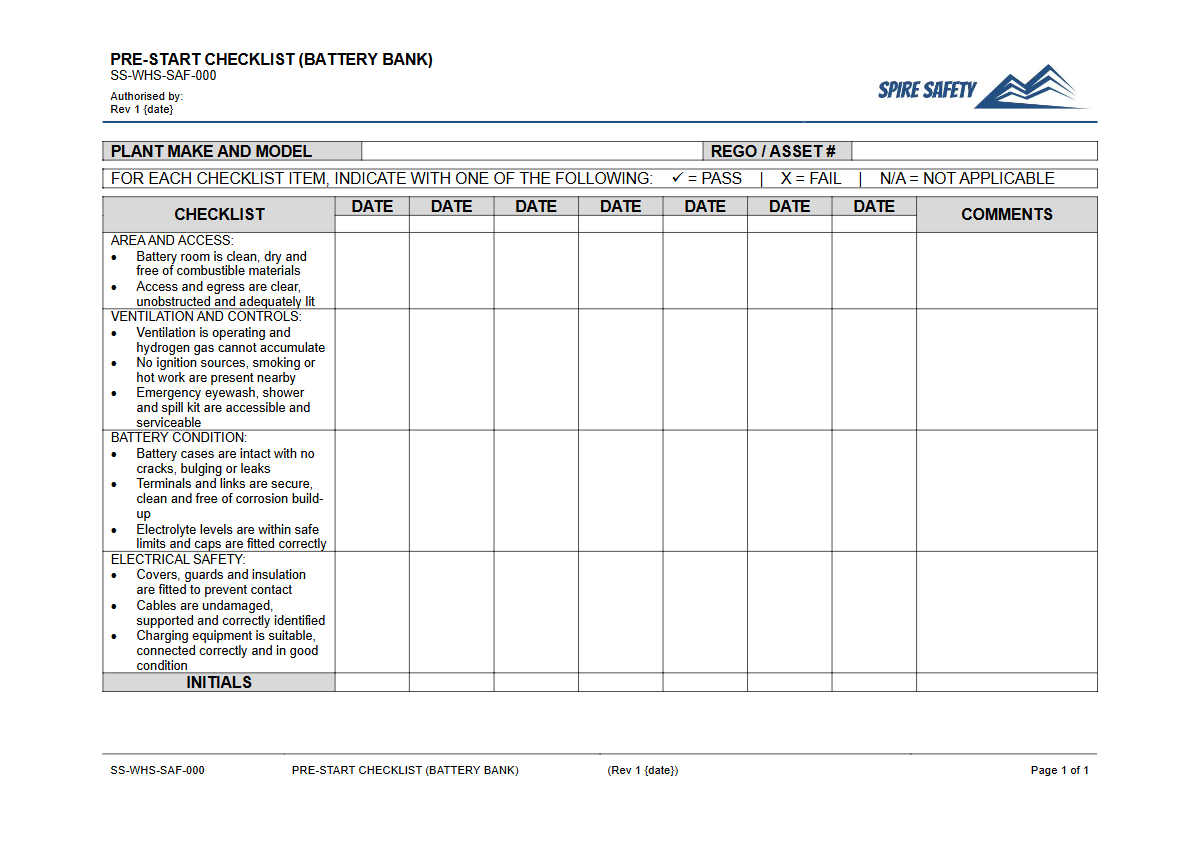
Download our Free Pre-Start Checklist (Battery Bank) Template to formalise equipment checks and manage electrical hazards in your Australian workplace.
Free Pre-Start Checklist (Battery Bank) Template
DOCX • 125 KB + PDF
Updated Oct 2026
No signup required
Purpose of the Free Pre-Start Checklist (Battery Bank) Template
Working with battery banks, whether for uninterruptible power supplies (UPS), solar energy storage, or industrial vehicles, involves significant risks. This free Pre-Start Checklist (Battery Bank) Template provides a structured framework to help workers identify and manage potential hazards before they operate or work near the equipment.
Formalising these checks helps prevent incidents related to electric shock, arc flash, chemical spills, and fire.
Using a documented pre-start process is a fundamental component of proactive safety management. It helps an organisation demonstrate its commitment to meeting its duties under WHS legislation by systematically identifying faults and ensuring equipment is safe for use.
Integrating such procedures is a practical step in developing a robust WHS management system that protects both your workers and your assets.
Video walkthrough
How to use the Free Pre-Start Checklist (Battery Bank) Template
This resource is available as a fully editable DOCX file and a print-ready PDF. The checklist is designed as a starting point, covering general inspection points applicable to many battery bank systems, such as checking for physical damage, leaks, correct ventilation, and functional safety equipment like fire extinguishers and spill kits. Records of completed checks provide valuable data for maintenance scheduling and can demonstrate due diligence during WHS compliance audits.
It is crucial to adapt this template to your specific operational context. Different battery chemistries (e.g., Lead-Acid, Lithium-Ion, Ni-Cd) have unique inspection requirements and failure modes.
You must modify the checklist to include manufacturer-specific recommendations, site-specific hazards, and the required Personal Protective Equipment (PPE).
Please note: This document is a template designed to support, not replace, your safety obligations. We are not WHS lawyers.
You must customise it to the specific battery systems, equipment, and legislative requirements of your state or territory. For tailored advice, consider engaging professional WHS consulting services.
When to use it
A pre-start check for a battery bank should be conducted before the equipment is used or energised at the start of each shift. It is also essential to perform a thorough check after any maintenance has been carried out, following a long period of inactivity, or if there is any reason to suspect the system may have been compromised or damaged.
Additional triggers for a check may include:
- Following an environmental event, such as a flood, fire, or extreme temperature fluctuations.
- When alerts or alarms have been triggered by a Battery Management System (BMS).
- Before performing any work in the vicinity of the battery bank, even if not directly interacting with it.
Who should use it
Only personnel who are trained, competent, and authorised should perform pre-start checks on battery banks. This typically includes qualified electricians, maintenance technicians, or specially trained operators who understand the specific hazards of the system they are inspecting.
Competency involves not only knowing what to check but also recognising the signs of a potential failure and understanding the correct emergency procedures.
Regular training and reinforcement of safety procedures are vital for these roles. Using a Pre-Start Checks and Plant Maintenance Toolbox Talk can be an effective way to brief teams on the importance of diligent inspections and discuss any recent issues or changes in procedure. You can find more helpful safety documents in our free resources library.
Common mistakes
Common mistakes to avoid
- Using a generic checklist without customising it for specific battery types (e.g., lead-acid, Li-ion, Ni-Cd).
- Ignoring the need for specific Personal Protective Equipment (PPE) like insulated gloves and face shields.
- Performing checks without being properly trained or competent, leading to missed signs of failure.
- Failing to keep completed checklists as a record of maintenance and due diligence.
Legal references
Legal considerations
The following legal requirements may be relevant to this type of work.
- Work Health and Safety Act (Harmonised) — Provides the primary duties for protecting workers and other people from work health and safety risks.
- Work Health and Safety Regulations (Harmonised) — Sets out requirements supporting the management of workplace hazards and risks.
The following codes may be relevant to this type of work.
- Managing WHS Risks Code of Practice — Provides practical guidance on identifying hazards, assessing risks and applying effective controls.
- Work Health and Safety Consultation, Cooperation and Coordination Code of Practice — Provides practical guidance on consulting workers and coordinating with other duty holders.
- Managing the Work Environment and Facilities Code of Practice — Provides practical guidance on safe work environments, workplace facilities and related controls.
Did you know
Hydrogen Hazard
The hydrogen gas released by some charging batteries is colourless, odourless, and highly flammable. It is lighter than air and can accumulate near ceilings, creating a significant explosion risk.
Arc Flash Danger
A short circuit in a large battery bank can create an arc flash, an explosive electrical event with temperatures reaching up to 20,000°C, causing severe burns and vaporising metal.
FAQ
Frequently asked questions
01What hazards are associated with battery banks?
02Why is ventilation important for a battery room?
03Do I need a specific pre-start checklist for lithium-ion vs lead-acid batteries?
04How often should a battery bank pre-start check be done?
Share this resource
Free Pre-Start Checklist (Battery Bank) Template
Browse Categories
How To Use It
- 1Download and open in Word or PDF.
- 2Replace the placeholders with your business details.
- 3Get it reviewed by a WHS specialist before rollout.
Need it customised?
Our WHS consultants can adapt this template to your site, run a gap analysis, or audit what you already have in place.
Book a Free Consultation WHS consulting servicesor call 1300 156 382