
Free Pre-Start Checklist (Bead Roller) Template
Download our free Pre-Start Checklist (Bead Roller) Template to formalise safety checks in your workshop. Available in DOCX and PDF. Download today.
Free Pre-Start Checklist (Bead Roller) Template
DOCX • 125 KB + PDF
Updated Oct 2026
No signup required
Purpose of the Free Pre-Start Checklist (Bead Roller) Template
A bead roller is a powerful piece of metalworking equipment that requires careful handling to prevent serious injuries, particularly to hands and fingers. Implementing a formal inspection process is a critical control measure.
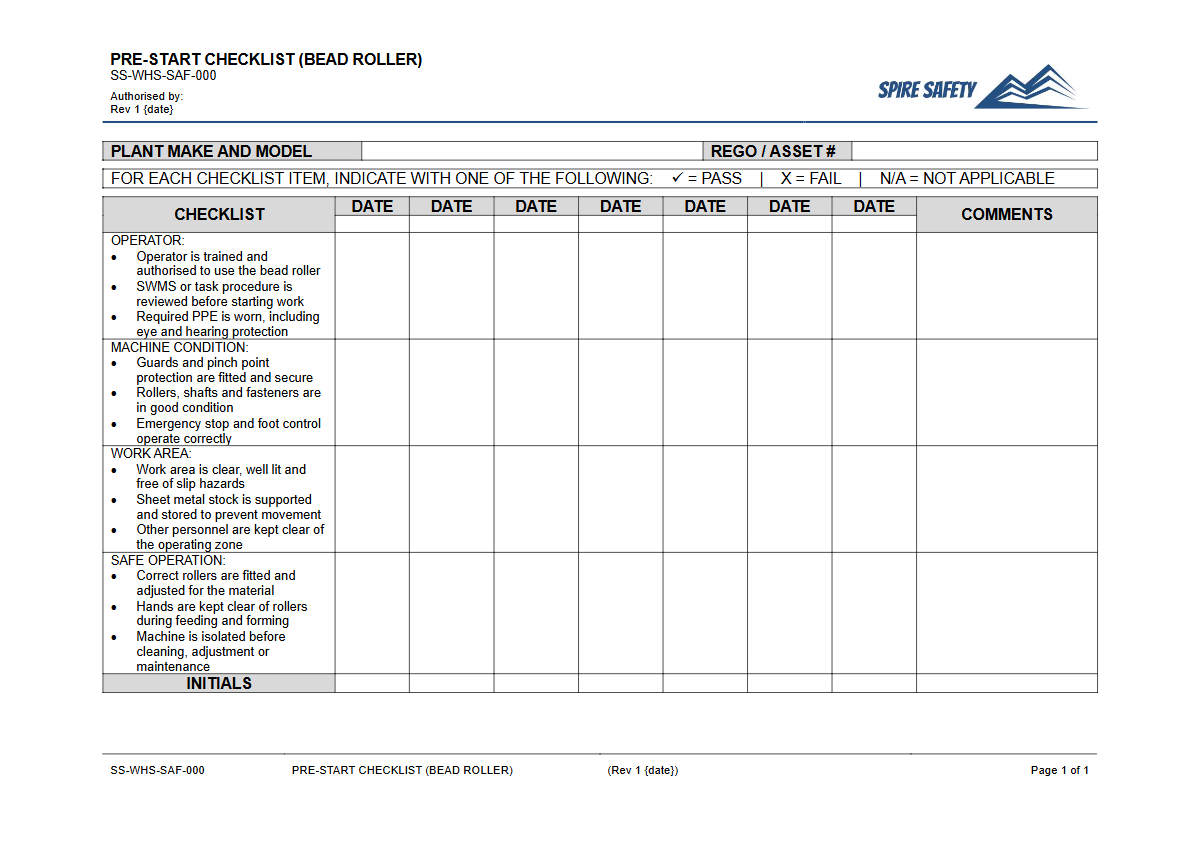
This Free Pre-Start Checklist (Bead Roller) Template provides a structured starting point for organisations to formalise their daily equipment checks, helping operators identify potential faults or hazards before they lead to an incident.
Using a pre-start checklist helps your business meet its primary duty of care under WHS legislation by ensuring plant is safe to use. It creates a documented record of inspections, demonstrates proactive hazard management, and fosters a positive safety culture where equipment condition is taken seriously.
Regularly performing these checks is a fundamental part of any effective plant safety program. To further embed this practice, consider running a Pre-Start Checks and Plant Maintenance Toolbox Talk with your team.
Video walkthrough
How to use the Free Pre-Start Checklist (Bead Roller) Template
This checklist is designed to be straightforward and easy to implement. After downloading the file, you can choose between the DOCX version for easy editing or the PDF for immediate printing.
The key to effective use is customisation. A generic checklist can lead to critical items being missed.
You must adapt this template to the specific makes and models of bead rollers used in your workshop. Consider:
- The type of drive system (manual or powered).
- The specific guarding arrangements on your machines.
- Emergency stop mechanisms and their function.
- The condition and variety of dies or rollers used.
- Mounting stability (bench or stand-mounted).
Important: We have provided a comprehensive foundation aligned with Australian WHS practice, but it is essential that you customise this template to reflect the specific equipment, attachments, and unique risks present in your workplace. This checklist should be one component of your overall WHS management systems, not a standalone solution.
When to use it
A pre-start checklist for a bead roller should be completed by the operator before its first use on any given shift. It is a pre-operational check, not a weekly or monthly inspection.
If multiple operators use the same machine during a single shift, it's good practice for each new operator to conduct a quick visual check, even if a full checklist was completed at the start of the day. The principle is simple: verify the machine is safe before you turn it on.
Who should use it
The primary person responsible for completing the pre-start checklist is the trained and competent operator assigned to use the bead roller. They have the most immediate interaction with the equipment and are best placed to notice subtle changes or developing faults.
Supervisors and managers have a responsibility to ensure these checks are being completed correctly and that any identified issues are addressed promptly. This includes signing off on the checklist, scheduling maintenance, and ensuring faulty equipment is tagged out and removed from service.
The procedure for this should be outlined in your Roller SOP (Safe Operating Procedure). Maintenance personnel may also refer to completed checklists to understand fault history and prioritise repairs.
Completed checklists form an important part of your safety records. They provide valuable evidence of your safety procedures during formal processes like WHS compliance auditing. For more templates and safety tools, browse our complete free WHS resources library.
Common mistakes
Common mistakes to avoid
- Ticking boxes without physically inspecting each item ('pencil-whipping').
- Failing to report 'minor' issues like a loose guard, which can escalate into a major hazard.
- Using a generic checklist that doesn't cover the specific features or risks of the bead roller model in use.
- Not removing faulty equipment from service immediately after a defect is identified.
Legal references
Legal considerations
The following legal requirements may be relevant to this type of work.
- Work Health and Safety Act (Harmonised) — Provides the primary duties for protecting workers and other people from work health and safety risks.
- Work Health and Safety Regulations (Harmonised) — Sets out requirements supporting the management of workplace hazards and risks.
The following codes may be relevant to this type of work.
- Managing WHS Risks Code of Practice — Provides practical guidance on identifying hazards, assessing risks and applying effective controls.
- Work Health and Safety Consultation, Cooperation and Coordination Code of Practice — Provides practical guidance on consulting workers and coordinating with other duty holders.
- Managing the Work Environment and Facilities Code of Practice — Provides practical guidance on safe work environments, workplace facilities and related controls.
Did you know
Rotating Machinery Risk
Injuries involving stationary machinery often occur during maintenance or when clearing blockages. A robust pre-start check and lock-out tag-out procedure are the most effective defences.
FAQ
Frequently asked questions
01Why is a bead roller pre-start check important?
02What should be included in a bead roller checklist?
03Who is responsible for completing the pre-start checklist?
04What happens if a fault is found during the pre-start check?
Share this resource
Free Pre-Start Checklist (Bead Roller) Template
Browse Categories
How To Use It
- 1Download and open in Word or PDF.
- 2Replace the placeholders with your business details.
- 3Get it reviewed by a WHS specialist before rollout.
Need it customised?
Our WHS consultants can adapt this template to your site, run a gap analysis, or audit what you already have in place.
Book a Free Consultation WHS consulting servicesor call 1300 156 382