
Free Pre-Start Checklist (Bench Drill) Template
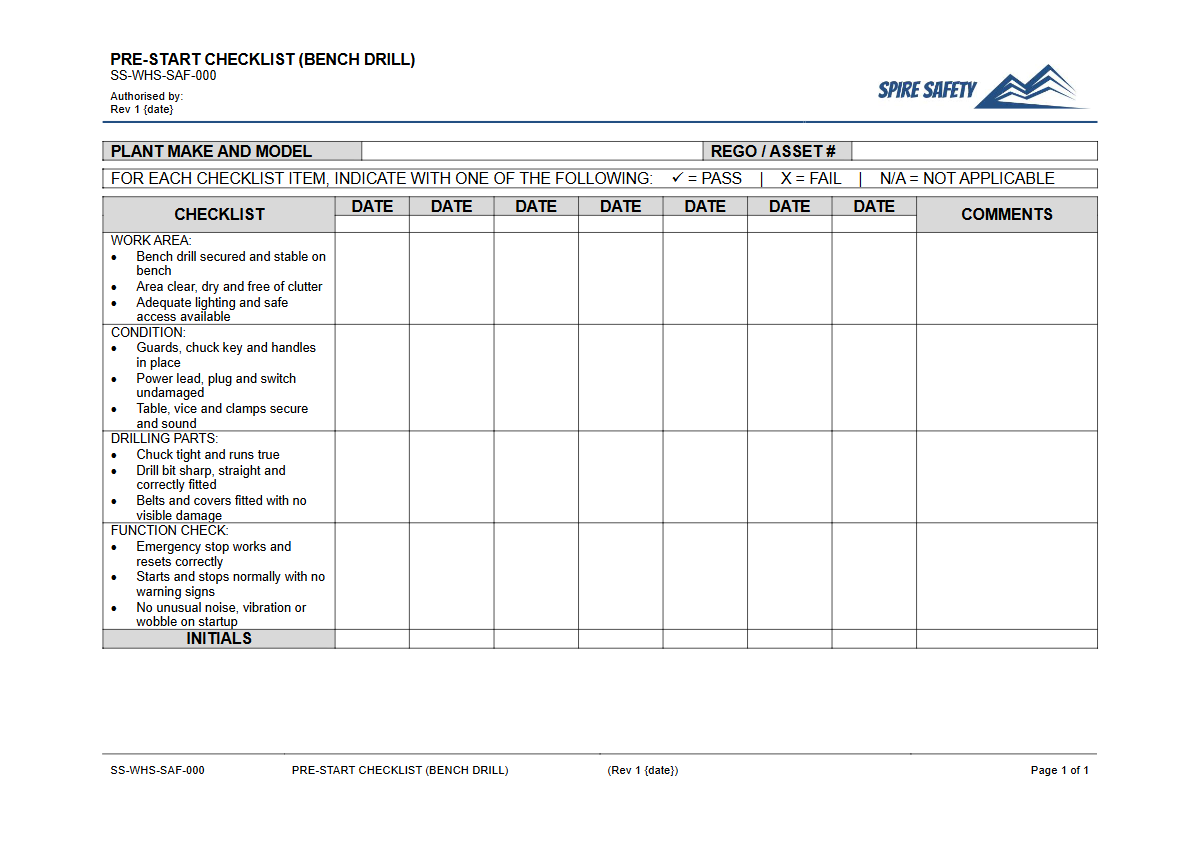
Download our free Pre-Start Checklist (Bench Drill) Template. This DOCX & PDF resource helps formalise daily equipment checks and manage workshop safety risks.
Free Pre-Start Checklist (Bench Drill) Template
DOCX • 125 KB + PDF
Updated Oct 2026
No signup required
Purpose of the Free Pre-Start Checklist (Bench Drill) Template
A bench drill, while a common workshop tool, poses significant risks if not properly maintained and inspected. This Free Pre-Start Checklist (Bench Drill) Template provides a structured framework for operators to systematically inspect the equipment before use.
Its primary purpose is to identify potential hazards such as damaged parts, missing guards, or electrical faults that could lead to injury. Formalising this process helps create a consistent safety standard across your operations, reduces the likelihood of incidents, and provides documented evidence of your organisation's due diligence in managing plant safety.
Using a dedicated checklist ensures that no critical safety component is overlooked. It prompts a thorough examination of everything from the chuck and key to the emergency stop and guarding.
For similar workshop equipment, our Pre-Start Checklist (Drill Press) Template offers a comparable level of detail for larger, floor-standing models.
Video walkthrough
How to use the Free Pre-Start Checklist (Bench Drill) Template
Using this template is straightforward. First, download the document in your preferred format—either DOCX for easy editing or PDF for straightforward printing.
The next crucial step is customisation. While this template is aligned with Australian WHS principles, every workplace and piece of equipment is unique.
You must adapt the checklist to reflect the specific makes and models of bench drills used in your facility, the unique environmental conditions of your workshop, and any specific procedures outlined in your safety management system.
Important: This document is a starting point. We strongly advise that you modify it to align with the manufacturer's instructions and the specific risks identified in your own risk assessments.
Integrating this checklist into your broader WHS management systems ensures it becomes a routine part of your operational safety behaviour. Once customised, train all operators on how to complete the checklist correctly and what actions to take if a fault is identified.
When to use this Pre-Start Checklist
A bench drill pre-start check should be completed before its first use on any given day or shift. This ensures the equipment is in a safe condition before any work commences.
It is also best practice to perform the check after a change of operator, as the previous user may have noticed an issue without documenting it. The checklist should also be used following any maintenance or repair work to verify that the drill has been returned to a safe operational state.
For workshops with multiple pieces of stationary equipment, establishing a consistent routine for all machinery is key. Similar daily checks are essential for tools like grinders, and our Pre-Start Checklist (Bench Grinder) Template can help standardise that process as well.
Who should use this Pre-Start Checklist
This checklist is designed primarily for the operators of the bench drill. They are the individuals most at risk and are best placed to identify any changes or defects in the equipment they use daily.
However, responsibility for safety extends beyond the operator. Supervisors and managers have a duty to ensure these checks are being completed correctly and that any reported issues are addressed promptly.
They may use the completed checklists to verify compliance and track equipment condition over time.
Maintenance personnel can also use the information gathered from these checklists to inform preventative maintenance schedules and prioritise repairs. Regular reviews of completed forms can highlight recurring problems that may indicate a need for component replacement or further training. This documentation is a vital component of demonstrating safety compliance, a process often reviewed during a WHS compliance audit.
Key Items to Inspect on a Bench Drill
While your customised checklist will be more detailed, a thorough inspection should always include several key areas. These checks help prevent the most common causes of incidents, such as entanglement or projectiles.
- Guarding: Ensure all guards, particularly around the chuck and belt drive, are in place, secure, and undamaged.
- Emergency Stop: Test the emergency stop button to confirm it functions correctly and immediately cuts power to the motor.
- Chuck and Key: Check that the chuck operates smoothly and that the chuck key is removed before starting. A key left in the chuck can become a dangerous projectile.
- Work Table: Verify that the work table and any clamping devices are secure and free from damage or excessive wear.
- Power Cord and Switch: Inspect the electrical cord for any fraying, exposed wires, or damage. Check that the on/off switch works as intended.
- General Condition: Look for any cracks in the machine's body, loose bolts, or excessive vibration during a brief test run (if safe to do so). Similar principles apply to other powerful cutting tools, as outlined in our checklist for a Pre-Start Checklist for Floor Saws.
- Housekeeping: Ensure the area around the bench drill is clear of clutter, debris, and slip hazards.
By focusing on these elements, operators can significantly mitigate the risk of an incident. For more document templates and safety tools, browse our complete free WHS resources library.
Common mistakes
Common mistakes to avoid
- Failing to remove the chuck key before starting the drill, turning it into a projectile.
- Neglecting to check that guards are in place and properly adjusted.
- Using a generic checklist that doesn't match the specific model of the bench drill.
- Performing the check from memory and skipping critical steps, rather than using a formal checklist.
Legal references
Legal considerations
The following legal requirements may be relevant to this type of work.
- Work Health and Safety Act (Harmonised) — Provides the primary duties for protecting workers and other people from work health and safety risks.
- Work Health and Safety Regulations (Harmonised) — Sets out requirements supporting the management of workplace hazards and risks.
The following codes may be relevant to this type of work.
- Managing WHS Risks Code of Practice — Provides practical guidance on identifying hazards, assessing risks and applying effective controls.
- Work Health and Safety Consultation, Cooperation and Coordination Code of Practice — Provides practical guidance on consulting workers and coordinating with other duty holders.
- Managing the Work Environment and Facilities Code of Practice — Provides practical guidance on safe work environments, workplace facilities and related controls.
Did you know
Entanglement Hazard
Contact with rotating parts is a leading cause of serious injury with drills. Even a moment of contact with a spinning chuck can cause severe entanglement injuries if loose clothing, gloves, or hair are caught.
FAQ
Frequently asked questions
01Why is a pre-start check necessary for a bench drill?
02What happens if a fault is found during the check?
03How often should this pre-start check be performed?
04Can this template be used for a larger drill press?
Share this resource
Free Pre-Start Checklist (Bench Drill) Template
Browse Categories
How To Use It
- 1Download and open in Word or PDF.
- 2Replace the placeholders with your business details.
- 3Get it reviewed by a WHS specialist before rollout.
Need it customised?
Our WHS consultants can adapt this template to your site, run a gap analysis, or audit what you already have in place.
Book a Free Consultation WHS consulting servicesor call 1300 156 382