
Free Pre-Start Checklist (Drill Press) Template
Formalise your workshop safety procedures with our free Pre-Start Checklist (Drill Press) Template. Identify hazards and ensure equipment is safe for use.
Free Pre-Start Checklist (Drill Press) Template
DOCX • 125 KB + PDF
Updated Oct 2026
No signup required
Purpose of the Free Pre-Start Checklist (Drill Press) Template
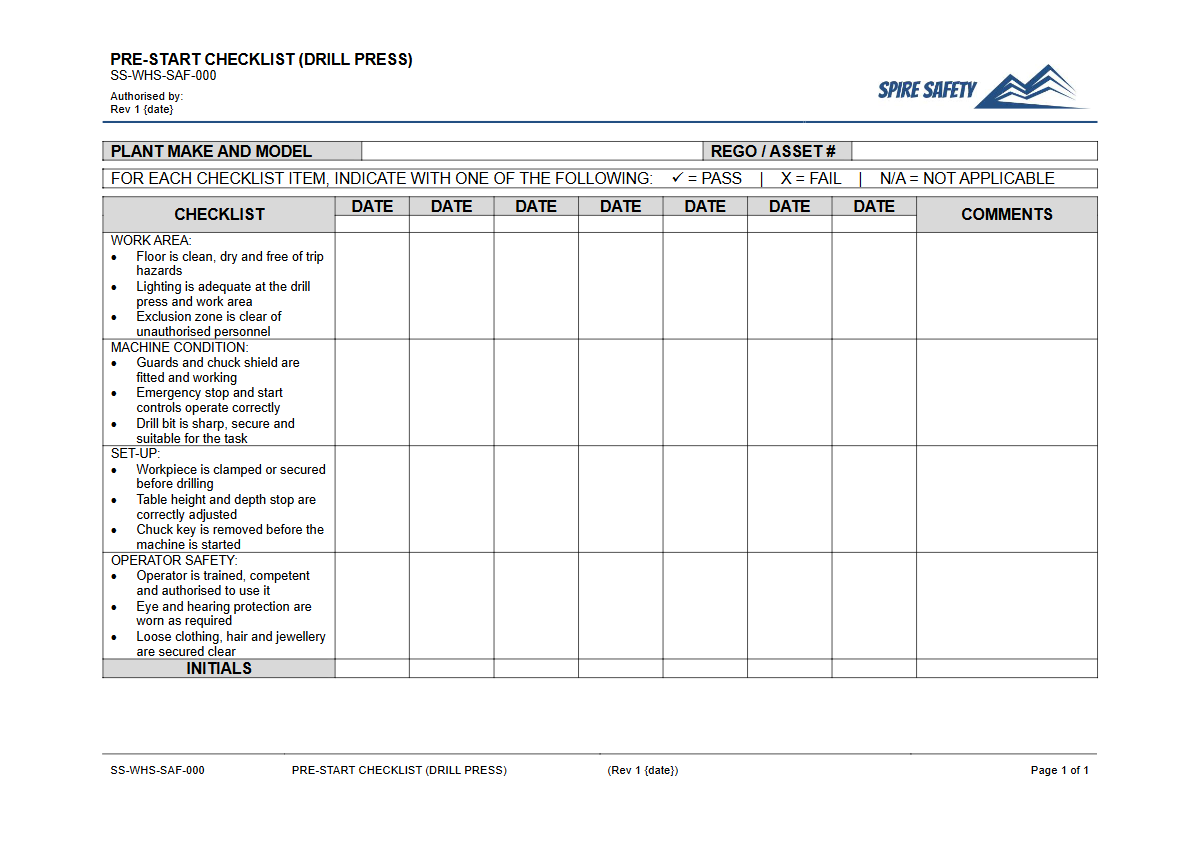
Regularly inspecting workshop equipment is a fundamental part of maintaining a safe working environment. This free Pre-Start Checklist (Drill Press) Template provides a structured format for operators to verify that a drill press is safe to use before commencing work.
The checklist helps formalise the inspection process, ensuring key safety components are checked consistently every time. Using a pre-start checklist helps identify potential hazards like damaged wiring, missing guards, or unsecured components before they can cause an incident involving entanglement, electric shock, or projectiles.
A documented pre-start process creates a record of due diligence, demonstrating a commitment to proactive risk management. It encourages a safety-first mindset among workers and helps standardise equipment safety across your organisation.
For a broader perspective on equipment checks, our Pre-Start Checks and Plant Maintenance Toolbox Talk can help reinforce these principles with your team.
Video walkthrough
How to use the Free Pre-Start Checklist (Drill Press) Template
This template is provided in both DOCX and PDF formats for your convenience. The DOCX file is fully editable, allowing you to tailor the checklist to your specific operational needs. To implement it effectively:
- Customise: Add your company branding and modify the checklist items to match the specific makes and models of drill presses used in your workplace. Include checks relevant to your unique tasks and risk profile.
- Train: Ensure all operators are trained on how to properly conduct the pre-start check and understand the importance of each item. Training should cover the procedure for reporting faults or taking faulty equipment out of service.
- Implement: Make the checklist readily available at each drill press station. Integrate the completed forms into your daily safety paperwork and record-keeping processes.
- Review: Periodically review the checklist's effectiveness and update it as necessary, especially after an incident or when new equipment is introduced.
IMPORTANT: This is a template only. We have designed it as a starting point that you must adapt to the specific makes and models of equipment in your workplace, your unique operational risks, and relevant Australian safety standards. Verifying that an operator is competent to use the machinery is also critical, which can be formalised using our free Drill Press VOC template.
When to use a Drill Press Pre-Start Checklist
A pre-start check should be completed before the first use of the drill press on any given day or shift. It is a brief, focused inspection designed to catch obvious faults that may have developed since its last use.
If multiple operators use the same machine during a single shift, it is good practice for each new operator to conduct their own pre-start check to ensure continuity of safety. This routine helps embed safe work practices and ensures no operator inadvertently uses a machine that a previous user found to be faulty.
Who should use it
This checklist is primarily designed for the machine operators who will be using the drill press. They are in the best position to assess the immediate condition of the equipment.
Supervisors and managers should also be familiar with the checklist to oversee its correct use and ensure that any reported defects are addressed promptly. The information gathered is a vital input for comprehensive WHS management systems, helping to track plant condition and inform maintenance schedules.
Integrating this checklist with other safety documents creates a more robust safety framework. For example, the findings from a pre-start can inform the review of a Safe Work Method Statement, like our Hammer Drill SWMS template, ensuring that identified controls are still effective.
These documented procedures serve as critical evidence during a WHS compliance auditing process, demonstrating systematic risk management.
While this checklist is for a drill press, the principles apply to other machinery. For example, a similar systematic approach should be applied to hydraulic equipment, which can be guided by resources like our FREE Hydraulic Press SOP (Safe Operating Procedure) template. You can also adapt this pre-start concept for other fixed plant in your workshop, such as with our Free Pre-Start Checklist (CNC Router) Template.
Common mistakes
Common mistakes to avoid
- Failing to securely clamp the workpiece before drilling, leading to it spinning or being thrown.
- Using dull, damaged, or incorrect types of drill bits for the material being worked on.
- Wearing gloves, loose-fitting clothing, or jewellery that could become entangled in the rotating spindle.
- Forgetting to remove the chuck key from the chuck after changing a bit.
Legal references
Legal considerations
The following legal requirements may be relevant to this type of work.
- Work Health and Safety Act (Harmonised) — Provides the primary duties for protecting workers and other people from work health and safety risks.
- Work Health and Safety Regulations (Harmonised) — Sets out requirements supporting the management of workplace hazards and risks.
The following codes may be relevant to this type of work.
- Managing WHS Risks Code of Practice — Provides practical guidance on identifying hazards, assessing risks and applying effective controls.
- Work Health and Safety Consultation, Cooperation and Coordination Code of Practice — Provides practical guidance on consulting workers and coordinating with other duty holders.
- Managing the Work Environment and Facilities Code of Practice — Provides practical guidance on safe work environments, workplace facilities and related controls.
Did you know
Entanglement Hazard
The rotating chuck and spindle of a drill press are a major entanglement hazard. Loose clothing, long hair, and jewellery can be caught in seconds, causing severe injury.
Chuck Keys
A common cause of injury is leaving the chuck key in the chuck after changing a bit. When the drill press is started, the key can be ejected at high speed, becoming a dangerous projectile.
FAQ
Frequently asked questions
01What should be on a drill press pre-start checklist?
02How often should a drill press be inspected?
03Is a pre-start checklist a legal requirement in Australia?
04Can I use a single checklist for different types of workshop machinery?
Share this resource
Free Pre-Start Checklist (Drill Press) Template
Browse Categories
How To Use It
- 1Download and open in Word or PDF.
- 2Replace the placeholders with your business details.
- 3Get it reviewed by a WHS specialist before rollout.
Need it customised?
Our WHS consultants can adapt this template to your site, run a gap analysis, or audit what you already have in place.
Book a Free Consultation WHS consulting servicesor call 1300 156 382