
Free Pre-Start Checklist (Drum Lifter) Template
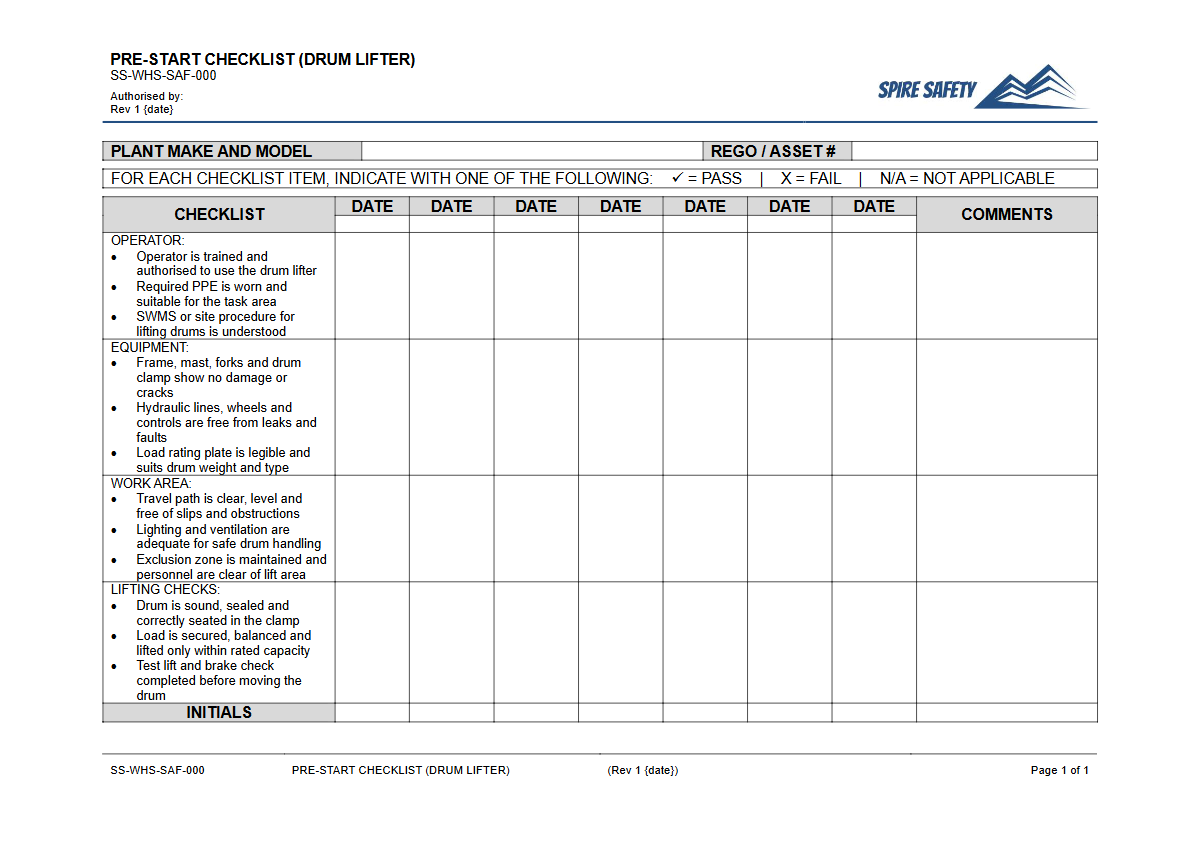
Download our free Pre-Start Checklist (Drum Lifter) Template. This structured Word & PDF resource helps formalise daily equipment safety inspections.
Free Pre-Start Checklist (Drum Lifter) Template
DOCX • 125 KB + PDF
Updated Oct 2026
No signup required
Purpose of the Free Pre-Start Checklist (Drum Lifter) Template
Regularly inspecting plant and equipment is a cornerstone of effective workplace safety. This free Pre-Start Checklist (Drum Lifter) Template provides a structured starting point for organisations to formalise their daily equipment checks.
Using a checklist helps operators systematically identify potential faults, damage, or wear and tear before the equipment is used, significantly reducing the risk of incidents, injuries, and costly equipment failure. Drum lifters are crucial mechanical aids for mitigating risks associated with manual handling, and ensuring they are in safe working order is a primary duty of care.
A documented pre-start process demonstrates a commitment to proactive risk management. It encourages a safety-first mindset among operators and provides a clear record that inspections are being completed.
While drum lifters are designed to prevent injury, a faulty lifter can introduce new and severe hazards. Formalising these checks is a critical control measure within your broader safety framework.
For a deeper look into the principles of reducing physical strain, consider reviewing our Aged Care Manual Handling Toolbox Talk, which covers concepts applicable across many industries.
Video walkthrough
How to use the Free Pre-Start Checklist (Drum Lifter) Template
You can download this Pre-Start Checklist (Drum Lifter) Template in both DOCX and PDF formats. The DOCX file is fully editable, allowing you to add your company branding and tailor the inspection points to the specific make and model of drum lifter used in your workplace.
This might include adding checks for hydraulic systems, specific grab mechanisms, or unique features of your equipment.
IMPORTANT: This document is a template and serves as a starting point. We cannot guarantee it is suitable for your specific plant, operational context, or legislative requirements.
You must customise this checklist by reviewing the manufacturer’s instructions, conducting a risk assessment, and consulting with operators. Integrating customised documents like this one is a key part of building effective WHS management systems.
When to use it
A pre-start checklist should be completed by the operator before the drum lifter is used for the first time each day or at the beginning of each shift. This frequency ensures that any damage that may have occurred during previous use or overnight is identified before the equipment becomes a risk.
If multiple operators use the same lifter during a shift, it is good practice for the incoming operator to also conduct a brief handover inspection.
Establishing this routine is vital for maintaining a safe working environment. Consistent checks help catch minor issues before they escalate into major failures.
To reinforce this behaviour across all equipment, you can use our Pre-Start Checks and Plant Maintenance Toolbox Talk to train your team on the importance of these daily inspections.
Who should use it
The pre-start check must be carried out by a person who is competent to operate the drum lifter. This means they have received adequate information, instruction, and training on its safe use and are familiar with its specific features and potential hazards.
The operator is best placed to recognise if something about the equipment feels, looks, or sounds different from its normal operating condition.
Supervisors and managers also have a role. They are responsible for ensuring that operators are trained on how to use the checklist correctly and that the checks are being consistently completed and documented. These records are essential evidence of procedural compliance and can be reviewed during internal safety checks or more formal WHS compliance auditing.
For high-risk tasks involving mobile plant, a pre-start check is often a prerequisite documented in a Safe Work Method Statement. While a drum lifter may not always require a SWMS, seeing how pre-starts fit into a broader safety process in our Safe Work Method Statement (Concrete Truck Operation) template can provide valuable context for your procedures.
By implementing a robust system of pre-start inspections, your organisation can proactively manage the risks associated with lifting equipment. This template is one of many tools available in our free WHS resources library designed to help you build a safer workplace.
Common mistakes
Common mistakes to avoid
- Using a generic checklist that doesn't match the specific make and model of the drum lifter.
- Ticking boxes without physically or visually inspecting the corresponding component ('pencil-whipping').
- Failing to immediately tag out faulty equipment and report the defect to a supervisor.
- Operators not being properly trained on what to look for during the inspection.
Legal references
Legal considerations
The following legal requirements may be relevant to this type of work.
- Work Health and Safety Act (Harmonised) — Provides the primary duties for protecting workers and other people from work health and safety risks.
- Work Health and Safety Regulations (Harmonised) — Sets out requirements supporting the management of workplace hazards and risks.
The following codes may be relevant to this type of work.
- Managing WHS Risks Code of Practice — Provides practical guidance on identifying hazards, assessing risks and applying effective controls.
- Work Health and Safety Consultation, Cooperation and Coordination Code of Practice — Provides practical guidance on consulting workers and coordinating with other duty holders.
- Managing the Work Environment and Facilities Code of Practice — Provides practical guidance on safe work environments, workplace facilities and related controls.
Did you know
The Weight of a Drum
A standard 205-litre (or 44-gallon) steel drum of oil can weigh over 200 kilograms. Using a well-maintained mechanical lifter is a critical engineering control to prevent serious musculoskeletal injuries.
Hierarchy of Control
Using a drum lifter is an example of applying the hierarchy of control. It substitutes the hazardous manual task of lifting with a safer engineering control, which is a more effective risk management strategy than relying on PPE or administrative controls alone.
FAQ
Frequently asked questions
01What is the purpose of a drum lifter pre-start check?
02How often should a drum lifter be inspected?
03Who is responsible for conducting pre-start checks on a drum lifter?
04What happens if a fault is found during a drum lifter inspection?
Share this resource
Free Pre-Start Checklist (Drum Lifter) Template
Browse Categories
How To Use It
- 1Download and open in Word or PDF.
- 2Replace the placeholders with your business details.
- 3Get it reviewed by a WHS specialist before rollout.
Need it customised?
Our WHS consultants can adapt this template to your site, run a gap analysis, or audit what you already have in place.
Book a Free Consultation WHS consulting servicesor call 1300 156 382