
Free Pre-Start Checklist (Dry Vac) Template
Download our free Pre-Start Checklist (Dry Vac) Template. This DOCX & PDF resource helps formalise daily equipment checks and manage WHS risks. Get started now.
Free Pre-Start Checklist (Dry Vac) Template
DOCX • 125 KB + PDF
Updated Oct 2026
No signup required
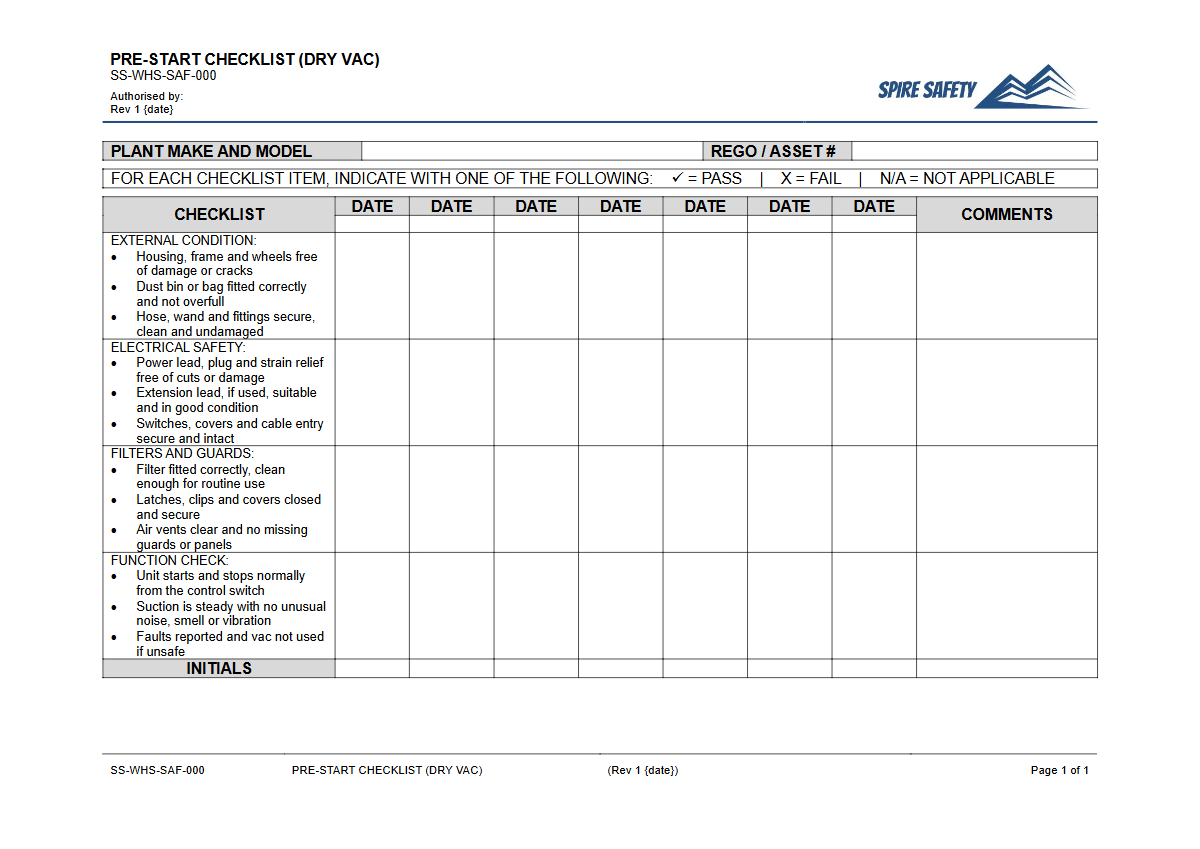
Formalising equipment inspections is a critical step in managing workplace safety. Our Free Pre-Start Checklist (Dry Vac) Template provides a structured starting point for organisations to ensure their industrial dry vacuums are safe to operate before each use.
Consistent pre-start checks help identify mechanical faults, electrical hazards, or blockages that could lead to incidents, equipment damage, or exposure to hazardous dust. This document is designed to be easily adapted to your specific operational needs.
Video walkthrough
Purpose of the Free Pre-Start Checklist (Dry Vac) Template
The primary purpose of a pre-start checklist for a dry vacuum is to systematically verify its condition and operational safety. By following a standardised procedure, operators can proactively identify and report potential hazards before they cause harm.
This includes checking for damaged power cords, worn-out filters, cracked hoses, or faulty switches. Documenting these checks creates a clear record of equipment maintenance and due diligence, which is a fundamental component of effective WHS management systems. It helps demonstrate that a PCBU (Person Conducting a Business or Undertaking) is taking reasonably practicable steps to provide and maintain safe plant and equipment.
How to use the Free Pre-Start Checklist (Dry Vac) Template
Using this template effectively involves more than just printing it out. Follow these steps to integrate it into your safety processes:
- Download and Customise: Download the template in your preferred format (DOCX or PDF). The DOCX version is fully editable. Important: We provide this as a starting point. You must customise this template to reflect the specific make and model of your dry vacuum, the tasks it's used for, and the unique hazards in your workplace. Add or remove checks as necessary.
- Train Operators: Ensure all personnel who use the dry vac are trained not only on its safe operation but also on how to properly complete the pre-start checklist. They must understand what each checkpoint means and the procedure for reporting faults.
- Implement and Monitor: Make the checklist readily available near the equipment's storage location. Supervisors should periodically review completed checklists to ensure they are being filled out correctly and that reported faults are being addressed promptly.
- Review and Update: Regularly review the checklist's effectiveness. If incidents occur or if new hazards are identified, update the document to reflect these changes.
This process of tailoring a checklist to a specific piece of equipment is crucial for all plant. For example, the checks required for a vacuum differ significantly from those in our Free Pre-Start Checklist (Bench Grinder) Template, highlighting the need for customisation.
What the Pre-Start Checklist Covers
A comprehensive dry vac pre-start checklist should prompt the operator to inspect several key areas. While our template provides a solid foundation, your customised version should confirm the integrity of:
- Power Supply: Check the cord for cuts, abrasions, or exposed wires. Inspect the plug and socket for damage.
- Filters: Ensure the primary filter and any secondary (e.g., HEPA) filters are clean, correctly installed, and free from damage.
- Hose and Wand: Look for cracks, splits, or blockages in the suction hose, wand, and floor tool.
- Casing and Wheels: Check the main body for cracks or damage, and ensure the casters or wheels move freely.
- Controls and Switches: Confirm the on/off switch functions correctly and that any other controls are operational.
- Warning Labels: Ensure all safety and operational labels are present and legible.
Different types of industrial equipment will have vastly different inspection points, as seen when comparing this list to the critical checks outlined in a resource like our Free Pre-Start Checklist (Floor Saw) Template.
When to use it
The pre-start checklist should be completed before the dry vacuum is used for the first time each day or at the beginning of each shift. It should also be performed if the equipment is being used by a new operator during the same shift.
Completing the check after maintenance or repairs is also good practice to ensure it has been returned to service in a safe condition. The records generated from these checks provide valuable data for safety reviews and WHS compliance auditing.
Who should use it
This checklist is designed to be used by trained and authorised operators of the dry vacuum. These are the individuals with hands-on responsibility for the equipment and the first line of defence against mechanical failure.
Supervisors and managers also have a role in reviewing the completed checklists, ensuring that any reported issues are logged, and that faulty equipment is immediately tagged out and removed from service until it can be repaired by a competent person. This operator-led approach is vital for many types of specialised equipment, from vacuums to laboratory gear covered by our Free Pre-Start Checklist (Fume Cabinet) Template.
By integrating this simple yet effective tool, you can improve equipment reliability, reduce the risk of incidents, and build a stronger safety culture. Explore our complete free WHS resources library for more templates and guides to support your safety management system.
Common mistakes
Common mistakes to avoid
- Ignoring 'minor' damage to power cords or hoses, which can lead to electrical shock or poor performance.
- Using the checklist as a 'tick and flick' exercise without conducting a genuine physical inspection of each item.
- Failing to immediately tag and remove a faulty vacuum from service after it fails a pre-start check.
- Not customising the generic template to the specific make, model, and work environment of the vacuum.
Legal references
Legal considerations
The following legal requirements may be relevant to this type of work.
- Work Health and Safety Act (Harmonised) — Provides the primary duties for protecting workers and other people from work health and safety risks.
- Work Health and Safety Regulations (Harmonised) — Sets out requirements supporting the management of workplace hazards and risks.
The following codes may be relevant to this type of work.
- Managing WHS Risks Code of Practice — Provides practical guidance on identifying hazards, assessing risks and applying effective controls.
- Work Health and Safety Consultation, Cooperation and Coordination Code of Practice — Provides practical guidance on consulting workers and coordinating with other duty holders.
- Managing the Work Environment and Facilities Code of Practice — Provides practical guidance on safe work environments, workplace facilities and related controls.
Did you know
Hazardous Dust Classification
Some industrial dust is so hazardous (e.g., silica, asbestos) that standard dry vacs can make the problem worse by dispersing fine particles. These applications require specialised H-Class vacuums and strict control measures.
Noise Levels
Many industrial vacuums operate at noise levels exceeding 85 decibels (dBA). Under Australian WHS regulations, this is the exposure standard at which hearing protection becomes mandatory.
FAQ
Frequently asked questions
01What are the key WHS risks associated with using a dry vacuum?
02How often should a dry vac pre-start check be completed?
03Can this template be used for a wet and dry vacuum?
04Who is responsible for ensuring pre-start checks are done?
Share this resource
Free Pre-Start Checklist (Dry Vac) Template
Browse Categories
How To Use It
- 1Download and open in Word or PDF.
- 2Replace the placeholders with your business details.
- 3Get it reviewed by a WHS specialist before rollout.
Need it customised?
Our WHS consultants can adapt this template to your site, run a gap analysis, or audit what you already have in place.
Book a Free Consultation WHS consulting servicesor call 1300 156 382