
Free Pre-Start Checklist (Dry Cleaner) Template
Formalise safety checks on your dry cleaning equipment with our Free Pre-Start Checklist (Dry Cleaner) Template. Download your customisable DOCX & PDF.
Free Pre-Start Checklist (Dry Cleaner) Template
DOCX • 125 KB + PDF
Updated Oct 2026
No signup required
Purpose of the Free Pre-Start Checklist (Dry Cleaner) Template
Operating dry cleaning machinery involves significant risks, including exposure to hazardous chemicals, high temperatures, pressurised systems, and moving parts. This Free Pre-Start Checklist (Dry Cleaner) Template provides a structured framework for operators to conduct essential safety and operational checks before starting work.
Using this checklist helps formalise the process of identifying and controlling hazards, reducing the risk of equipment failure, incidents, and injuries. It serves as a daily reminder of safety protocols and encourages a proactive approach to maintenance and hazard reporting.
A consistent pre-start inspection routine is a fundamental component of effective equipment management. By documenting checks on critical components like solvent levels, door seals, temperature gauges, and emergency stops, your organisation can demonstrate its commitment to safety and due diligence.
Regular inspections help ensure machinery operates as intended by the manufacturer, prolonging its operational life and preventing costly breakdowns. These daily checks are an excellent subject for a Pre-Start Checks and Plant Maintenance Toolbox Talk to reinforce their importance with your team.
Key Safety Checks
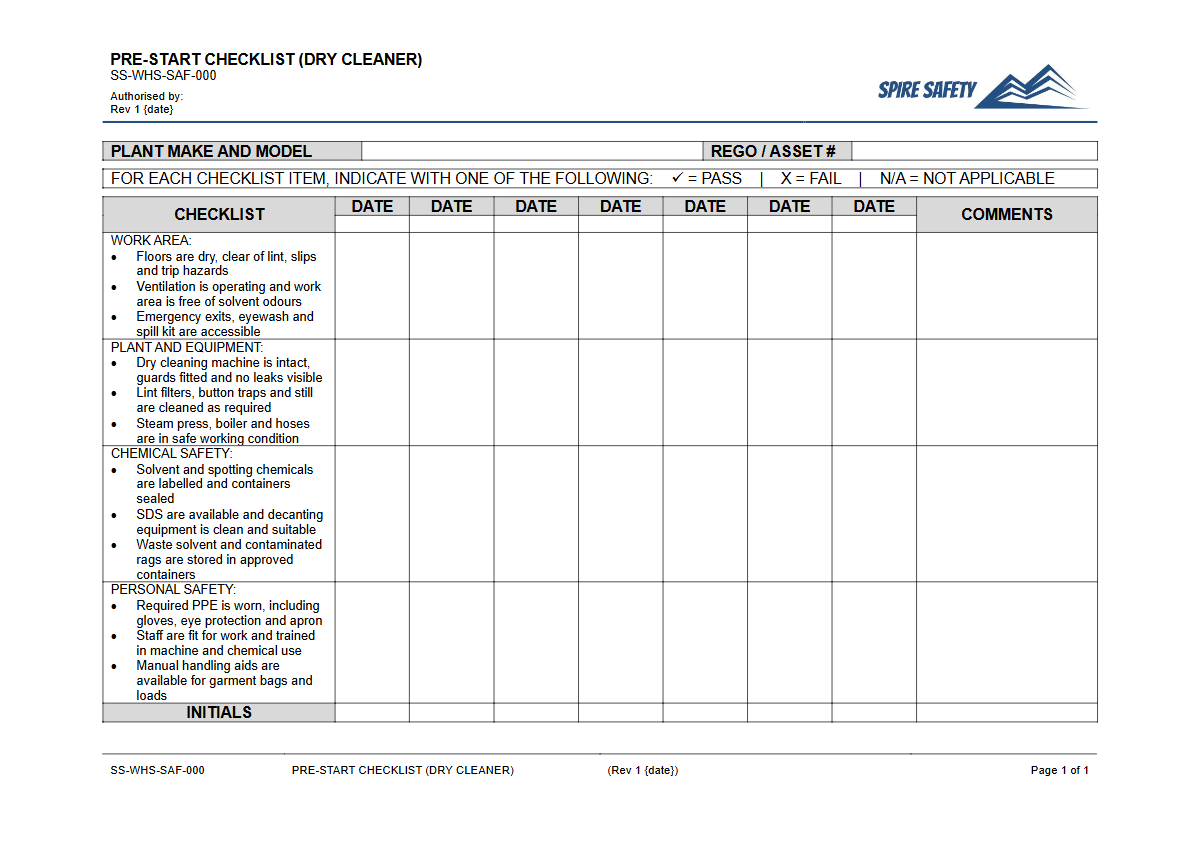
This template prompts users to inspect key areas of dry cleaning equipment, including:
- Emergency stop buttons and safety interlocks
- Gaskets, seals, and piping for leaks
- Solvent levels and filtration systems
- Temperature and pressure gauges
- Ventilation and extraction systems
- General machine cleanliness and surrounding area
Video walkthrough
How to use the Free Pre-Start Checklist (Dry Cleaner) Template
This document is a starting point designed for easy adaptation. First, download the template in your preferred format (DOCX or PDF).
Next, customise it to reflect the specific make, model, and configuration of the dry cleaning machines used in your workplace. This step is crucial for its effectiveness.
Important: This is a template, not a finished document. We cannot guarantee it covers every hazard unique to your specific equipment and work environment.
You must customise this checklist by adding, removing, or modifying items based on your own risk assessments, manufacturer's instructions, and relevant Australian safety standards. A well-tailored checklist becomes a powerful record within your overall WHS management systems, demonstrating proactive risk management.
Once customised, integrate the checklist into your daily start-up procedure. Train all operators on how to complete it correctly and what actions to take if a fault or hazard is identified.
Completed checklists should be reviewed by a supervisor and retained as a record of your safety activities. These records are invaluable during WHS compliance auditing as evidence of your safety processes in action.
When to use it
A pre-start checklist for dry cleaning equipment should be completed before the first use of the machine on any given day or shift. This ensures that the equipment is in a safe condition before it is pressurised, heated, or filled with chemical solvents.
It should also be completed after any maintenance, repair, or adjustment to verify that the machine has been returned to a safe operational state. Regular verification of competency is also essential, especially for associated tasks; for example, you might use a free Pressure Cleaner VOC to confirm skills for cleaning and maintenance activities in the plant area.
Who should use it
The primary user of this checklist is the trained and authorised operator of the dry cleaning machine. They are best placed to notice subtle changes in the equipment's condition or performance.
Supervisors and managers also have a key role. They are responsible for ensuring the checks are being completed diligently, reviewing the completed forms, and initiating corrective actions for any reported defects.
For businesses needing guidance on establishing these safety roles and responsibilities, expert WHS consulting services can provide valuable support and direction.
By systematically checking equipment before use, your organisation fosters a stronger safety culture and meets its obligations to provide a safe working environment. For more templates to support your safety framework, explore our complete free WHS resources library.
Common mistakes
Common mistakes to avoid
- Failing to customise the checklist for the specific make and model of the dry cleaning machine.
- Operators 'pencil-whipping' the form without physically inspecting each item.
- Not immediately taking faulty equipment out of service and reporting the defect.
- Poor record-keeping, making it impossible to track recurring faults or prove due diligence.
Legal references
Legal considerations
The following legal requirements may be relevant to this type of work.
- Work Health and Safety Act (Harmonised) — Provides the primary duties for protecting workers and other people from work health and safety risks.
- Work Health and Safety Regulations (Harmonised) — Sets out requirements supporting the management of workplace hazards and risks.
The following codes may be relevant to this type of work.
- Managing WHS Risks Code of Practice — Provides practical guidance on identifying hazards, assessing risks and applying effective controls.
- Work Health and Safety Consultation, Cooperation and Coordination Code of Practice — Provides practical guidance on consulting workers and coordinating with other duty holders.
- Managing the Work Environment and Facilities Code of Practice — Provides practical guidance on safe work environments, workplace facilities and related controls.
Did you know
Chemical Exposure Risks
Perchloroethylene (PERC), a common dry cleaning solvent, is classified as a probable human carcinogen. Effective pre-start checks on seals, gaskets, and ventilation are critical to minimising operator exposure.
Fire and Explosion Hazards
Many modern hydrocarbon and alternative solvents are combustible. A pre-start check that verifies the condition of electrical components, bonding, and grounding can significantly reduce the risk of a fire or explosion.
FAQ
Frequently asked questions
01What specific hazards should a dry cleaner pre-start checklist cover?
02How often should pre-start checks be performed on dry cleaning equipment?
03Can this template be used for all types of dry cleaning machines?
04Who is responsible for signing off on a pre-start checklist?
Share this resource
Free Pre-Start Checklist (Dry Cleaner) Template
Browse Categories
How To Use It
- 1Download and open in Word or PDF.
- 2Replace the placeholders with your business details.
- 3Get it reviewed by a WHS specialist before rollout.
Need it customised?
Our WHS consultants can adapt this template to your site, run a gap analysis, or audit what you already have in place.
Book a Free Consultation WHS consulting servicesor call 1300 156 382