
Free Pre-Start Checklist (Bitumen Spray) Template
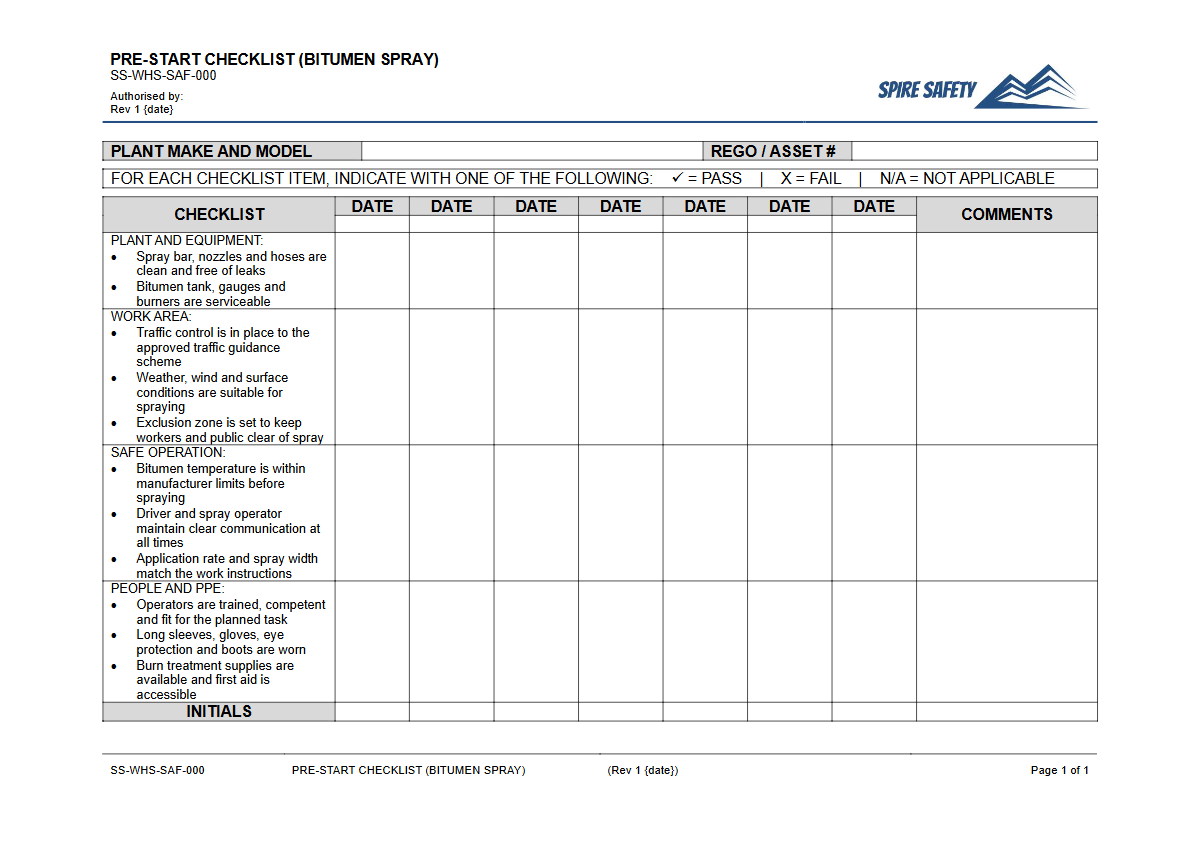
Download our free Pre-Start Checklist (Bitumen Spray) Template. This structured DOCX and PDF helps formalise daily safety checks for bitumen sprayers.
Free Pre-Start Checklist (Bitumen Spray) Template
DOCX • 125 KB + PDF
Updated Oct 2026
No signup required
Purpose of the Free Pre-Start Checklist (Bitumen Spray) Template
Operating a bitumen sprayer involves significant thermal, chemical, and mechanical hazards. A systematic pre-start inspection is a critical control measure to ensure the equipment is safe to operate before any work begins.
This Free Pre-Start Checklist (Bitumen Spray) Template provides a structured starting point for organisations to formalise their daily equipment checks. Using a checklist helps identify potential faults, leaks, or damage that could lead to serious incidents such as burns, fires, high-pressure fluid injection, or equipment failure.
Regularly completing these checks is a practical way for a Person Conducting a Business or Undertaking (PCBU) to meet their primary duty of care. The records generated also provide valuable data for maintenance scheduling and demonstrate due diligence.
Integrating such procedures into your broader WHS management systems reinforces a proactive safety culture where equipment safety is systematically verified, not assumed.
Video walkthrough
How to use the Free Pre-Start Checklist (Bitumen Spray) Template
This resource is available as a DOCX file, allowing for full customisation to suit your specific operational needs. A PDF version is also provided for immediate use.
It is crucial to adapt this template to align with the manufacturer's operating manual for your particular bitumen sprayer model, as well as any site-specific risks identified in your risk assessments.
Important: We strongly recommend you consult with competent persons, such as operators and maintenance staff, when customising the document. Their hands-on experience is invaluable for ensuring the checklist is practical and relevant.
Once finalised, use the checklist to train operators on the expected inspection standard. You can reinforce this training with our Pre-Start Checks and Plant Maintenance Toolbox Talk to further embed the importance of these daily inspections.
Key Checks for a Bitumen Sprayer
While your customised checklist should be specific, it will generally cover these critical areas:
General and Mechanical Checks
- Check fluid levels (engine oil, hydraulic fluid, coolant).
- Inspect tyres for correct pressure and condition.
- Verify function of lights, indicators, mirrors, and reversing alarms.
- Check for any signs of fluid leaks on the ground beneath the plant.
- Ensure machine guarding is secure and in good condition.
- Confirm cabin is clean, with clear visibility and secure access/egress.
Spraying System Checks
Similar to checks for other specialised plant detailed in resources like our Pre-Start Checklist (Agitator) Template, bitumen sprayers have unique systems that demand careful inspection.
- Inspect hoses, fittings, and connections for wear, cracks, or leaks.
- Check the condition and function of spray bars, nozzles, and valves.
- Verify pressure gauges are functional and readings are within the safe operating range.
- Ensure heating systems (burners, flues) are clear of obstruction and functioning correctly.
- Check the function of the pump and its drive system.
Safety and Emergency Equipment
- Confirm fire extinguishers are in place, correctly charged, and within their service date.
- Ensure first aid kits and burn kits are fully stocked and accessible.
- Verify that emergency stops and system overrides are functional and unobstructed.
- Check that all required Personal Protective Equipment (PPE) is available and in good condition.
When to use it
The pre-start checklist should be completed by the operator at the beginning of every shift or before the bitumen sprayer is used for the first time each day. It should be a non-negotiable part of the daily routine.
If a different operator takes over mid-shift, they should also review the checklist and conduct a takeover inspection to verify the equipment's condition.
Completed checklists should be submitted to a supervisor for review. These records are an important part of your safety documentation and can be reviewed during WHS compliance auditing to verify that safety procedures are being consistently followed.
Who should use it
This checklist is designed to be used by trained and competent operators who have been deemed competent to operate the specific model of bitumen sprayer. Supervisors and managers should use the completed checklists to monitor the condition of their fleet and ensure any reported defects are addressed promptly.
On a busy worksite, it is also important to coordinate safety checks across all machinery; if you also operate loaders, a resource like the Pre-Start Checklist (Artic Loader) Template can help standardise your processes.
This document is just one of many templates available to support your organisation. Explore our complete free WHS resources library for more tools to help you manage workplace health and safety effectively.
Common mistakes
Common mistakes to avoid
- Failing to customise the template for the specific make and model of the sprayer.
- Operators completing the checklist as a 'tick and flick' exercise without physically inspecting the items.
- Ignoring minor defects or leaks, which can escalate into major failures.
- Poor record-keeping, where completed checklists are lost or not reviewed by a supervisor.
Legal references
Legal considerations
The following legal requirements may be relevant to this type of work.
- Work Health and Safety Act (Harmonised) — Provides the primary duties for protecting workers and other people from work health and safety risks.
- Work Health and Safety Regulations (Harmonised) — Sets out requirements supporting the management of workplace hazards and risks.
The following codes may be relevant to this type of work.
- Managing WHS Risks Code of Practice — Provides practical guidance on identifying hazards, assessing risks and applying effective controls.
- Work Health and Safety Consultation, Cooperation and Coordination Code of Practice — Provides practical guidance on consulting workers and coordinating with other duty holders.
- Managing the Work Environment and Facilities Code of Practice — Provides practical guidance on safe work environments, workplace facilities and related controls.
Did you know
Extreme Temperatures
Hot mix asphalt is applied at temperatures between 150°C and 190°C. Contact at these temperatures can cause instantaneous, severe third-degree burns, making pre-start checks on hoses and fittings a critical safety step.
FAQ
Frequently asked questions
01What are the key hazards associated with bitumen spraying?
02Is a pre-start checklist a legal requirement in Australia?
03How often should a bitumen sprayer be inspected?
04Can this template be used for other road work equipment?
Share this resource
Free Pre-Start Checklist (Bitumen Spray) Template
Browse Categories
How To Use It
- 1Download and open in Word or PDF.
- 2Replace the placeholders with your business details.
- 3Get it reviewed by a WHS specialist before rollout.
Need it customised?
Our WHS consultants can adapt this template to your site, run a gap analysis, or audit what you already have in place.
Book a Free Consultation WHS consulting servicesor call 1300 156 382