
Free Pre-Start Checklist (Blood Fridge) Template
Download our Free Pre-Start Checklist (Blood Fridge) Template. This structured Word & PDF resource helps ensure equipment integrity in medical and lab settings.
Free Pre-Start Checklist (Blood Fridge) Template
DOCX • 125 KB + PDF
Updated Oct 2026
No signup required
Purpose of the Free Pre-Start Checklist (Blood Fridge) Template
Ensuring the integrity of blood, plasma, and other biological products is critical in any healthcare or laboratory setting. Our Free Pre-Start Checklist (Blood Fridge) Template provides a structured starting point for operators to verify that medical refrigeration units are functioning correctly.
This formalises daily inspections, supports patient safety, and helps maintain operational consistency in line with good clinical practice. Available in both DOCX and PDF formats, this template is designed to be integrated into your facility's daily procedures.
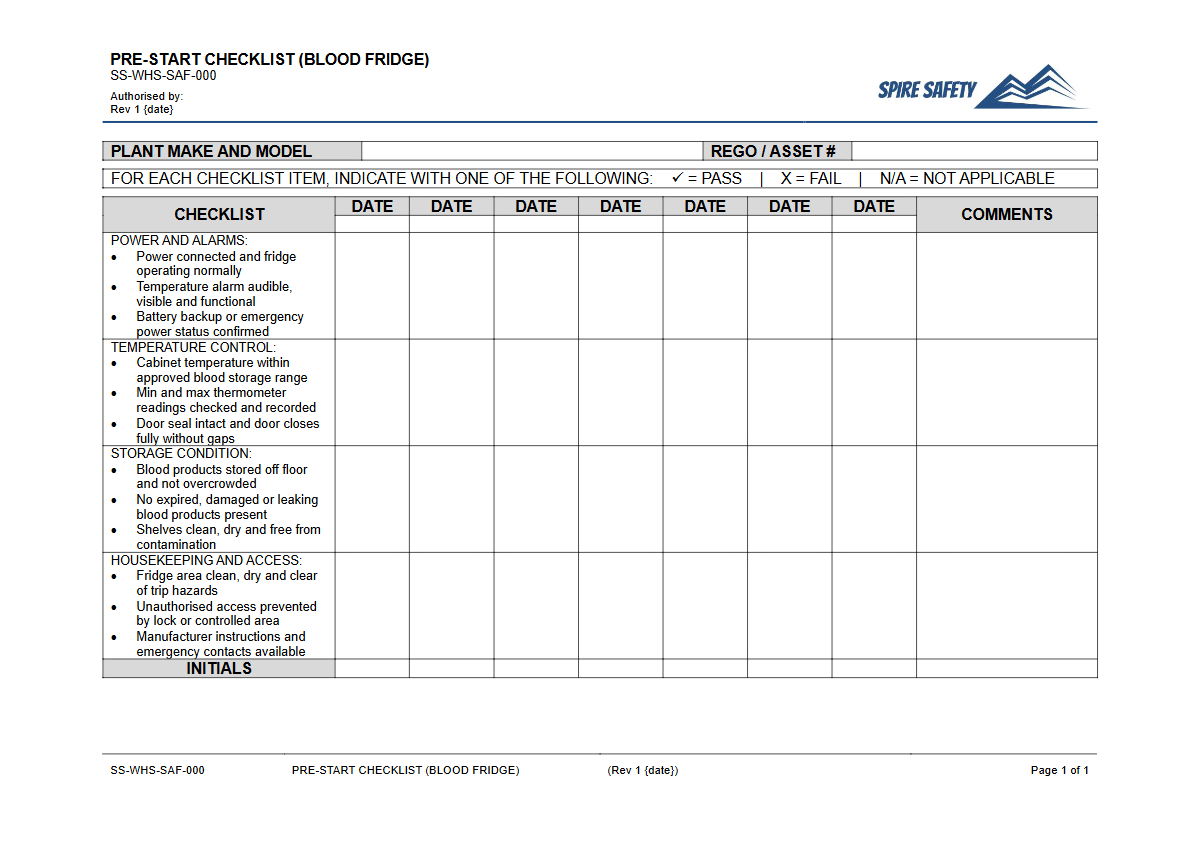
This Pre-Start Checklist for Blood Fridges serves as a daily record of equipment status. Its primary purpose is to systematically verify critical functions like temperature stability, alarm systems, and physical integrity before the unit is relied upon for another operational period.
Consistent use helps organisations demonstrate due diligence and maintain the quality of stored products, forming a key part of robust WHS management systems by creating auditable records of safety-critical checks.
What's included in the template?
The checklist provides prompts for essential verification points, including:
- Temperature checks (current, min/max)
- Alarm system functionality (audible and visual)
- Physical condition (cleanliness, door seal integrity)
- Chart recorder or data logger operation
- Confirmation of power supply
- Space for operator sign-off and corrective action notes
Video walkthrough
How to use the Free Pre-Start Checklist (Blood Fridge) Template
To get started, download the template in your preferred format (DOCX for easy editing or PDF for immediate use). The document provides a comprehensive list of checks aligned with Australian WHS practice for medical equipment operation.
It is designed to be printed and used daily or integrated into a digital record-keeping system.
Important: This is a template, not a finished, universal document. We have designed it to be customised.
You must review and adapt it to reflect the specific make and model of your refrigerators, your site's unique procedures, and any relevant state, federal, or accreditation body requirements (such as those from the TGA or NPAAC). Failure to tailor the checklist to your workplace could result in overlooking critical hazards or procedural gaps.
When to use it
The checklist should be completed at the beginning of every shift or, at a minimum, once every 24 hours. It is also essential to perform these checks after any disruption that could affect the unit's performance.
This includes after a power outage, following scheduled or unscheduled maintenance, or after the unit has been moved or serviced. Completing a check after an alarm has been resolved also helps confirm the unit has returned to a stable state.
Documenting these actions is a key theme within our pre-start checks and plant maintenance toolbox talk, highlighting the importance of routine verification across all types of equipment.
Who should use it
This checklist is intended for use by all personnel authorised to handle and monitor blood storage equipment. This typically includes laboratory technicians, pathologists, nurses, phlebotomists, and other clinical staff.
It's vital that users are trained not only on how to complete the checklist but also on the corrective actions to take if a check fails. Verifying competency in these tasks is crucial for safety in high-risk environments like healthcare and pathology, a principle also covered in resources like our aged care manual handling toolbox talk.
Regularly reviewing completed checklists is a valuable exercise. It can reveal patterns of equipment degradation or recurring issues that may require a more in-depth maintenance response.
This data is invaluable during internal reviews or external WHS compliance auditing, providing tangible evidence of your organisation's commitment to safety and quality.
If you need assistance adapting this template or developing a more comprehensive safety program for your medical or laboratory facilities, our team offers specialised WHS consulting services to help you meet your obligations.
Explore our full range of templates, checklists, and toolbox talks in our free WHS resources library to further support your workplace safety initiatives.
Common mistakes
Common mistakes to avoid
- Failing to record the actual temperature and just ticking the 'OK' box.
- Ignoring or silencing alarms without investigating and documenting the cause.
- Neglecting to physically inspect the door seal for brittleness, cracks, or gaps.
- Not verifying the onboard thermometer's reading with a calibrated, independent thermometer periodically.
Legal references
Legal considerations
The following legal requirements may be relevant to this type of work.
- Work Health and Safety Act (Harmonised) — Provides the primary duties for protecting workers and other people from work health and safety risks.
- Work Health and Safety Regulations (Harmonised) — Sets out requirements supporting the management of workplace hazards and risks.
The following codes may be relevant to this type of work.
- Managing WHS Risks Code of Practice — Provides practical guidance on identifying hazards, assessing risks and applying effective controls.
- Work Health and Safety Consultation, Cooperation and Coordination Code of Practice — Provides practical guidance on consulting workers and coordinating with other duty holders.
- Managing the Work Environment and Facilities Code of Practice — Provides practical guidance on safe work environments, workplace facilities and related controls.
Did you know
Strict Temperature Range
The required storage temperature for red blood cells in Australia is 2°C to 6°C. Any deviation outside this range, known as a temperature excursion, can compromise the viability and safety of the blood product.
Alarm Importance
Blood fridge alarms are not just for temperature. They can also alert staff to power failures or a door being left ajar, both of which can lead to catastrophic product loss if not addressed immediately.
FAQ
Frequently asked questions
01Is this checklist compliant with TGA or NPAAC standards?
02How often should a blood fridge pre-start check be performed?
03What are the most critical checks for a blood fridge?
04Can I use this template for vaccine or other medical refrigerators?
Share this resource
Free Pre-Start Checklist (Blood Fridge) Template
Browse Categories
How To Use It
- 1Download and open in Word or PDF.
- 2Replace the placeholders with your business details.
- 3Get it reviewed by a WHS specialist before rollout.
Need it customised?
Our WHS consultants can adapt this template to your site, run a gap analysis, or audit what you already have in place.
Book a Free Consultation WHS consulting servicesor call 1300 156 382