
Free Pre-Start Checklist (Bogie Trailer) Template
Download our free Pre-Start Checklist for Bogie Trailers. This customisable DOCX & PDF template helps formalise daily equipment checks and manage WHS risks.
Free Pre-Start Checklist (Bogie Trailer) Template
DOCX • 125 KB + PDF
Updated Oct 2026
No signup required
Purpose of the Free Pre-Start Checklist (Bogie Trailer) Template
A bogie trailer is a critical piece of equipment in many transport, construction, and logistics operations. Ensuring its mechanical soundness before each use is fundamental to workplace safety.
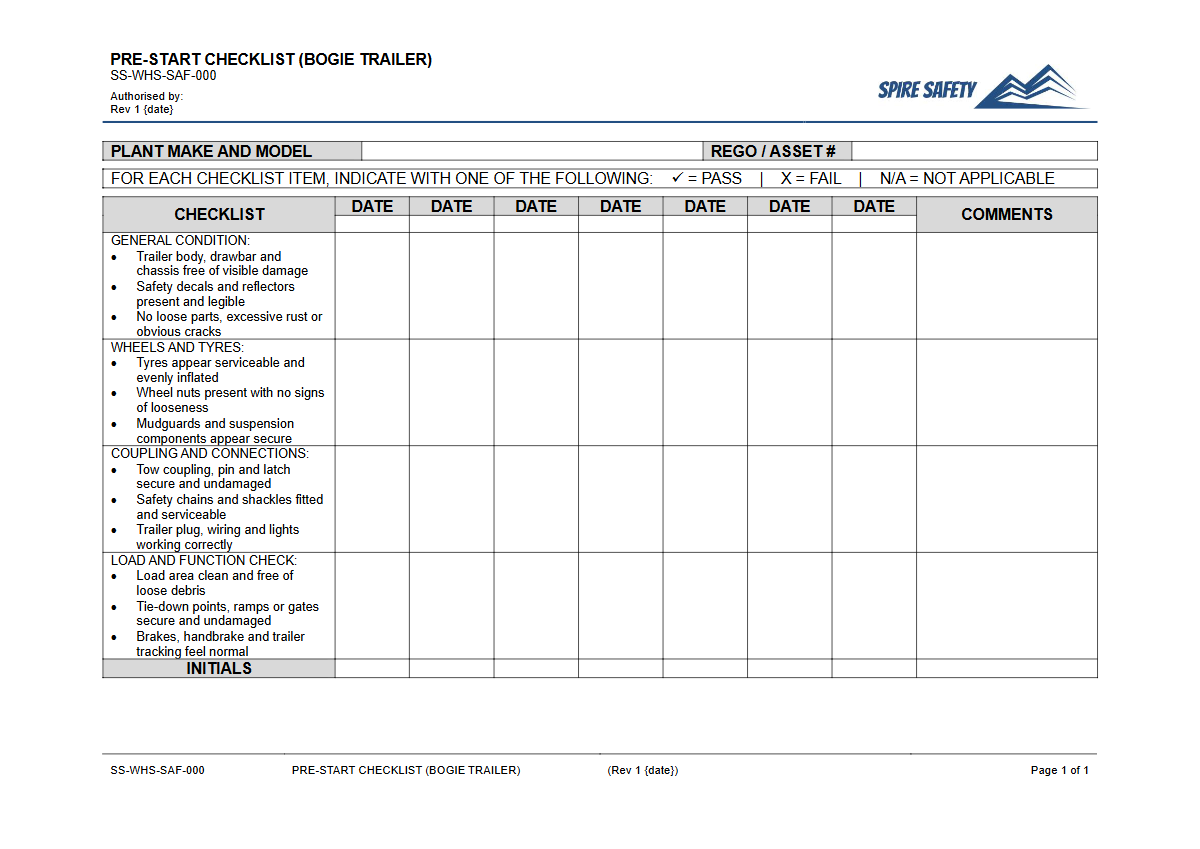
Our Free Pre-Start Checklist (Bogie Trailer) Template provides a structured framework for operators to conduct thorough, repeatable inspections. Using this checklist helps identify potential defects in key components like couplings, brakes, tyres, and lighting systems before they lead to incidents on the road or at a worksite.
Regular, documented checks are a key part of demonstrating due diligence and form an essential record for maintenance scheduling and safety management.
This systematic approach helps your organisation meet its primary duty of care under WHS legislation by proactively managing risks associated with heavy vehicle operation. The process is similar for other types of trailers, and you may find our Pre-Start Checklist for Dump Trailers useful for related equipment.
Video walkthrough
How to Use the Free Pre-Start Checklist (Bogie Trailer) Template
This template is designed for practical application in your workplace. It's provided as a DOCX file for easy customisation and a PDF for immediate printing and use. To implement it effectively, follow these steps:
1. Download and Customise
Download the template and adapt it to the specific models of bogie trailers used in your operations. It's crucial to tailor the checklist to your unique context, including the types of loads carried, the operating environments (e.g., road vs.
off-road), and any manufacturer-specific requirements.
Important: We provide this document as a starting point. It is your responsibility to ensure the final checklist is customised to be fully relevant and comprehensive for your specific equipment, tasks, and workplace risks.
2. Train Your Workers
Ensure all operators and drivers are trained on how to conduct the checks properly. This includes understanding what they are looking for, recognising signs of wear or damage, and knowing the correct procedure for reporting any faults they discover.
Training should also cover the importance of not using equipment that fails an inspection.
3. Implement and Monitor
Integrate the pre-start check into your daily operational procedures. Completed checklists should be reviewed by a supervisor to ensure they are being filled out correctly and to action any reported defects promptly.
These records are vital components of broader WHS management systems, providing valuable data for safety performance and maintenance planning.
What's Covered in the Checklist?
Our template prompts a thorough inspection of all critical safety components of a bogie trailer. It is organised into logical sections to guide the operator through a systematic check, including:
- Couplings and Connections: Verifying the security of the turntable, kingpin, and any air or electrical lines.
- Tyres and Wheels: Checking for correct inflation, adequate tread depth, and any signs of damage or wear.
- Braking System: Inspecting air lines, tanks, and confirming brake function.
- Lights and Electrical: Testing all indicators, brake lights, and clearance lights.
- Chassis and Body: A visual inspection for structural integrity, including checking for cracks, corrosion, or damage to the frame and suspension.
- Load Securing Points: Ensuring tie-down points, chains, or binders are present and in good condition.
For more templates covering a wide range of plant and equipment, browse our complete free WHS resources library.
When to Use This Pre-Start Checklist
A pre-start check should be conducted at the beginning of every shift or before the trailer is used for the first time on any given day. It should also be performed after any change of operator.
This frequency ensures that any faults that may have developed overnight, during transit, or from previous use are identified before the vehicle becomes a risk. The consistent completion of these checks can be verified during internal or external WHS compliance audits.
Who Should Use It?
The primary person responsible for completing the bogie trailer pre-start check is the driver or operator. They are in the best position to conduct a physical inspection of the equipment they are about to use. However, other personnel have a role to play:
- Supervisors: Should review completed checklists, supports your compliance efforts with the process, and escalate any reported defects for immediate action.
- Maintenance Personnel: Use the information from completed checklists to schedule preventative maintenance and carry out repairs.
- Persons Conducting a Business or Undertaking (PCBUs): Are ultimately responsible for providing safe plant and systems of work, which includes implementing procedures like pre-start checks. Getting these systems right can be complex, and our WHS consulting team can provide expert guidance.
Common mistakes
Common mistakes to avoid
- Failing to physically verify items and just ticking boxes ('pencil-whipping').
- Not reporting minor defects, which can escalate into major failures if left unaddressed.
- Using a generic checklist that doesn't cover the specific features or risks of the trailer model.
- Lack of a clear process for taking faulty equipment out of service until it is repaired.
Legal references
Legal considerations
The following legal requirements may be relevant to this type of work.
- Work Health and Safety Act (Harmonised) — Provides the primary duties for protecting workers and other people from work health and safety risks.
- Work Health and Safety Regulations (Harmonised) — Sets out requirements supporting the management of workplace hazards and risks.
The following codes may be relevant to this type of work.
- Managing WHS Risks Code of Practice — Provides practical guidance on identifying hazards, assessing risks and applying effective controls.
- Work Health and Safety Consultation, Cooperation and Coordination Code of Practice — Provides practical guidance on consulting workers and coordinating with other duty holders.
- Managing the Work Environment and Facilities Code of Practice — Provides practical guidance on safe work environments, workplace facilities and related controls.
Did you know
Tyre Pressure Matters
According to industry studies, under-inflated tyres are a leading cause of tyre-related incidents for heavy vehicles. Even a 10% under-inflation can significantly increase fuel consumption and the risk of a blowout.
Coupling Checks Are Critical
A 'tug test'—gently pulling forward against the locked trailer brakes—is a simple but critical physical check to confirm the fifth wheel jaws have locked correctly around the kingpin. This should be part of every coupling procedure.
FAQ
Frequently asked questions
01What should be included in a bogie trailer pre-start checklist?
02How often should a bogie trailer pre-start check be performed?
03Who is responsible for completing a bogie trailer pre-start check?
04Is this pre-start checklist a legal document?
Share this resource
Free Pre-Start Checklist (Bogie Trailer) Template
Browse Categories
How To Use It
- 1Download and open in Word or PDF.
- 2Replace the placeholders with your business details.
- 3Get it reviewed by a WHS specialist before rollout.
Need it customised?
Our WHS consultants can adapt this template to your site, run a gap analysis, or audit what you already have in place.
Book a Free Consultation WHS consulting servicesor call 1300 156 382