
Free Pre-Start Checklist (Bone Saw) Template
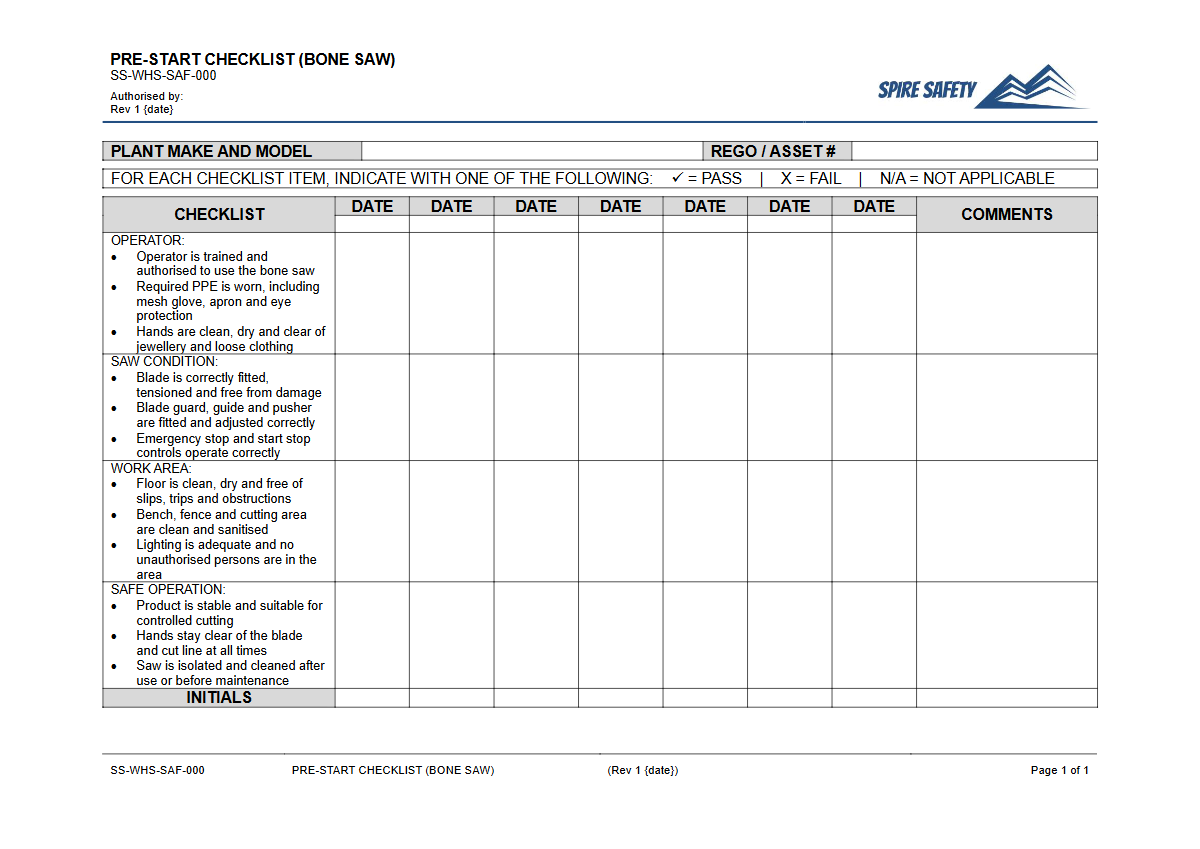
Download our Free Pre-Start Checklist for Bone Saws. This DOCX & PDF template helps formalise safety checks for butchers and food processors in Australia.
Free Pre-Start Checklist (Bone Saw) Template
DOCX • 125 KB + PDF
Updated Oct 2026
No signup required
Purpose of the Free Pre-Start Checklist (Bone Saw) Template
This Free Pre-Start Checklist (Bone Saw) Template provides a structured framework for operators to inspect equipment before use, ensuring it is safe to operate. Bone saws, common in butcheries, abattoirs, and food processing facilities, pose significant risks of cuts, lacerations, and amputation if not properly maintained and inspected.
Using this checklist helps your organisation systematically identify potential faults, damage, or missing safety features before they can lead to an incident. It serves as a practical tool to help meet your Person Conducting a Business or Undertaking (PCBU) duties to provide and maintain safe plant and equipment.
Formalising daily inspections creates a documented record of due diligence and promotes a proactive safety culture. It encourages operators to take ownership of their equipment's condition and embeds safety as a critical step in the workflow.
For a broader discussion on this topic with your team, our Pre-Start Checks and Plant Maintenance Toolbox Talk can be a valuable resource to reinforce these principles.
Video walkthrough
How to use the Free Pre-Start Checklist (Bone Saw) Template
This checklist is available in both DOCX and PDF formats. The DOCX file is fully editable, allowing you to tailor it to your specific needs, while the PDF is ready for immediate printing and use.
It is designed as a starting point, aligned with Australian WHS practice, to be integrated into your daily operational procedures.
Important: This template provides a general guide. We strongly recommend you customise it to reflect the specific make and model of your bone saw, your unique operational environment, and any hazards identified in your workplace risk assessments.
Effective safety management involves embedding these checks into your broader comprehensive WHS management systems to ensure they are consistently completed, reviewed, and acted upon.
Key Inspection Points for a Bone Saw
While your customised checklist will be more detailed, a thorough pre-start inspection for a bone saw should always verify:
- Guards: All guards (blade guards, pulley guards) are in place, secure, and undamaged.
- Blade: The blade is correctly tensioned, sharp, free from cracks or missing teeth, and properly tracked on the pulleys.
- Emergency Stop: The e-stop button is clearly visible, accessible, and functional. Test it before starting any work.
- Cleaning and Sanitisation: The machine, guides, and surrounding area are clean and free from meat scraps or residue that could cause slips or interfere with moving parts.
- Frame and Stability: The saw is stable on a level surface and the frame has no cracks or signs of stress.
- Power Supply: The power cord and plug are free from damage, cuts, or exposed wires.
The principles of checking for guarding, power supply integrity, and emergency stop functionality apply to a wide range of powered tools. This systematic approach is just as critical when using other high-risk equipment, as detailed in resources like an air arc pre-start checklist.
When to use it
A pre-start checklist for a bone saw should be completed:
- Before the first use of the day or at the beginning of each shift.
- After any maintenance, cleaning, or blade change has been performed.
- If a new operator is taking over the machine mid-shift.
Consistent use is key to its effectiveness. A completed check should be the final step before the machine is energised for work.
The associated tasks around using a bone saw, such as moving heavy carcasses, also present risks like musculoskeletal injuries. These should be managed with proper training, which can be reinforced with tools like a manual handling toolbox talk adapted for your specific lifting tasks.
Who should use it
This checklist is designed to be completed by the person operating the bone saw. Operators must be trained and deemed competent not only in the machine's use but also in how to conduct a thorough pre-start inspection and recognise the hazards associated with the equipment.
Supervisors should periodically review completed checklists to verify that inspections are being done correctly and that any reported faults are being addressed promptly. If you require assistance in developing competency frameworks or tailoring safety documents for your specific operations, engaging professional WHS consulting services can provide expert guidance. You can find many other helpful templates in our free WHS resources library.
Common mistakes
Common mistakes to avoid
- Failing to check blade tension, leading to the blade coming off the pulleys during operation.
- Operating the saw with a dull or damaged blade, which requires more force and increases the risk of slipping.
- Neglecting to test the emergency stop button as part of the daily check.
- Allowing meat scraps and residue to build up, creating slip hazards and interfering with machine components.
Legal references
Legal considerations
The following legal requirements may be relevant to this type of work.
- Work Health and Safety Act (Harmonised) — Provides the primary duties for protecting workers and other people from work health and safety risks.
- Work Health and Safety Regulations (Harmonised) — Sets out requirements supporting the management of workplace hazards and risks.
The following codes may be relevant to this type of work.
- Managing WHS Risks Code of Practice — Provides practical guidance on identifying hazards, assessing risks and applying effective controls.
- Work Health and Safety Consultation, Cooperation and Coordination Code of Practice — Provides practical guidance on consulting workers and coordinating with other duty holders.
- Managing the Work Environment and Facilities Code of Practice — Provides practical guidance on safe work environments, workplace facilities and related controls.
Did you know
Blade Speed
The blade on a commercial band saw can travel at speeds of over 3,000 feet per minute. This high speed is what allows it to cut through bone and frozen meat, but also makes contact exceptionally dangerous.
Industry Risk
The food and accommodation services industry, which includes many businesses that use bone saws, consistently ranks among the top industries for serious workers' compensation claims related to cuts and lacerations.
FAQ
Frequently asked questions
01What are the main hazards of using a bone saw?
02How often should a bone saw pre-start check be done?
03Is specific training required to operate a bone saw?
04What should I do if I find a fault during a pre-start check?
Share this resource
Free Pre-Start Checklist (Bone Saw) Template
Browse Categories
How To Use It
- 1Download and open in Word or PDF.
- 2Replace the placeholders with your business details.
- 3Get it reviewed by a WHS specialist before rollout.
Need it customised?
Our WHS consultants can adapt this template to your site, run a gap analysis, or audit what you already have in place.
Book a Free Consultation WHS consulting servicesor call 1300 156 382