
Free Pre-Start Checklist (Boat Lift) Template
Download our free Pre-Start Checklist (Boat Lift) Template in DOCX & PDF.
Free Pre-Start Checklist (Boat Lift) Template
DOCX • 125 KB + PDF
Updated Oct 2026
No signup required
Purpose of the Free Pre-Start Checklist (Boat Lift) Template
Operating a boat lift involves significant risks, from structural failure to hydraulic system malfunctions. Implementing a routine inspection process is a fundamental control measure to manage these risks.
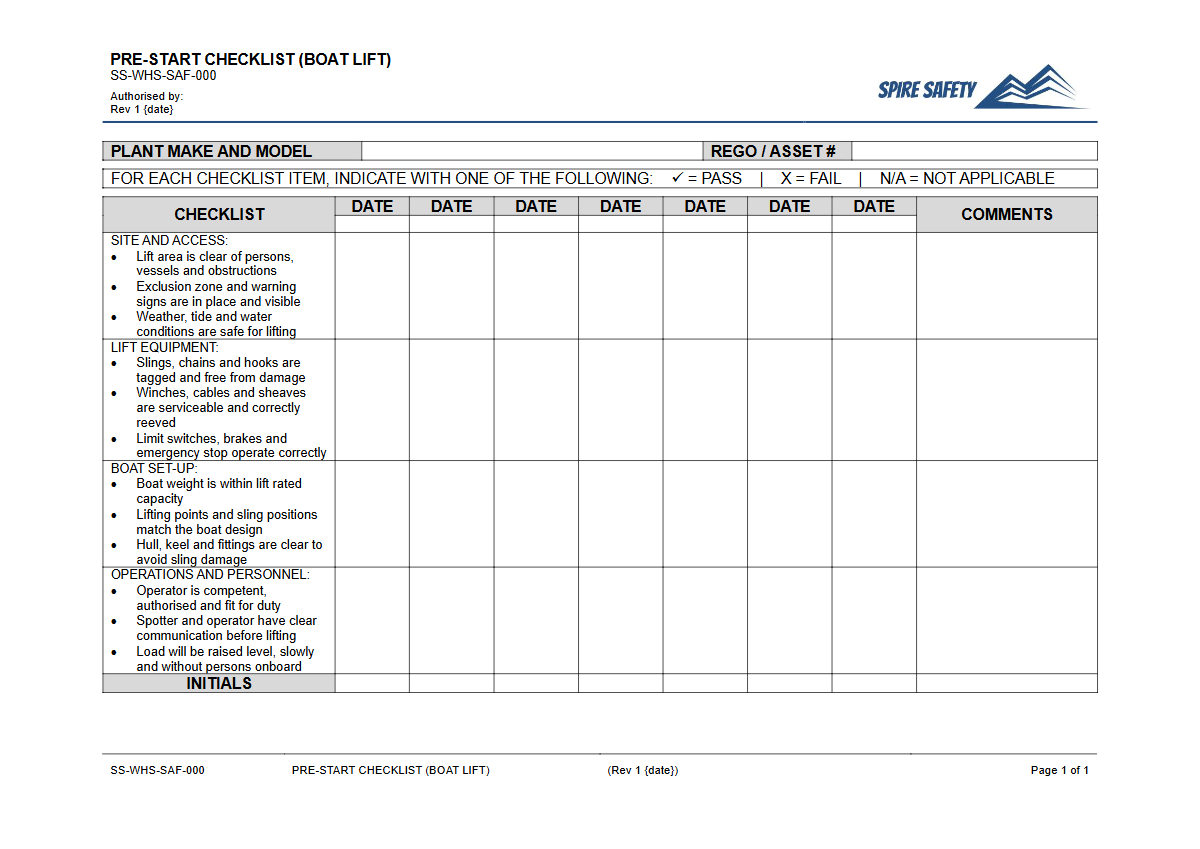
This Free Pre-Start Checklist (Boat Lift) Template provides a structured format for operators to conduct and record daily safety and operational checks before use. Using a checklist helps formalise the process, ensuring no critical components are overlooked.
It serves as a record of due diligence and demonstrates a commitment to proactive safety management.
Regularly completing these checks helps identify developing faults, such as corrosion, frayed cables, or hydraulic leaks, before they lead to catastrophic failure, equipment damage, or serious injury. This simple procedure is a critical part of maintaining a safe working environment in any marina, shipyard, or private facility that uses a boat lift.
Integrating such checks is a cornerstone of effective WHS management systems, reinforcing a safety-first culture among all personnel.
Video walkthrough
How to use the Free Pre-Start Checklist (Boat Lift) Template
This template is designed to be a practical tool for your business. It is provided in both DOCX and PDF formats for your convenience.
The DOCX file is fully editable, allowing you to tailor it to your specific operational needs. The process is straightforward:
- Download the template.
- Customise the checklist items to match the specific make, model, and configuration of your boat lift(s).
- Add your company branding and specific site information.
- Train all operators on how to properly complete the checklist and what actions to take if a fault is identified.
- Implement the checklist as a mandatory daily procedure for all boat lift operations.
IMPORTANT: Every workplace is unique. We provide this template as a starting point.
You must customise it to reflect the specific make and model of your boat lift, your marina's operating environment (e.g., saltwater vs. freshwater), and your organisation's specific safety procedures.
To support implementation, consider running a session with your team to explain the importance of these checks. Our Pre-Start Checks and Plant Maintenance Toolbox Talk template can provide a useful framework for this discussion.
When to use it
A pre-start check should be completed before the first use of the boat lift at the beginning of each day or shift. This ensures its condition has not changed overnight and it is safe for operation.
A check should also be conducted if the equipment has been idle for an extended period, or after it has undergone maintenance or repairs, to verify it has been returned to service in a safe condition. The frequency and triggers for these checks should be formally documented in your operational procedures, similar to how one might detail steps in a Scissor Lift SOP (Safe Operating Procedure) template.
Who should use it
The pre-start checklist must be completed by a person who is trained, competent, and authorised to operate the specific boat lift. This operator has the most direct responsibility for ensuring the equipment is safe before they use it.
Supervisors or managers should periodically review the completed checklists to ensure they are being filled out correctly and to identify any recurring maintenance issues that may require attention. Verifying operator competency is a key obligation for employers; for similar plant, a document like our free Scissor Lift VOC (Verification of Competency) template offers a structured way to formalise this assessment.
This pre-start checklist should also be integrated with your broader risk management documentation. For instance, completing the checklist can be listed as a key safety control in your risk assessments or a prerequisite step in a relevant task procedure.
This is often a critical component of a Safe Work Method Statement for scissor lift operations and similar high-risk tasks.
Ensuring these procedures are consistently followed is crucial for ongoing compliance and safety. A periodic review of completed checklists, maintenance logs, and operator training records is an essential part of the safety assurance process.
Many organisations engage external experts for WHS compliance auditing to get an independent assessment of how well their safety systems are functioning in practice.
Common mistakes
Common mistakes to avoid
- Pencil-whipping the form without physically inspecting the components.
- Ignoring minor issues like small hydraulic drips or surface rust, which can indicate larger problems.
- Failing to customise the generic checklist for the specific boat lift model and site conditions.
- Proceeding with a lift operation even after a potential fault has been noted on the checklist.
Legal references
Legal considerations
The following legal requirements may be relevant to this type of work.
- Work Health and Safety Act (Harmonised) — Provides the primary duties for protecting workers and other people from work health and safety risks.
- Work Health and Safety Regulations (Harmonised) — Sets out requirements supporting the management of workplace hazards and risks.
The following codes may be relevant to this type of work.
- Managing WHS Risks Code of Practice — Provides practical guidance on identifying hazards, assessing risks and applying effective controls.
- Work Health and Safety Consultation, Cooperation and Coordination Code of Practice — Provides practical guidance on consulting workers and coordinating with other duty holders.
- Managing the Work Environment and Facilities Code of Practice — Provides practical guidance on safe work environments, workplace facilities and related controls.
Did you know
Corrosion is Key
In saltwater environments, galvanic corrosion can severely compromise the structural integrity of a boat lift's metal components. Regular checks for corrosion, especially around welds and fasteners, are critical for preventing structural failure.
Hydraulic vs. Cable
Cable lift systems often show visible signs of wear like fraying strands before failure, which can be caught in a pre-start check. Hydraulic systems, however, can fail suddenly due to internal seal ruptures or hose bursts, making fluid level and leak checks paramount.
FAQ
Frequently asked questions
01Why are pre-start checks for boat lifts so important?
02What should happen if a fault is found during a boat lift pre-start check?
03How often should a boat lift pre-start check be performed?
04Does this template cover all specific models of boat lifts?
Share this resource
Free Pre-Start Checklist (Boat Lift) Template
Browse Categories
How To Use It
- 1Download and open in Word or PDF.
- 2Replace the placeholders with your business details.
- 3Get it reviewed by a WHS specialist before rollout.
Need it customised?
Our WHS consultants can adapt this template to your site, run a gap analysis, or audit what you already have in place.
Book a Free Consultation WHS consulting servicesor call 1300 156 382