
Safe Work Method Statement (Scissor Lift Operation) Template
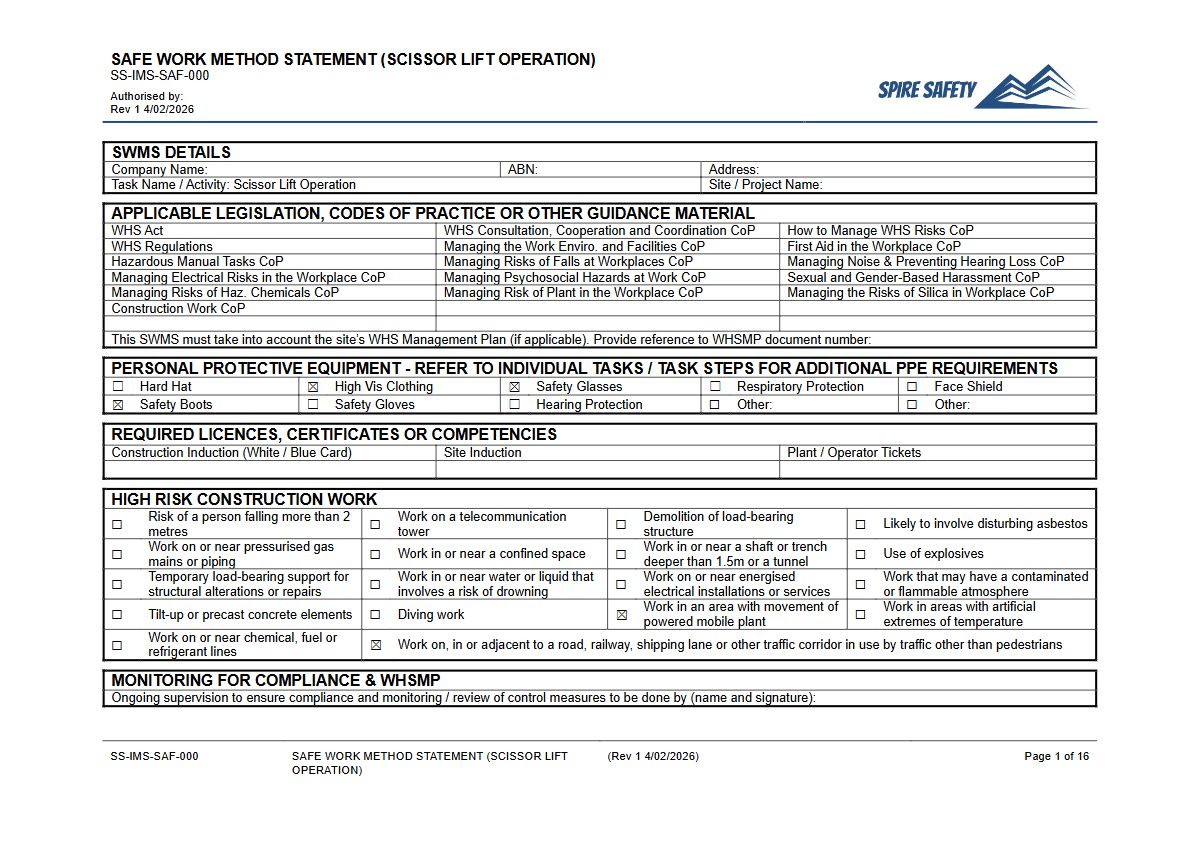
Download our free Safe Work Method Statement (SWMS) template for scissor lift operations. A structured starting point for managing WHS risks in your workplace.
Safe Work Method Statement (Scissor Lift Operation) Template
DOCX • 165 KB + PDF
Updated Oct 2026
No signup required
Purpose of the Safe Work Method Statement (Scissor Lift Operation) Template
This Safe Work Method Statement (Scissor Lift Operation) template provides a structured starting point for effectively managing work health and safety (WHS) risks associated with operating scissor lifts. It is designed to help persons conducting a business or undertaking (PCBUs) identify hazards, assess risks, and implement control measures to ensure the safety of workers and others in the vicinity of elevating work platforms.
Utilising a comprehensive SWMS for high-risk activities like operating scissor lifts is crucial for preventing incidents and demonstrating a proactive approach to safety management.
Our template assists in documenting the step-by-step process of scissor lift operations, from pre-start checks to emergency procedures, aligning with Australian WHS practice. This document aids in communicating safety requirements to all personnel involved, promoting a safer work environment for tasks performed at height.
Video walkthrough
How to use the Safe Work Method Statement (Scissor Lift Operation) Template
Our free Safe Work Method Statement (Scissor Lift Operation) template is available in both DOCX and PDF formats for your convenience. To effectively use this template, first download the DOCX version.
This allows you to customise all sections to reflect the specific hazards, risks, and control measures relevant to your workplace, specific scissor lift model, and the unique conditions of the job site. This template is a guide, and it must be customised to your workplace, specific tasks, and the plant you are operating.
We have pre-filled key sections common to most scissor lift operations, but you will need to add details such as site-specific controls, worker competencies, and emergency contact information. Ensure all workers involved in the task have been consulted and understand the SWMS before work commences.
Regularly review and update the SWMS to reflect any changes in work procedures, plant, or site conditions. For comprehensive guidance on managing WHS risks across your organisation, consider our WHS management systems consulting.
When to use it
A Safe Work Method Statement for scissor lift operation should be developed and implemented whenever work involving a scissor lift is classified as high-risk construction work, or whenever the PCBU determines that a SWMS is the best way to manage risks associated with the plant's operation. This includes tasks such as:
- Working near overhead power lines
- Operating on uneven or unstable ground
- Tasks involving lifting heavy materials
- Work performed in close proximity to other plant or structures
- Maintenance or repair work at height
Always ensure the SWMS is readily available at the work site and that all workers undertaking the task have access to and understand its contents before commencing operations.
Who should use it
This template is primarily for PCBUs, WHS managers, site supervisors, and project managers responsible for planning and overseeing tasks involving scissor lifts. It is also a valuable resource for WHS consultants and trainers who assist organisations in developing robust safety documentation.
Workers who operate scissor lifts should be familiar with the content of a SWMS to understand their responsibilities and the control measures in place.
Developing effective SWMS
Creating an effective Safe Work Method Statement requires a thorough understanding of WHS legislation, hazard identification, and risk control. Beyond simply filling out a template, it involves site-specific assessments, worker consultation, and ongoing review.
Our template simplifies the initial documentation, but the real work lies in its application and regular revision. Remember that a SWMS is a living document, critical for ongoing safety management.
Staying current with WHS obligations
WHS legislation and best practices evolve. Regular updates to your SWMS and other safety documentation are essential to ensure ongoing compliance and the effectiveness of your risk controls.
Explore our free WHS resources library for additional templates and guides, helping your organisation stay abreast of its safety obligations and foster a culture of continuous improvement in safety.
Common mistakes
Common mistakes to avoid
- Not customising the SWMS to the specific site and task, leading to generic and ineffective controls.
- Failing to review and update the SWMS when work conditions, plant, or personnel change.
- Not ensuring all workers involved in the task have read, understood, and signed the SWMS.
- Treating the SWMS as a bureaucratic formality rather than a dynamic safety planning tool.
Legal references
Legal considerations
The following legal requirements may be relevant to this type of work.
- Work Health and Safety Act (Harmonised) — Provides the primary duties for protecting workers and other people from work health and safety risks.
- Work Health and Safety Regulations (Harmonised) — Sets out requirements supporting the management of workplace hazards and risks.
The following codes may be relevant to this type of work.
- Managing WHS Risks Code of Practice — Provides practical guidance on identifying hazards, assessing risks and applying effective controls.
- Work Health and Safety Consultation, Cooperation and Coordination Code of Practice — Provides practical guidance on consulting workers and coordinating with other duty holders.
- Managing the Work Environment and Facilities Code of Practice — Provides practical guidance on safe work environments, workplace facilities and related controls.
Did you know
Frequent Fatalities and Seriouos Injuries
Falls from height, often involving elevated work platforms like scissor lifts, continue to be a leading cause of fatalities and serious injuries in Australian workplaces.
Mandatory Training
Operating a scissor lift requires specific training and a 'High Risk Work Licence' in Australia, depending on the type and height of the lift, to ensure operators are competent and safe.
FAQ
Frequently asked questions
01What is a Safe Work Method Statement (SWMS)?
02Is a SWMS legally required for all work involving scissor lifts?
03Who is responsible for preparing and reviewing a SWMS?
04Can I use this template for other types of elevated work platforms?
Share this resource
Safe Work Method Statement (Scissor Lift Operation) Template
Browse Categories
How To Use It
- 1Download and open in Word or PDF.
- 2Replace the placeholders with your business details.
- 3Get it reviewed by a WHS specialist before rollout.
Need it customised?
Our WHS consultants can adapt this template to your site, run a gap analysis, or audit what you already have in place.
Book a Free Consultation WHS consulting servicesor call 1300 156 382
Related templates
- Safe Work Method Statement (Scraper Operation) Template
- Safe Work Method Statement (Skid Steer Loader Operation) Template
- Safe Work Method Statement (Smooth Drum Roller Operation) Template
- Safe Work Method Statement (Telehandler Operation) Template
- Safe Work Method Statement (Tip Truck or Trailer Operation) Template
- Safe Work Method Statement (Truck and Dog Operation)