
Safe Work Method Statement (Truck and Dog Operation)
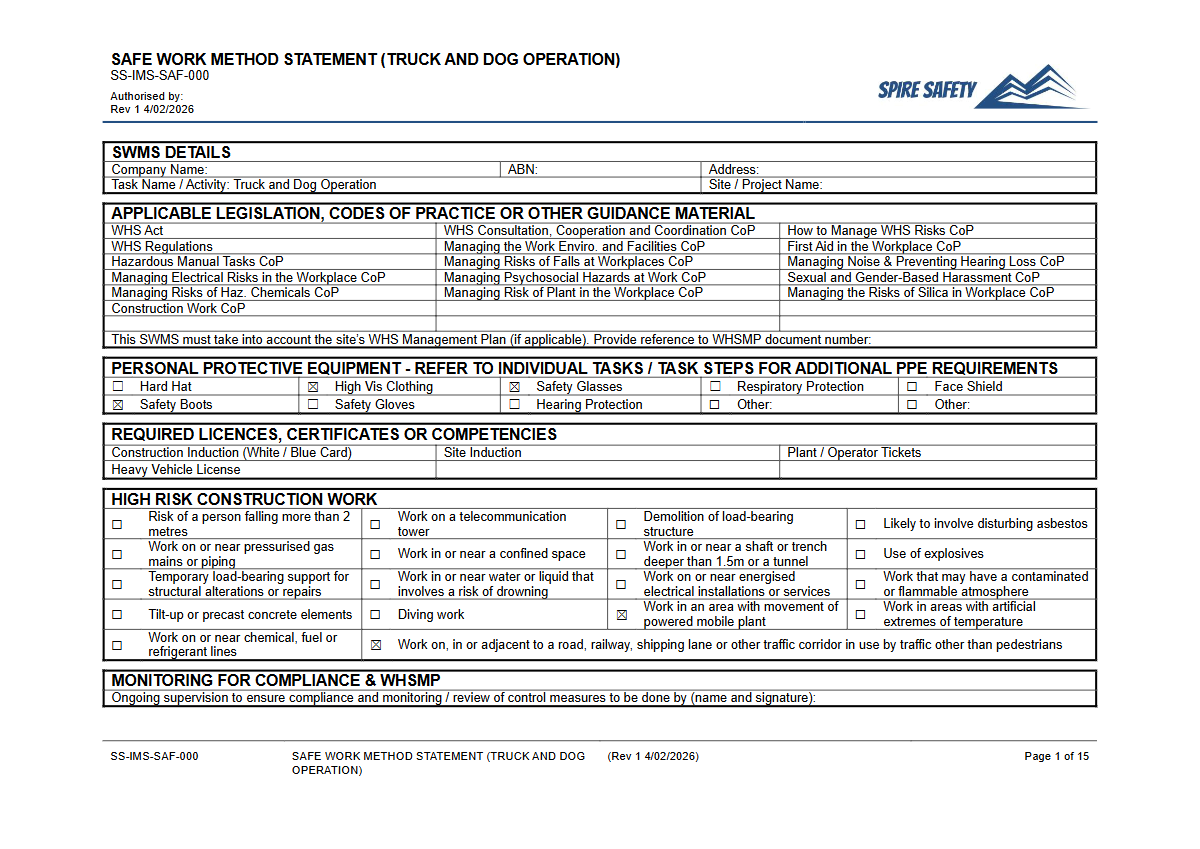
Download your free Safe Work Method Statement for Truck and Dog Operation. A structured starting point for managing WHS risks on your worksite.
Safe Work Method Statement (Truck and Dog Operation)
DOCX • 164 KB + PDF
Updated Oct 2026
No signup required
Purpose of the Safe Work Method Statement (Truck and Dog Operation)
A Safe Work Method Statement (SWMS) for Truck and Dog Operation outlines the high-risk construction work involved in operating 'truck and dog' trailer combinations and the control measures to manage associated risks. This document is crucial for ensuring the safety of workers, other road users, and the public during transportation, loading, unloading, and tipping operations.
It helps identify potential hazards such as vehicle rollovers, collisions, falls from height, and crushing injuries, detailing how these risks will be systematically controlled.
This free SWMS template from Spire Safety is designed to assist persons conducting a business or undertaking (PCBUs) in meeting their WHS obligations by providing a structured framework. It promotes a proactive approach to risk management, encouraging thorough planning and communication before work commences.
Utilising a comprehensive SWMS helps prevent incidents, minimise harm, and foster a safer working environment across all relevant operations.
Video walkthrough
How to use the Safe Work Method Statement (Truck and Dog Operation)
This Safe Work Method Statement (SWMS) for Truck and Dog Operation is a foundational document that must be customised to your specific workplace conditions, equipment, and tasks. It is designed to be a starting point, not a definitive solution. To effectively use this resource:
- Review and Adapt: Carefully read through each section, particularly the identified hazards and control measures. Modify them to accurately reflect the unique risks and operational procedures of your site and equipment.
- Consult Workers: Engage with your workers and their representatives who are involved in truck and dog operations. Their practical experience is invaluable in identifying hazards and developing effective controls. This consultation is a key aspect of effective WHS management systems.
- Add Site-Specific Details: Include details such as specific vehicle makes and models, site access restrictions, ground conditions, environmental factors (e.g., weather), and emergency procedures relevant to your operation.
- Specify Roles and Responsibilities: Clearly assign responsibilities for implementing and monitoring control measures to specific individuals or roles.
- Integration with Training: Use the SWMS as part of your worker induction and ongoing training programs. Ensure all relevant personnel understand its contents and their obligations.
- Regular Review: SWMS documents are not static. Review and update this document whenever there are changes to tasks, equipment, personnel, or site conditions, or after any incident.
When to use it
This Safe Work Method Statement should be used before commencing any high-risk construction work involving the operation of truck and dog combinations. This includes, but is not limited to, tasks such as transporting materials to and from construction sites, loading and unloading aggregates or other bulk materials, tipping operations, and manoeuvring in confined spaces.
It must be developed and implemented prior to any physical work occurring on site to ensure all risks are identified and controlled from the outset.
Who should use it
This SWMS is primarily intended for PCBUs, project managers, site supervisors, and WHS officers responsible for overseeing high-risk construction work involving truck and dog vehicles. It is also a critical document for truck drivers, plant operators, and other workers directly involved in these operations who need to understand the safe systems of work.
Furthermore, WHS consultants may find this a useful template when assisting clients with their WHS documentation, complementing broader WHS consulting services.
Key elements of a comprehensive SWMS
An effective Safe Work Method Statement goes beyond just listing hazards; it systematically addresses all aspects of safe work. Key elements include:
- Clearly defined scope of work.
- Identification of specific hazards associated with each step of the task.
- Detailed description of control measures to eliminate or minimise risks.
- Procedures for implementing and maintaining control measures.
- Responsibilities of various personnel involved.
- Provisions for monitoring and reviewing the effectiveness of controls.
- Emergency procedures relevant to the task.
Developing robust SWMS documents is a foundational component of effective WHS compliance. Explore our free WHS resources library for more valuable tools to support your safety management.
Common mistakes
Common mistakes to avoid
- Not customising the generic SWMS to specific site conditions and equipment.
- Failing to involve workers in the SWMS development and review process.
- Treating the SWMS as a 'tick-and-flick' exercise rather than a living safety document.
- Not adequately communicating the SWMS content to all workers involved in the task.
Legal references
Legal considerations
The following legal requirements may be relevant to this type of work.
- Work Health and Safety Act (Harmonised) — Provides the primary duties for protecting workers and other people from work health and safety risks.
- Work Health and Safety Regulations (Harmonised) — Sets out requirements supporting the management of workplace hazards and risks.
The following codes may be relevant to this type of work.
- Managing WHS Risks Code of Practice — Provides practical guidance on identifying hazards, assessing risks and applying effective controls.
- Work Health and Safety Consultation, Cooperation and Coordination Code of Practice — Provides practical guidance on consulting workers and coordinating with other duty holders.
- Managing the Work Environment and Facilities Code of Practice — Provides practical guidance on safe work environments, workplace facilities and related controls.
Did you know
Dog trailer design
The term 'dog' trailer comes from the fact that it 'follows' or 'dogs' behind the lead rigid truck, connected by a drawbar.
Truck and dog efficiency
Truck and dog combinations are a popular choice in Australia due to their high payload capacity and manoeuvrability, making them efficient for bulk haulage compared to other heavy vehicle configurations.
FAQ
Frequently asked questions
01What is a 'truck and dog' operation?
02Is a SWMS legally required for truck and dog operations in Australia?
03Who is responsible for developing and implementing a SWMS for truck and dog operations?
04How often should a Safe Work Method Statement be reviewed?
Share this resource
Safe Work Method Statement (Truck and Dog Operation)
Browse Categories
How To Use It
- 1Download and open in Word or PDF.
- 2Replace the placeholders with your business details.
- 3Get it reviewed by a WHS specialist before rollout.
Need it customised?
Our WHS consultants can adapt this template to your site, run a gap analysis, or audit what you already have in place.
Book a Free Consultation WHS consulting servicesor call 1300 156 382
Related templates
- Safe Work Method Statement (Truck and Float Operation) Template
- Safe Work Method Statement (Truck Operation)
- Safe Work Method Statement (Vacuum Truck Operation) Template
- Safe Work Method Statement (Vehicle Loading Crane Operation) Template
- Safe Work Method Statement (Water Cart Operation) Template
- Safe Work Method Statement (Wheel Loader Operation) Template