
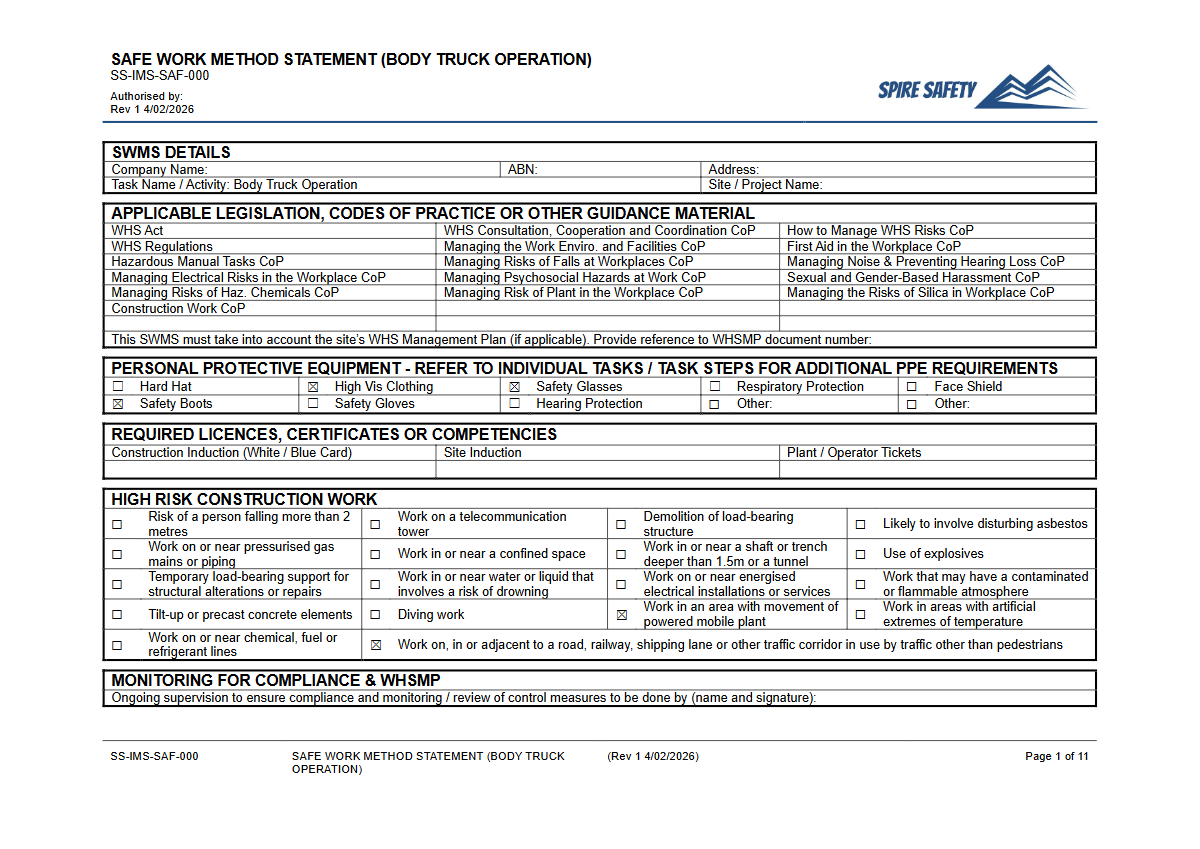
Safe Work Method Statement (Truck Operation)
Streamline your workplace safety with our Free Safe Work Method Statement for Truck Operation. Download your editable DOCX or PDF now.
Safe Work Method Statement (Truck Operation)
DOCX • 159 KB + PDF
Updated Oct 2026
No signup required
Purpose of this document
Our Safe Work Method Statement (SWMS) for Truck Operation provides a clear, systematic approach to identifying and controlling hazards associated with transporting goods by truck. This document supports organisations in meeting their WHS obligations by outlining required safety measures, procedures, and responsibilities before and during truck operations. It focuses on practical applications to minimise risks to drivers, other workers, and the public, ensuring a safer work environment.
Scope
This free WHS resource covers all essential aspects of truck operation, including pre-start checks, loading and unloading, on-road driving, site navigation, and maintenance considerations. It is designed to be comprehensive yet adaptable, allowing businesses to integrate it seamlessly into their existing WHS management systems.
Key Objectives
- To facilitate proactive hazard identification specific to truck operation.
- To detail effective risk control measures for all stages of truck use.
- To provide a framework for clear communication of safety procedures to all relevant personnel.
- To assist in demonstrating compliance with Australian WHS legislation.
- To promote a culture of safety and responsibility among truck operators and related staff.
Video walkthrough
How to use this Safe Work Method Statements (SWMS)
This Safe Work Method Statement for Truck Operation is a foundational template. It must be customised to your specific workplace, operational context, and the type of trucks and goods being transported. Start by thoroughly reviewing each section and updating it with details relevant to your organisation's unique risks, equipment, and procedures. This includes detailing specific truck models, routes, loading/unloading zones, and any specialised equipment or materials handled. Involve your truck operators and other relevant workers in the customisation process to ensure all potential hazards are identified and controls are practical and effective. Once customised, ensure all workers involved in truck operations are trained on its contents and understand their responsibilities.
Customisation Steps
- Review and Localise: Replace generic information with your company's specifics, including site addresses, contact details, and emergency procedures.
- Hazard Identification: Conduct a site-specific risk assessment for each truck operation task. Identify all potential hazards not already listed.
- Control Measures: For each identified hazard, specify the control measures implemented in your workplace. Prioritise controls using the hierarchy of controls (elimination, substitution, engineering, administrative, PPE).
- Roles and Responsibilities: Clearly assign responsibilities for implementing and monitoring controls to specific individuals or roles.
- Consultation: Engage with your workers. Their practical experience is invaluable for identifying unforeseen hazards and suggesting effective control measures.
- Training and Communication: Once finalised, brief all operators and relevant personnel on the customised SWMS. Ensure understanding and adherence.
- Review and Update: Regularly review the SWMS, especially after incidents, changes in equipment or procedures, or new safety information becomes available.
When to use it
This Safe Work Method Statement (SWMS) for Truck Operation should be used before commencing any new truck operation activities, when introducing new types of trucks or goods, after any incident involving truck operations, or when there are changes in work procedures or the work environment. It's also critical to review and reissue the SWMS periodically as part of your ongoing WHS management. Regular use ensures that safety remains a continuous priority and that all personnel are consistently aware of the established safe work practices.
Who should use it
- PCBU (Person Conducting a Business or Undertaking): To ensure compliance with WHS legislation and provide a safe system of work.
- Truck Operators/Drivers: As a clear guide for safe operation and their responsibilities.
- Supervisors and Managers: For overseeing safe truck operations, training, and incident management.
- WHS Officers/Coordinators: For developing, implementing, and reviewing WHS documentation and procedures.
- Loading/Unloading Staff: To understand their role in safe interaction with trucks during material handling.
- Any Worker Interacting with Trucks: To be aware of exclusion zones and safe interaction protocols.
Common mistakes
Common mistakes to avoid
- Using a generic SWMS without customising it for specific site conditions or truck types.
- Failing to involve workers in the development and review of the SWMS.
- Not regularly reviewing and updating the SWMS after incidents or changes in procedures.
- Treating the SWMS as a paperwork exercise rather than a living safety document.
Legal references
Legal considerations
The following legal requirements may be relevant to this type of work.
- Work Health and Safety Act (Harmonised) — Provides the primary duties for protecting workers and other people from work health and safety risks.
- Work Health and Safety Regulations (Harmonised) — Sets out requirements supporting the management of workplace hazards and risks.
The following codes may be relevant to this type of work.
- Managing WHS Risks Code of Practice — Provides practical guidance on identifying hazards, assessing risks and applying effective controls.
- Work Health and Safety Consultation, Cooperation and Coordination Code of Practice — Provides practical guidance on consulting workers and coordinating with other duty holders.
- Managing the Work Environment and Facilities Code of Practice — Provides practical guidance on safe work environments, workplace facilities and related controls.
Did you know
Truck Rollovers
Around 8% of all truck crashes in Australia involve a rollover, often due to excessive speed for conditions, improper load distribution, or sharp turns.
Fatigue is a Major Factor
Fatigue contributes to approximately 20-30% of all road fatalities in Australia, with truck drivers being particularly susceptible due to long hours and demanding schedules.
FAQ
Frequently asked questions
01What is a Safe Work Method Statement (SWMS)?
02Is a SWMS legally required for all truck operations in Australia?
03How often should a SWMS for truck operation be reviewed?
04Can I use this SWMS template without customising it?
Share this resource
Safe Work Method Statement (Truck Operation)
Browse Categories
How To Use It
- 1Download and open in Word or PDF.
- 2Replace the placeholders with your business details.
- 3Get it reviewed by a WHS specialist before rollout.
Need it customised?
Our WHS consultants can adapt this template to your site, run a gap analysis, or audit what you already have in place.
Book a Free Consultation WHS consulting servicesor call 1300 156 382
Related templates
- Safe Work Method Statement (Vacuum Truck Operation) Template
- Safe Work Method Statement (Vehicle Loading Crane Operation) Template
- Safe Work Method Statement (Water Cart Operation) Template
- Safe Work Method Statement (Wheel Loader Operation) Template
- Free Angle Grinder SWMS (Safe Work Method Statement) Template
- Free Belt Sander SWMS (Safe Work Method Statement) Template