
Safe Work Method Statement (Vacuum Truck Operation) Template
Download our free Safe Work Method Statement (SWMS) template for vacuum truck operations. A structured starting point for managing WHS risks.
Safe Work Method Statement (Vacuum Truck Operation) Template
DOCX • 162 KB + PDF
Updated Oct 2026
No signup required
Purpose of the Safe Work Method Statement (Vacuum Truck Operation) Template
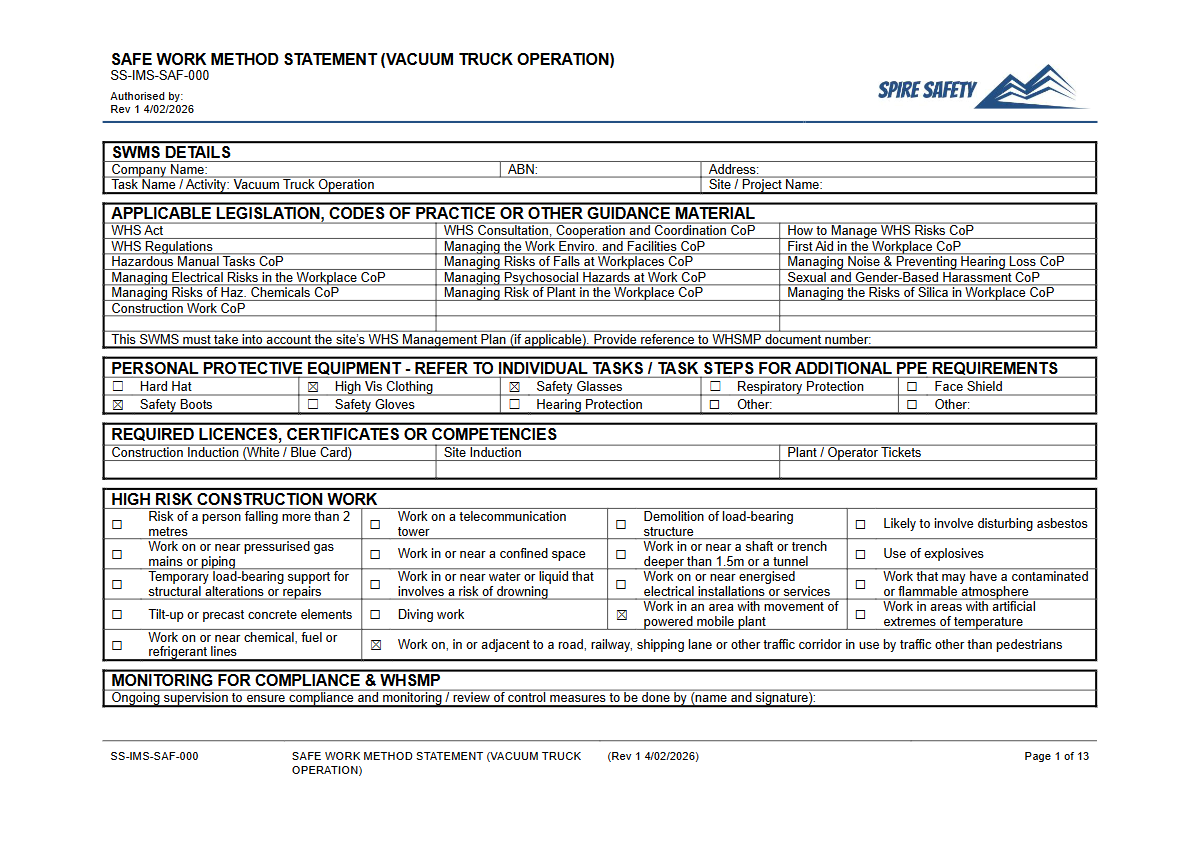
This free WHS resource provides a structured Safe Work Method Statement (SWMS) template for vacuum truck operations. It is designed to assist persons conducting a business or undertaking (PCBUs) in identifying high-risk construction work (HRCW) activities associated with vacuum truck use and outlining the control measures required to manage related WHS risks.
This template serves as a foundational document for developing site-specific procedures that align with Australian WHS practice, helping to ensure the safety of workers and others who may be affected by these operations. The template prompts users to consider hazards such as vehicle movement, high-pressure water, confined spaces, hazardous chemicals, and plant maintenance, facilitating a proactive approach to risk management.
A well-prepared Safe Work Method Statement (Vacuum Truck Operation) is crucial for any workplace where these vehicles are used. It promotes a systematic approach to identifying potential hazards, assessing risks, and implementing effective control measures.
This not only helps prevent incidents and injuries but also demonstrates a commitment to worker welfare and regulatory compliance. Regular review and updating of SWMS are essential to maintain their effectiveness, particularly with changes in equipment, processes, or site conditions.
Video walkthrough
How to use the Safe Work Method Statement (Vacuum Truck Operation) Template
Our Safe Work Method Statement (Vacuum Truck Operation) template is provided in both DOCX and PDF formats for ease of access and customisation. The DOCX version allows you to directly edit and adapt the content to suit your specific workplace, vacuum truck models, and operational context.
It includes pre-filled sections for common hazards and control measures, which you must review, verify, and modify to accurately reflect your activities. Remember, this template is a starting point; it must be customised to your workplace, specific tasks, and site conditions.
Blanket application without thorough customisation is not recommended and does not fulfil your WHS obligations.
Begin by clearly defining the scope of the vacuum truck operation within your workplace. Identify all tasks performed, from pre-start checks to clean-up.
For each task, list potential hazards and then detail the specific control measures in place, following the hierarchy of controls where practicable. Assign responsibilities, allocate resources, and ensure all workers involved are trained and understand the SWMS.
Regular supervision and monitoring are vital to ensure control measures are implemented effectively.
When to use it
You should use this Safe Work Method Statement template whenever high-risk construction work involving vacuum truck operations is undertaken. This includes tasks such as excavation, material handling, utility locating, pipeline cleaning, and any other activity where the vacuum truck's functions pose significant risks to health and safety.
The SWMS must be developed before the work commences and be available to all workers involved in the activity. It is particularly important for projects classified as high-risk construction work under the WHS Regulations.
Who should use it
This template is primarily for PCBUs, WHS managers, supervisors, and project managers responsible for planning and overseeing vacuum truck operations. Workers involved in these tasks should also be familiar with the SWMS and actively participate in its development and review, providing valuable on-the-ground insights.
If you need assistance in developing or implementing comprehensive WHS management systems that integrate SWMS effectively, Spire Safety can provide expert guidance.
Elements of an effective SWMS
- Clear description of the high-risk construction work.
- Identification of specific hazards associated with the work.
- Detailed control measures, following the hierarchy of controls.
- Allocation of roles and responsibilities for implementing control measures.
- Procedures for monitoring worker compliance with control measures.
- Requirements for training, supervision, and consultation.
- Provisions for reviewing and updating the SWMS.
Review and revision
An SWMS is a living document and must be reviewed and revised whenever there is a change in the work methods, plant, or environment. This includes new equipment, altered site conditions, or an incident or near-miss.
Regular reviews, even without specific triggers, ensure the document remains relevant and effective in managing risks. Involving workers in the review process can significantly enhance its practical application and effectiveness, fostering a strong safety culture.
Common mistakes
Common mistakes to avoid
- Using a generic SWMS without customising it for specific site conditions and tasks.
- Failing to involve workers who perform the tasks in the SWMS development and review process.
- Not regularly reviewing and updating the SWMS when changes occur, rendering it obsolete.
- Treating the SWMS as a paperwork exercise rather than a practical tool for risk management.
Legal references
Legal considerations
The following legal requirements may be relevant to this type of work.
- Work Health and Safety Act (Harmonised) — Provides the primary duties for protecting workers and other people from work health and safety risks.
- Work Health and Safety Regulations (Harmonised) — Sets out requirements supporting the management of workplace hazards and risks.
The following codes may be relevant to this type of work.
- Managing WHS Risks Code of Practice — Provides practical guidance on identifying hazards, assessing risks and applying effective controls.
- Work Health and Safety Consultation, Cooperation and Coordination Code of Practice — Provides practical guidance on consulting workers and coordinating with other duty holders.
- Managing the Work Environment and Facilities Code of Practice — Provides practical guidance on safe work environments, workplace facilities and related controls.
Did you know
Vacuum Trucks and Confined Spaces
Many vacuum truck operations occur in conjunction with confined space entry, which is one of the highest-risk activities in construction and maintenance work. This requires stringent safety protocols and specific SWMS elements.
Noise Hazard
The powerful vacuum systems on these trucks often generate significant noise levels, which can pose a hearing risk if not properly managed through controls like hearing protection and noise reduction strategies.
FAQ
Frequently asked questions
01What is high-risk construction work (HRCW) in relation to vacuum trucks?
02Is an SWMS legally required for all vacuum truck operations?
03How often should a vacuum truck SWMS be reviewed?
04Can this template be used across different Australian states?
Share this resource
Safe Work Method Statement (Vacuum Truck Operation) Template
Browse Categories
How To Use It
- 1Download and open in Word or PDF.
- 2Replace the placeholders with your business details.
- 3Get it reviewed by a WHS specialist before rollout.
Need it customised?
Our WHS consultants can adapt this template to your site, run a gap analysis, or audit what you already have in place.
Book a Free Consultation WHS consulting servicesor call 1300 156 382
Related templates
- Safe Work Method Statement (Vehicle Loading Crane Operation) Template
- Safe Work Method Statement (Water Cart Operation) Template
- Safe Work Method Statement (Wheel Loader Operation) Template
- Free Angle Grinder SWMS (Safe Work Method Statement) Template
- Free Belt Sander SWMS (Safe Work Method Statement) Template
- Free Bricklaying SWMS (Safe Work Method Statement) Template