
Safe Work Method Statement (Vehicle Loading Crane Operation) Template
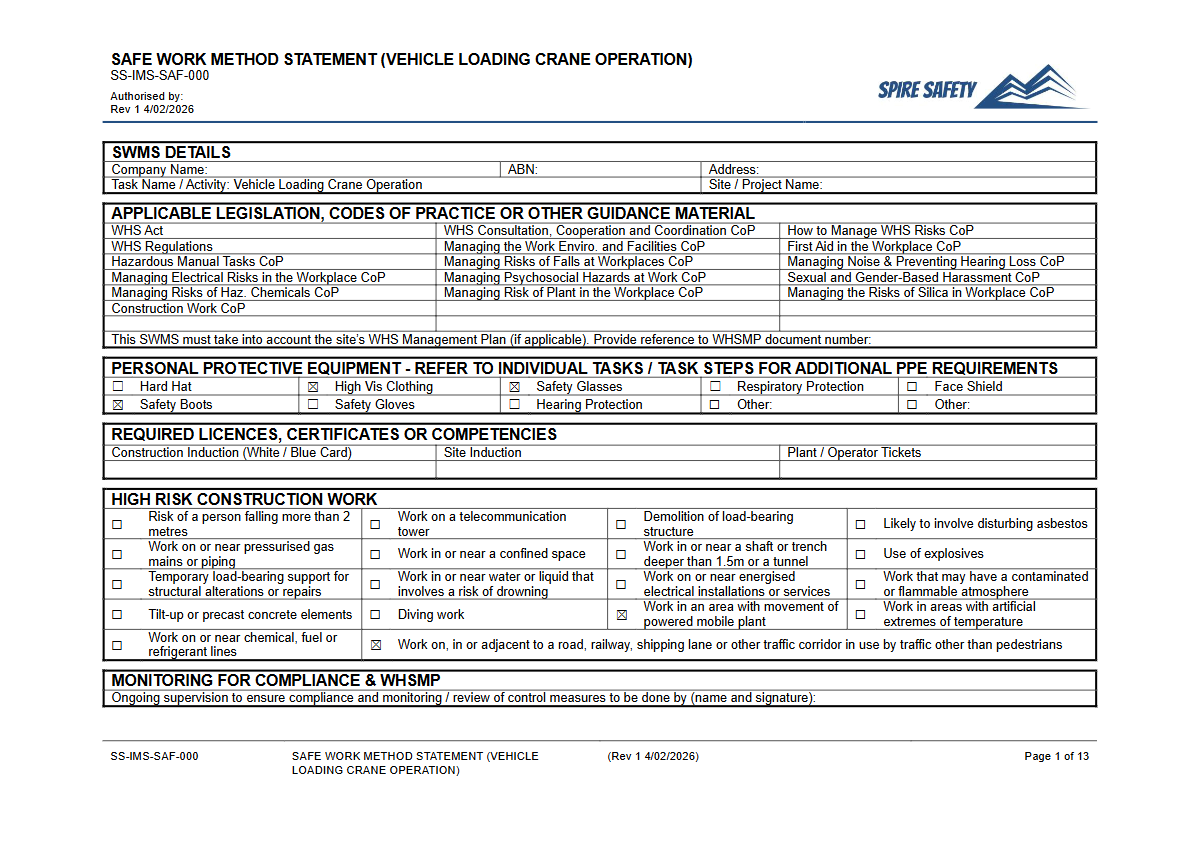
Download our free Safe Work Method Statement (Vehicle Loading Crane Operation) template. A structured starting point for your WHS documentation requirements.
Safe Work Method Statement (Vehicle Loading Crane Operation) Template
DOCX • 162 KB + PDF
Updated Oct 2026
No signup required
Purpose of the Safe Work Method Statement (Vehicle Loading Crane Operation) Template
Our Safe Work Method Statement (Vehicle Loading Crane Operation) template provides a structured starting point for developing site-specific documentation for these high-risk activities. Vehicle loading cranes, commonly used across industries for lifting and moving materials, present significant hazards if not operated correctly.
This template assists in outlining the necessary steps and control measures to manage risks associated with their use, helping to ensure the safety of workers and others on site.
Developing a comprehensive SWMS is a key component of effective WHS management systems, especially when undertaking high-risk construction work as defined by WHS Regulations. This template aims to streamline the process of identifying hazards, assessing risks, and implementing suitable controls specific to vehicle loading crane operations.
Video walkthrough
How to use the Safe Work Method Statement (Vehicle Loading Crane Operation) Template
This Safe Work Method Statement (Vehicle Loading Crane Operation) template is designed to be a foundation, not a final document. It is crucial that you customise this template to reflect the specific hazards, risks, control measures, and work procedures of your unique workplace and the tasks being performed.
Your SWMS must be specific to your site, equipment, and personnel. I cannot stress enough that this is a template; it must be customised to your workplace conditions and activities.
Steps for customisation:
- Review and Identify: Carefully review the pre-filled sections and identify any additional hazards present at your worksite relevant to vehicle loading crane operations.
- Risk Assessment: Assess the risks associated with identified hazards, considering the likelihood and potential consequences.
- Control Measures: Detail the specific control measures you will implement, following the hierarchy of controls (elimination, substitution, engineering controls, administrative controls, and personal protective equipment).
- Consultation: Consult with workers who will be performing the task to ensure the SWMS is realistic, practical, and effective. Worker input is invaluable for identifying unforeseen risks and fostering a safety-conscious culture.
- Training and Instruction: Ensure all workers involved are properly trained and instructed on the SWMS and the safe operating procedures.
- Review: Establish a process for regularly reviewing and, if necessary, revising the SWMS, especially when there are changes to work practices, equipment, or site conditions. For assistance with this, consider our WHS compliance auditing services.
When to use it
A Safe Work Method Statement (SWMS) for vehicle loading crane operation must be prepared before any high-risk construction work involving these cranes commences. It is required when the operation falls under the definition of high-risk construction work. This includes tasks such as:
- Loading or unloading materials with a vehicle loading crane.
- Any work where there is a risk of a person falling from one level to another (e.g., when accessing parts of the crane or loads at height).
- Work carried out in, on, or near energised electrical installations or services.
- Work carried out in an area that may have a contaminated atmosphere.
It acts as a critical planning tool ensuring that identified risks are controlled before work begins and throughout its duration.
Who should use it
This template is primarily for persons conducting a business or undertaking (PCBU) who are responsible for ensuring workplace safety, particularly those involved in:
- Construction companies.
- Transport and logistics providers.
- Utility providers.
- Equipment hire companies.
- Site supervisors, project managers, and WHS officers.
It provides a framework for these individuals and organisations to document their commitment to managing risks associated with high-risk work activities. Workers involved in the operation of vehicle loading cranes will also be instructed in and follow the procedures outlined in the completed SWMS.
Key components of a Vehicle Loading Crane SWMS
A robust SWMS for vehicle loading crane operations should cover several critical areas to ensure comprehensive risk management. This typically includes:
- Task Description: A clear outline of the work to be performed, including specific steps.
- Hazard Identification: Listing all potential hazards associated with the task, such as vehicle instability, overhead power lines, falling objects, or pinch points.
- Risk Assessment: An evaluation of the level of risk posed by each identified hazard.
- Control Measures: Detailed descriptions of the control measures to be implemented to eliminate or minimise each risk, including administrative controls, engineering controls, and the use of personal protective equipment (PPE).
- Responsibilities: Clearly defined roles and responsibilities for workers and supervisors.
- Emergency Procedures: Protocols for responding to incidents or emergencies during crane operation.
- Review and Sign-off: Sections for worker acknowledgement and management approval, indicating understanding and commitment to follow the SWMS.
These components collectively form a comprehensive plan to execute vehicle loading crane operations safely. Explore more resources in our free WHS resources library.
Common mistakes
Common mistakes to avoid
- Using a generic SWMS without customising it to specific site conditions and tasks.
- Failing to adequately consult with workers involved in the high-risk work during SWMS development.
- Not reviewing and updating the SWMS when work procedures or site conditions change.
- Inadequate communication and instruction of the SWMS to all workers before work begins.
Legal references
Legal considerations
The following legal requirements may be relevant to this type of work.
- Work Health and Safety Act (Harmonised) — Provides the primary duties for protecting workers and other people from work health and safety risks.
- Work Health and Safety Regulations (Harmonised) — Sets out requirements supporting the management of workplace hazards and risks.
The following codes may be relevant to this type of work.
- Managing WHS Risks Code of Practice — Provides practical guidance on identifying hazards, assessing risks and applying effective controls.
- Work Health and Safety Consultation, Cooperation and Coordination Code of Practice — Provides practical guidance on consulting workers and coordinating with other duty holders.
- Managing the Work Environment and Facilities Code of Practice — Provides practical guidance on safe work environments, workplace facilities and related controls.
Did you know
Crane Incident Statistics
WorkSafe Victoria's 2022 annual report noted 53 total lost time injury claims related to cranes and hoists, highlighting the ongoing risks associated with lifting equipment.
Hierarchy of Controls
The WHS Regulations mandate the application of the hierarchy of control measures to manage risks, starting with elimination, then substitution, engineering controls, administrative controls, and finally personal protective equipment (PPE).
FAQ
Frequently asked questions
01What is the primary purpose of a Safe Work Method Statement (SWMS)?
02Is a SWMS legally required for all work involving vehicle loading cranes?
03Who is responsible for developing and implementing a SWMS?
04How often should a Vehicle Loading Crane SWMS be reviewed?
Share this resource
Safe Work Method Statement (Vehicle Loading Crane Operation) Template
Browse Categories
How To Use It
- 1Download and open in Word or PDF.
- 2Replace the placeholders with your business details.
- 3Get it reviewed by a WHS specialist before rollout.
Need it customised?
Our WHS consultants can adapt this template to your site, run a gap analysis, or audit what you already have in place.
Book a Free Consultation WHS consulting servicesor call 1300 156 382
Related templates
- Safe Work Method Statement (Water Cart Operation) Template
- Safe Work Method Statement (Wheel Loader Operation) Template
- Free Angle Grinder SWMS (Safe Work Method Statement) Template
- Free Belt Sander SWMS (Safe Work Method Statement) Template
- Free Bricklaying SWMS (Safe Work Method Statement) Template
- Free Building SWMS (Safe Work Method Statement) Template