
Safe Work Method Statement (Scraper Operation) Template
Download a free Safe Work Method Statement (SWMS) template for scraper operation. A structured starting point for managing WHS risks. Get yours today!
Safe Work Method Statement (Scraper Operation) Template
DOCX • 159 KB + PDF
Updated Oct 2026
No signup required
Purpose of the Safe Work Method Statement (Scraper Operation) Template
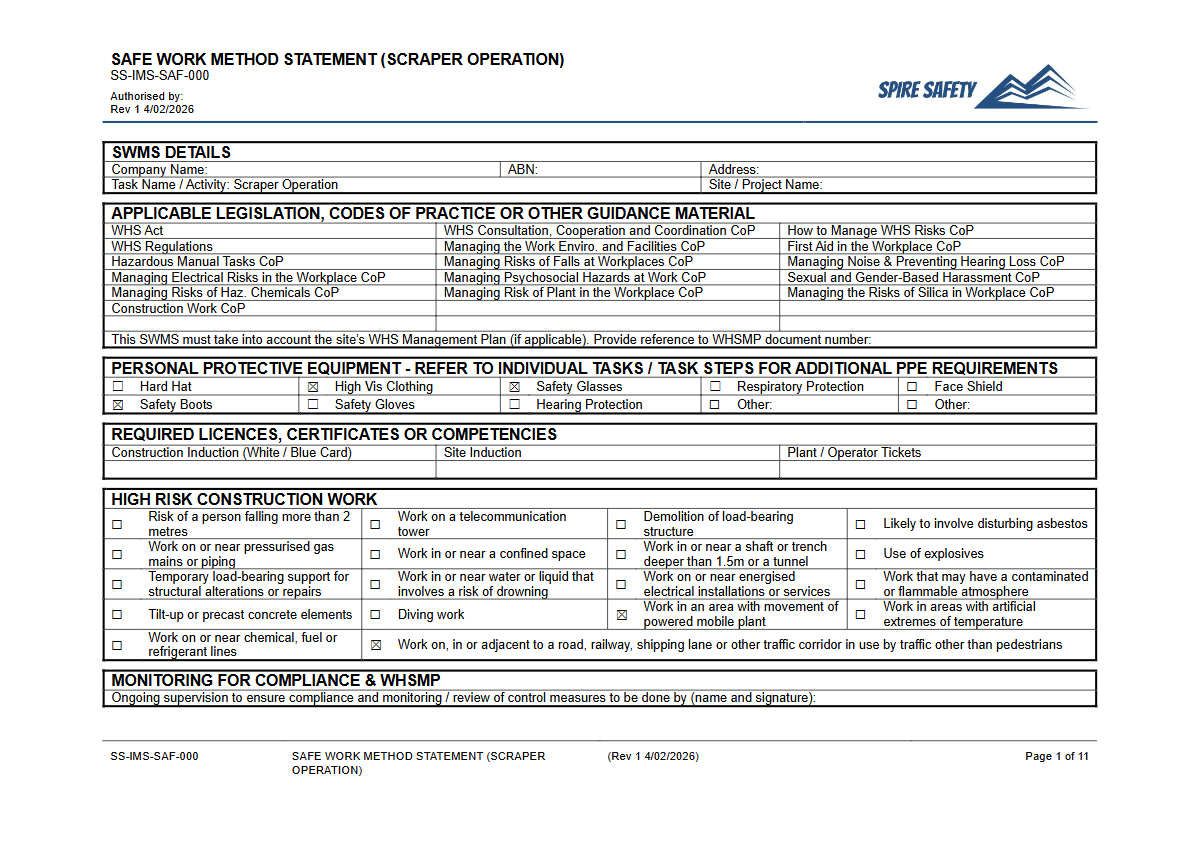
This Safe Work Method Statement (SWMS) template for scraper operation provides a structured approach to identifying and controlling hazards associated with operating earthmoving scrapers. It serves as a foundational document for organisations to develop site-specific procedures, helping to ensure the health and safety of workers involved in these high-risk activities.
By systematically outlining the work steps, potential hazards, and control measures, this template assists in fulfilling duties under Australian WHS laws to manage risks effectively.
Using a pre-formatted template like this can significantly streamline the process of developing a robust SWMS, ensuring that key considerations are not overlooked. It is aligned with Australian WHS practice and based on the model WHS framework for managing risks associated with plant and high-risk construction work.
Video walkthrough
How to use the Safe Work Method Statement (Scraper Operation) Template
Our free Safe Work Method Statement (Scraper Operation) Template is provided in an editable DOCX format, making it easy to adapt to your specific workplace conditions and operational requirements. To effectively use this template, you must:
- Customise it: This template is a starting point; it must be customised to your workplace, specific scraper models, site conditions, personnel, and identified hazards. Generic sections should be replaced with detailed information pertinent to your operations.
- Conduct a site-specific risk assessment: Before finalising your SWMS, conduct a thorough risk assessment on your particular work site. Identify all hazards unique to your environment and integrate appropriate control measures.
- Consult with workers: Engage your workers and relevant health and safety representatives throughout the customisation process. Their practical knowledge is invaluable for identifying hazards and developing effective control measures.
- Implement control measures: Ensure all identified control measures are put into practice and effectively maintained.
- Review and revise: Regularly review the SWMS, especially after incidents, near misses, or changes to plant, procedures, or the work environment.
For guidance on developing comprehensive WHS management systems that integrate SWMS and other crucial safety documentation, consider exploring Spire Safety's WHS management systems services.
When to use it
A Safe Work Method Statement for scraper operation is mandatory for any work involving the use of scrapers that falls under the definition of 'high-risk construction work' in Australia. This includes, but is not limited to, excavation work, work in an area where there is movement of earth, and the use of powered mobile plant.
It should be completed before any high-risk construction work commences and must be readily available at the worksite. This template is ideal for project managers, health and safety officers, site supervisors, and anyone responsible for planning or conducting earthmoving activities with scrapers.
Who should use it
This template is primarily intended for persons conducting a business or undertaking (PCBUs), site supervisors, WHS managers, and project managers responsible for earthmoving operations involving scrapers. It is also a valuable resource for WHS consultants, trainers, and workers seeking to understand the safety requirements for scraper operation.
Organisations striving for robust WHS frameworks or seeking ISO 45001 consulting will find this a useful component in their documentation suite.
Developing effective control measures
Developing effective control measures is central to any SWMS. For scraper operation, this involves anticipating hazards such as rollovers, collisions, falls from height during maintenance, exposure to dust and noise, contact with underground services, and proximity to overhead powerlines.
Control measures should follow the hierarchy of controls, prioritising elimination and substitution where possible, followed by engineering controls, administrative controls, and finally, personal protective equipment (PPE). Regular WHS compliance auditing can help verify the effectiveness of these controls.
Maintaining your SWMS
Once developed and implemented, a SWMS is not a static document. It requires ongoing maintenance and review to remain effective.
Any changes to the work environment, equipment, personnel, or observed incidents necessitate an immediate review and update of the SWMS. Regular consultation with workers about the SWMS's practical application on site is also crucial for its continued relevance and effectiveness.
Common mistakes
Common mistakes to avoid
- Not customising the generic template to specific site conditions or equipment.
- Failing to adequately consult with workers who will be performing the scraper operations.
- Treating the SWMS as a 'tick-box' exercise rather than a dynamic working document.
- Not reviewing and updating the SWMS after incidents, near misses, or changes to work processes.
Legal references
Legal considerations
The following legal requirements may be relevant to this type of work.
- Work Health and Safety Act (Harmonised) — Provides the primary duties for protecting workers and other people from work health and safety risks.
- Work Health and Safety Regulations (Harmonised) — Sets out requirements supporting the management of workplace hazards and risks.
The following codes may be relevant to this type of work.
- Managing WHS Risks Code of Practice — Provides practical guidance on identifying hazards, assessing risks and applying effective controls.
- Work Health and Safety Consultation, Cooperation and Coordination Code of Practice — Provides practical guidance on consulting workers and coordinating with other duty holders.
- Managing the Work Environment and Facilities Code of Practice — Provides practical guidance on safe work environments, workplace facilities and related controls.
Did you know
Historical Context
The earliest forms of scraper-like earthmoving equipment date back thousands of years, originally pulled by animals, demonstrating a long history of moving earth for construction and agriculture.
Modern Scraper Capacity
Some of the largest modern motor scrapers can have an heaped capacity exceeding 60 cubic metres, capable of moving vast quantities of material quickly on large-scale projects.
FAQ
Frequently asked questions
01What specifically is 'high-risk construction work' concerning scraper operations?
02Does this template make my business compliant with WHS laws?
03What is the primary benefit of using a SWMS template for scraper operations?
04Who needs to approve a completed Safe Work Method Statement?
Share this resource
Safe Work Method Statement (Scraper Operation) Template
Browse Categories
How To Use It
- 1Download and open in Word or PDF.
- 2Replace the placeholders with your business details.
- 3Get it reviewed by a WHS specialist before rollout.
Need it customised?
Our WHS consultants can adapt this template to your site, run a gap analysis, or audit what you already have in place.
Book a Free Consultation WHS consulting servicesor call 1300 156 382
Related templates
- Safe Work Method Statement (Skid Steer Loader Operation) Template
- Safe Work Method Statement (Smooth Drum Roller Operation) Template
- Safe Work Method Statement (Telehandler Operation) Template
- Safe Work Method Statement (Tip Truck or Trailer Operation) Template
- Safe Work Method Statement (Truck and Dog Operation)
- Safe Work Method Statement (Truck and Float Operation) Template