
Safe Work Method Statement (Skid Steer Loader Operation) Template
Download our free Safe Work Method Statement (SWMS) template for skid steer loader operation. A structured starting point for Australian WHS.
Safe Work Method Statement (Skid Steer Loader Operation) Template
DOCX • 159 KB + PDF
Updated Oct 2026
No signup required
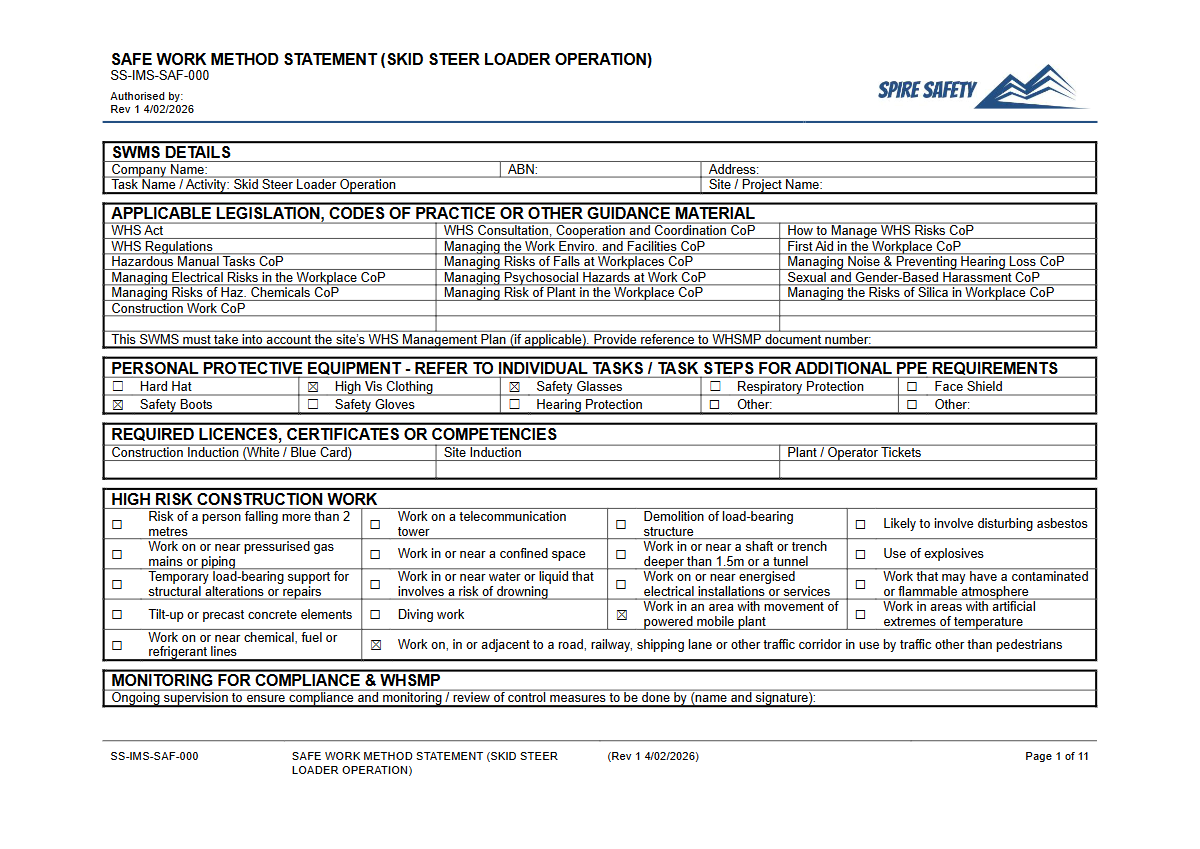
Purpose of the Safe Work Method Statement (Skid Steer Loader Operation) Template
Our Safe Work Method Statement (SWMS) for skid steer loader operation provides a structured framework to identify high-risk construction work activities and the hazards associated with operating skid steer loaders on your site. This template assists in planning and documenting the control measures required to manage those risks effectively, ensuring the safety of workers and others involved.
Developing a comprehensive SWMS is a critical part of a proactive approach to WHS. This template is designed to help organisations meet their duty to document safe work practices for high-risk activities, in line with Australian WHS practice.
It promotes a systematic approach to risk management, encouraging thorough consideration of each step involved in skid steer loader operations.
Video walkthrough
How to use the Safe Work Method Statement (Skid Steer Loader Operation) Template
This free Safe Work Method Statement (SWMS) for skid steer loader operation is provided as a DOCX and PDF download, offering a flexible starting point for your WHS documentation. To use it effectively, follow these steps:
- Download and Review: Obtain the DOCX version to enable editing. Read through the entire document to familiarise yourself with its structure and content regarding skid steer loader operations.
- Customise to Your Workplace: This template is a general guide. It must be customised to reflect the specific hazards, risks, controls, plant, personnel, and site conditions relevant to your unique work environment and the particular tasks involving skid steer loaders. You will need to add your company details, project specifics, and adjust the identified hazards and control measures accordingly.
- Consult with Workers: Engage with your workers who operate or are affected by skid steer loader operations. Their input is invaluable for identifying practical hazards and effective control measures, fostering a collaborative safety culture.
- Implement and Communicate: Once completed, ensure all workers involved in or affected by skid steer loader operations are trained and understand the SWMS. Make it readily available on-site.
- Monitor and Review: Regularly monitor the effectiveness of the control measures outlined in the SWMS. Review and update the document whenever there are changes to the work, plant, personnel, or if an incident occurs. This ensures continuous improvement of your WHS management system. For assistance with reviewing your overall safety procedures, consider our WHS compliance auditing services.
When to use it
A Safe Work Method Statement (SWMS) for skid steer loader operation should be developed and implemented before any high-risk construction work involving these machines commences. This includes tasks such as excavation, loading, backfilling, demolition, or any other activity where the operation of a skid steer loader poses a significant risk to health and safety.
It's crucial to have a SWMS in place not only for initial project planning but also whenever there are changes to work procedures, plant, site conditions, or personnel involved. Any new or modified high-risk activity requires a review and potential update of the existing SWMS to ensure it remains relevant and effective.
Who should use it
This template is primarily intended for persons conducting a business or undertaking (PCBUs), supervisors, WHS officers, project managers, and anyone responsible for planning and overseeing high-risk construction work involving skid steer loaders. It's a valuable resource for:
- Construction companies
- Civil contractors
- Landscaping businesses
- Demolition companies
- Anyone operating skid steer loaders on a construction site where the work is classified as 'high-risk'.
By utilising this template, these individuals and organisations can better ensure they are providing and maintaining a safe working environment. For more comprehensive support in developing robust safety documentation, explore our WHS management systems consulting services.
What is a Safe Work Method Statement (SWMS)?
A SWMS is a document that sets out the high-risk construction work activities to be carried out, the hazards arising from these activities, and the measures to be put in place to control the risks. It specifies how the control measures are to be implemented, monitored, and reviewed.
The purpose is to ensure that work is carried out safely and without risks to health.
Why are SWMS important for skid steer loader operations?
Skid steer loaders are powerful machines capable of a variety of tasks, but their operation involves inherent risks such as rollovers, crush injuries, falling objects, and collisions. A SWMS for skid steer loader operation is crucial for systematically identifying these specific hazards and detailing the practical steps and control measures required to manage them.
This proactive approach helps prevent incidents and ensures work is conducted safely.
What are common hazards associated with skid steer loader operation?
Common hazards include:
- Rollover/Tip-over: Due to uneven terrain, steep inclines, or improper loading.
- Crush Injuries: From being caught between the machine and an object, or between moving parts.
- Falling Objects: From the bucket or attachments.
- Collision: With people, other plant, or structures, particularly in congested areas or due to blind spots.
- Noise Exposure: From the engine.
- Vibration: Affecting operators over long periods.
- Dust & Fumes: From engine exhaust or disturbed materials.
- Entanglement: With rotating parts like the fan or belts.
Effective control measures, documented in a SWMS, are essential to mitigate these risks.
Can I use this template for other plant operations?
While the principles of risk management are universal, this template is specifically tailored for skid steer loader operation. You can adapt its structure for other plant, but you would need to thoroughly revise the identified hazards and control measures to suit the specific plant and tasks involved.
For a broader range of resources, visit our free WHS resources library, or contact Spire Safety for general WHS consulting to develop bespoke documents for your needs.
Common mistakes
Common mistakes to avoid
- Not customising the SWMS to the specific site and task, instead using a generic document.
- Failing to consult with workers who will perform the high-risk work when developing the SWMS.
- Not reviewing and updating the SWMS when work conditions, plant, or personnel change.
- Treating the SWMS as a 'tick-box' exercise rather than a living document to guide safe work.
Legal references
Legal considerations
The following legal requirements may be relevant to this type of work.
- Work Health and Safety Act (Harmonised) — Provides the primary duties for protecting workers and other people from work health and safety risks.
- Work Health and Safety Regulations (Harmonised) — Sets out requirements supporting the management of workplace hazards and risks.
The following codes may be relevant to this type of work.
- Managing WHS Risks Code of Practice — Provides practical guidance on identifying hazards, assessing risks and applying effective controls.
- Work Health and Safety Consultation, Cooperation and Coordination Code of Practice — Provides practical guidance on consulting workers and coordinating with other duty holders.
- Managing the Work Environment and Facilities Code of Practice — Provides practical guidance on safe work environments, workplace facilities and related controls.
Did you know
Australia's WHS Framework
Australia's WHS laws are based on a national model developed by Safe Work Australia, which provides a consistent approach to managing workplace health and safety across most states and territories.
Skid Steer Popularity
Skid steer loaders are popular due to their versatility and ability to operate in confined spaces, making them indispensable on many construction and landscaping sites across Australia.
FAQ
Frequently asked questions
01What is the primary purpose of a Safe Work Method Statement (SWMS)?
02When is a SWMS required for skid steer loader operations?
03Who is responsible for ensuring the SWMS is followed?
04How often should a SWMS for skid steer loader operations be reviewed?
Share this resource
Safe Work Method Statement (Skid Steer Loader Operation) Template
Browse Categories
How To Use It
- 1Download and open in Word or PDF.
- 2Replace the placeholders with your business details.
- 3Get it reviewed by a WHS specialist before rollout.
Need it customised?
Our WHS consultants can adapt this template to your site, run a gap analysis, or audit what you already have in place.
Book a Free Consultation WHS consulting servicesor call 1300 156 382
Related templates
- Safe Work Method Statement (Smooth Drum Roller Operation) Template
- Safe Work Method Statement (Telehandler Operation) Template
- Safe Work Method Statement (Tip Truck or Trailer Operation) Template
- Safe Work Method Statement (Truck and Dog Operation)
- Safe Work Method Statement (Truck and Float Operation) Template
- Safe Work Method Statement (Truck Operation)