
Safe Work Method Statement (Telehandler Operation) Template
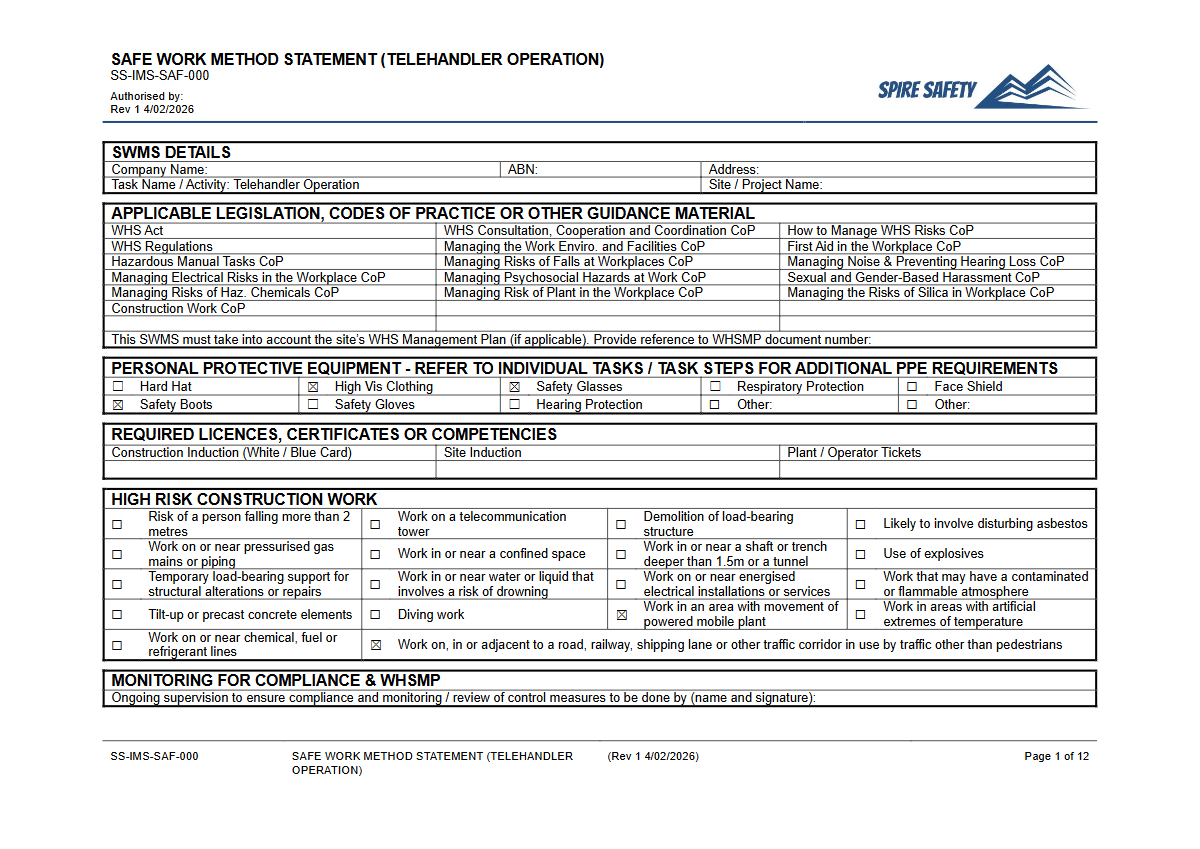
Download our free Safe Work Method Statement (Telehandler Operation) template. Customise this SWMS for safe telehandler use in your workplace.
Safe Work Method Statement (Telehandler Operation) Template
DOCX • 161 KB + PDF
Updated Oct 2026
No signup required
Purpose of the Safe Work Method Statement (Telehandler Operation) Template
Our free Safe Work Method Statement (Telehandler Operation) template provides a structured starting point for managing the risks associated with telehandler use in your workplace. This template is designed to help businesses document the step-by-step procedures required to perform telehandler operations safely, identifying potential hazards and outlining control measures to mitigate those risks.
By utilising this resource, organisations can enhance their safety planning and contribute to a safer working environment for all personnel involved in or around telehandler activities. It's an essential tool for demonstrating a proactive approach to work health and safety.
Developing comprehensive Safe Work Method Statements (SWMS) is a cornerstone of effective WHS management systems. This template aligns with Australian WHS practice, helping you to systematically address hazards such as tipovers, falling loads, collisions, and entanglement.
Video walkthrough
How to use the Safe Work Method Statement (Telehandler Operation) Template
To effectively use this Safe Work Method Statement (Telehandler Operation) template, download the DOCX version to enable full customisation. The document provides clear sections for outlining specific tasks, identifying associated hazards, and detailing control measures.
It is crucial that this template is customised to your specific workplace conditions, equipment, personnel, and the unique risks present during telehandler operations. Never use it as a 'fill-in-the-blanks' document without thorough review and adaptation. Engage relevant workers in the customisation process to ensure the SWMS accurately reflects on-site realities and promotes practical safety solutions. Once completed, the SWMS must be communicated to all workers involved in telehandler operations and kept accessible on-site.
Key sections to complete:
- Activity Details: Describe the specific telehandler tasks to be undertaken.
- Hazard Identification: List all potential hazards relevant to the operation.
- Risk Assessment: Evaluate the likelihood and consequence of each identified hazard.
- Control Measures: Detail the specific controls to eliminate or minimise risks, following the hierarchy of controls.
- Responsible Persons: Assign responsibilities for implementing and monitoring controls.
- Review and Approval: Ensure the SWMS is reviewed, approved, and understood by all involved parties.
When to use it
A Safe Work Method Statement for telehandler operation should be developed and implemented whenever telehandler work is classified as 'high-risk construction work' or whenever significant risks are identified through a general risk assessment. This typically includes tasks involving: lifting heavy or awkward loads, working near power lines, operating on uneven terrain, working at heights (e.g., with a work platform attachment), or operating in congested areas.
It should be in place before commencing any such work and reviewed regularly, especially if conditions change or incidents occur.
Who should use it
This template is primarily intended for WHS managers, supervisors, site managers, project managers, and business owners responsible for planning, supervising, or conducting telehandler operations. Operators, dogmen, and other workers involved in telehandler activities should also be familiar with the content and contribute to its development.
Organisations seeking to improve their safety documentation and control measures will find this a valuable free resource. You can explore our free WHS resources library for more useful templates.
Common mistakes
Common mistakes to avoid
- Not customising the SWMS to specific site conditions and tasks.
- Failing to review and update the SWMS when conditions change or after incidents.
- Not ensuring all workers involved understand and follow the SWMS.
- Treating the SWMS as a bureaucratic formality rather than a living safety document.
Legal references
Legal considerations
The following legal requirements may be relevant to this type of work.
- Work Health and Safety Act (Harmonised) — Provides the primary duties for protecting workers and other people from work health and safety risks.
- Work Health and Safety Regulations (Harmonised) — Sets out requirements supporting the management of workplace hazards and risks.
The following codes may be relevant to this type of work.
- Managing WHS Risks Code of Practice — Provides practical guidance on identifying hazards, assessing risks and applying effective controls.
- Work Health and Safety Consultation, Cooperation and Coordination Code of Practice — Provides practical guidance on consulting workers and coordinating with other duty holders.
- Managing the Work Environment and Facilities Code of Practice — Provides practical guidance on safe work environments, workplace facilities and related controls.
Did you know
Telehandler Accidents
Telehandlers are involved in a significant number of workplace incidents, often due to tipovers, falling loads, or collisions with people or structures.
Operator Training
Proper training and licensing for telehandler operators are crucial, as a lack of competency is a frequent contributing factor in accidents.
FAQ
Frequently asked questions
01What is a Safe Work Method Statement (SWMS)?
02Is a SWMS legally required for all telehandler operations in Australia?
03How often should a Telehandler Operation SWMS be reviewed?
04Can I use this template as is, without customisation?
Share this resource
Safe Work Method Statement (Telehandler Operation) Template
Browse Categories
How To Use It
- 1Download and open in Word or PDF.
- 2Replace the placeholders with your business details.
- 3Get it reviewed by a WHS specialist before rollout.
Need it customised?
Our WHS consultants can adapt this template to your site, run a gap analysis, or audit what you already have in place.
Book a Free Consultation WHS consulting servicesor call 1300 156 382
Related templates
- Safe Work Method Statement (Tip Truck or Trailer Operation) Template
- Safe Work Method Statement (Truck and Dog Operation)
- Safe Work Method Statement (Truck and Float Operation) Template
- Safe Work Method Statement (Truck Operation)
- Safe Work Method Statement (Vacuum Truck Operation) Template
- Safe Work Method Statement (Vehicle Loading Crane Operation) Template