
Free Pre-Start Checklist (Belt Conveyor) Template
Download our free Pre-Start Checklist (Belt Conveyor) Template to formalise daily equipment inspections and manage WHS risks.
Free Pre-Start Checklist (Belt Conveyor) Template
DOCX • 125 KB + PDF
Updated Oct 2026
No signup required
Purpose of the Free Pre-Start Checklist (Belt Conveyor) Template
Belt conveyors are essential in industries like manufacturing, mining, and logistics, but they also introduce significant workplace hazards. This free Pre-Start Checklist (Belt Conveyor) Template provides a structured framework for operators to conduct thorough safety inspections before each use.
Regular checks help identify and control risks such as entanglement in moving parts, crushing, nip points, and manual handling injuries associated with clearing blockages. By formalising the inspection process, organisations can systematically document their safety diligence, reduce the likelihood of incidents, and promote a proactive safety culture.
Implementing routine checks is a fundamental component of effective WHS management systems. This template serves as a practical tool to ensure that critical safety features are functional and the equipment is in safe operating condition, aligning with the PCBU's primary duty of care to provide safe plant and machinery.
Key Items Covered in the Checklist
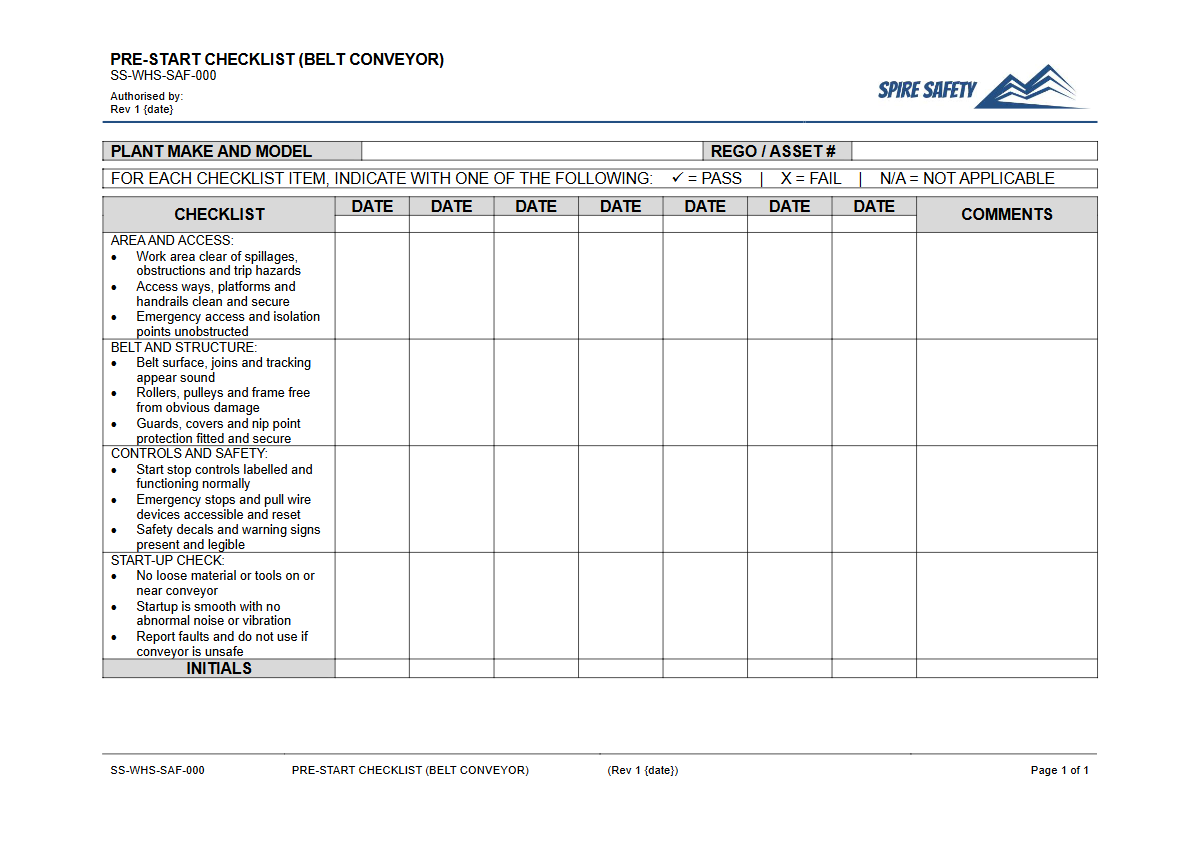
This template prompts the user to inspect critical components and safety features, including:
- Guarding: Ensuring all guards for drive mechanisms, rollers, and nip points are secure and undamaged.
- Emergency Stops: Verifying the accessibility and functionality of all e-stops and pull cords.
- Belt Condition: Checking for tears, fraying, or excessive wear on the conveyor belt itself.
- Structure and Rollers: Inspecting the frame for stability and ensuring rollers and idlers rotate freely.
- Warning Devices: Confirming audible alarms and visual warnings are operational.
- Work Area: Ensuring the surrounding area is clear of obstructions, spills, or trip hazards.
Video walkthrough
How to use the Free Pre-Start Checklist (Belt Conveyor) Template
Using this template effectively involves more than just downloading it. First, download the document in your preferred format (DOCX for easy editing or PDF for straightforward printing).
The next critical step is customisation. Every workplace and conveyor system is unique, with different configurations, loads, and environmental factors.
You must adapt the checklist to reflect the specific hazards of your equipment and operational context.
Once customised, integrate the checklist into your daily operational procedures. Train all operators on how to use the checklist correctly, what each checkpoint means, and the proper procedure for reporting and isolating faulty equipment.
Store completed checklists as part of your safety records. This documentation is invaluable for incident investigations, maintenance planning, and demonstrating safety compliance. A similar structured approach is useful for other workshop equipment, as shown in our Free Pre-Start Checklist (Bench Grinder) Template.
While this checklist is for general industrial belt conveyors, specialised applications may require different checks. For example, systems in food processing have additional hygiene requirements, which are addressed in our Free Pre-Start Checklist (Food Conveyor) Template.
A Note on Customisation
This document is a template, not a finished safety procedure. We have provided a structured starting point aligned with Australian WHS principles, but we cannot know the specific risks of your site.
You must review, edit, and add or remove items to ensure the final checklist is comprehensive for your specific belt conveyor and workplace.
When to use it
A pre-start checklist for a belt conveyor should be completed before the start of every shift or before the equipment is used for the first time each day. It is a preventative tool designed to catch potential failures before they lead to an incident.
The checklist should also be used after any maintenance or repair work has been performed to verify that the equipment has been returned to a safe operational state. Regular use helps create a consistent safety habit and ensures that no check is overlooked, which is a key focus area in formal WHS compliance auditing.
Who should use it
This Pre-Start Checklist is primarily designed for trained and authorised operators of the belt conveyor. These individuals are best placed to notice subtle changes in the equipment's performance or condition.
Supervisors and line managers also have a role in ensuring the checks are being completed diligently and that any reported issues are addressed promptly. Maintenance personnel may also use the checklist as a reference before and after conducting repairs to ensure all safety systems are reinstated correctly.
For organisations needing assistance in defining these roles and responsibilities, engaging with WHS consulting services can provide valuable clarity. If you're looking for more templates, you can browse our entire free WHS resources library.
Common mistakes
Common mistakes to avoid
- Using a generic checklist without customising it for the specific conveyor model and workplace environment.
- Operators 'pencil-whipping' the form without physically performing the checks.
- Failing to take immediate action on identified faults, allowing faulty equipment to be used.
- Poor record-keeping, making it difficult to track recurring issues or prove due diligence.
Legal references
Legal considerations
The following legal requirements may be relevant to this type of work.
- Work Health and Safety Act (Harmonised) — Provides the primary duties for protecting workers and other people from work health and safety risks.
- Work Health and Safety Regulations (Harmonised) — Sets out requirements supporting the management of workplace hazards and risks.
The following codes may be relevant to this type of work.
- Managing WHS Risks Code of Practice — Provides practical guidance on identifying hazards, assessing risks and applying effective controls.
- Work Health and Safety Consultation, Cooperation and Coordination Code of Practice — Provides practical guidance on consulting workers and coordinating with other duty holders.
- Managing the Work Environment and Facilities Code of Practice — Provides practical guidance on safe work environments, workplace facilities and related controls.
Did you know
Nip Point Dangers
The force at a conveyor nip point can be immense, often exceeding 10,000 pounds per square inch (PSI). This is why ensuring guards are in place and functional is one of the most critical pre-start checks.
FAQ
Frequently asked questions
01What are the most common hazards associated with belt conveyors?
02How often should a belt conveyor pre-start check be done?
03Is this pre-start checklist a legal document?
04What should an operator do if they find a fault during a pre-start check?
Share this resource
Free Pre-Start Checklist (Belt Conveyor) Template
Browse Categories
How To Use It
- 1Download and open in Word or PDF.
- 2Replace the placeholders with your business details.
- 3Get it reviewed by a WHS specialist before rollout.
Need it customised?
Our WHS consultants can adapt this template to your site, run a gap analysis, or audit what you already have in place.
Book a Free Consultation WHS consulting servicesor call 1300 156 382