
Free Pre-Start Checklist (Beam Clamp) Template
Download our free Pre-Start Checklist (Beam Clamp) Template. This customisable DOCX and PDF helps ensure your lifting equipment is safe before use.
Free Pre-Start Checklist (Beam Clamp) Template
DOCX • 125 KB + PDF
Updated Oct 2026
No signup required
Purpose of the Free Pre-Start Checklist (Beam Clamp) Template
A beam clamp is a critical piece of lifting equipment that attaches to a steel I-beam to provide a temporary or permanent anchor point for hoists and rigging gear. The integrity of this single component is paramount to preventing catastrophic failures, load drops, and serious injuries.
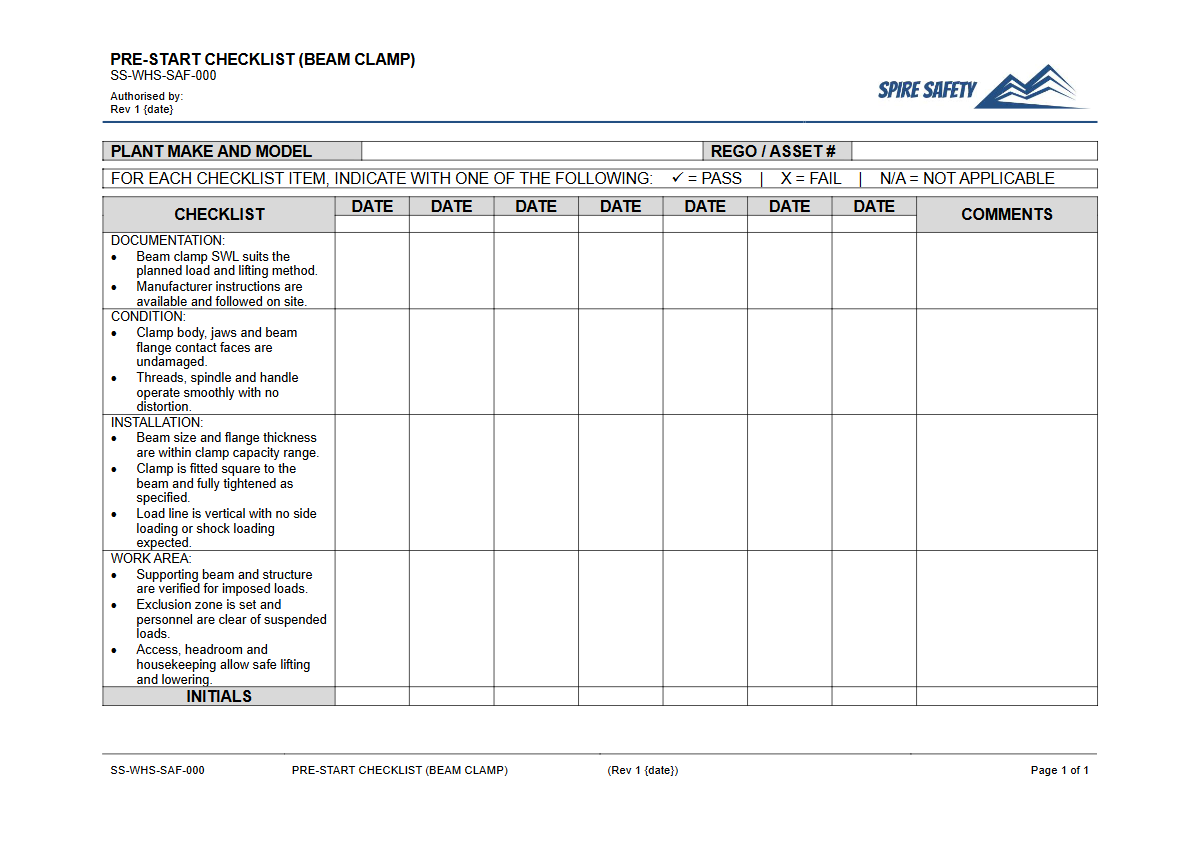
This Free Pre-Start Checklist (Beam Clamp) Template provides a structured framework for operators to conduct a thorough visual and functional inspection before each shift or use, ensuring the equipment is safe and fit for purpose. Systematically conducting and documenting these checks is a fundamental part of a safe system of work and demonstrates proactive risk management.
Integrating documented pre-start checks into daily operations helps formalise safety procedures and provides a record of due diligence. This practice is a key component of robust WHS management systems, helping to identify potential faults before they escalate into hazardous situations.
By catching wear, damage, or defects early, organisations can prevent accidents, protect workers, and avoid costly downtime and equipment damage. This template is designed to be a practical tool aligned with Australian WHS principles for managing risks associated with plant and equipment.
Video walkthrough
How to use the Free Pre-Start Checklist (Beam Clamp) Template
This document is available in both DOCX and PDF formats for your convenience. Download the template and integrate it into your existing safety documentation.
The checklist guides the user through key inspection points, including the clamp body, spindle, jaw, locking mechanism, and load pin. Operators should be trained to methodically work through each item, physically verifying the condition of each component and noting any signs of damage, wear, corrosion, or deformation.
The process should be hands-on, not just a tick-and-flick exercise.
It is crucial to customise this template to reflect the specific models of beam clamps used at your workplace, your operational procedures, and the unique risks identified in your risk assessments. We have included comments to guide you, but the final responsibility for the document's content rests with the Person Conducting a Business or Undertaking (PCBU). Regular reviews of these procedures are also a key activity checked during WHS compliance audits.
When to use it
A pre-start check for a beam clamp should be completed before the first use on any given day or shift. It should also be performed if the clamp has been dropped, subjected to a shock load, or if there is any reason to suspect its integrity has been compromised.
The environment also plays a role; if the clamp is used in a particularly corrosive or harsh environment, more frequent checks may be necessary. The goal is to ensure that the operator is confident in the equipment's condition immediately before attaching a load to it.
These checks are brief but essential and should be considered a non-negotiable part of the lifting process.
These daily inspections supplement, but do not replace, the need for periodic, in-depth inspections by a competent person as required by Australian Standards and manufacturer specifications. For difficult or complex integrations, you may benefit from external advice.
Spire Safety provides WHS consulting services that can help your business develop and implement safe operating procedures for all types of plant and equipment.
Who should use it
This checklist is designed for any worker tasked with operating lifting equipment that involves a beam clamp. This includes riggers, doggers, boilermakers, mechanics, and other tradespeople who need to set up temporary lifting points.
It is the responsibility of the PCBU to ensure that anyone using this equipment is competent to do so. Competency involves more than just reading a checklist; it requires formal training, practical experience, and a thorough understanding of the equipment's limitations, the principles of safe lifting, and the specific hazards involved.
This template can also be used by supervisors and safety officers to audit and verify that pre-start inspections are being carried out correctly.
To reinforce the importance of these checks, consider running regular training sessions with your team. Our pre-start checks and plant maintenance toolbox talk template provides an excellent resource for facilitating these important safety discussions.
You can find more helpful documents like this in our free WHS resources library, covering a wide range of safety topics.
Common mistakes
Common mistakes to avoid
- Exceeding the stamped Working Load Limit (WLL).
- Using the clamp on a beam flange that is too wide, too narrow, or tapered beyond the clamp's specifications.
- Failing to fully tighten the clamp onto the beam before applying a load.
- Applying a load at an angle ('side loading') when the clamp is only rated for vertical lifts.
Legal references
Legal considerations
The following legal requirements may be relevant to this type of work.
- Work Health and Safety Act (Harmonised) — Provides the primary duties for protecting workers and other people from work health and safety risks.
- Work Health and Safety Regulations (Harmonised) — Sets out requirements supporting the management of workplace hazards and risks.
The following codes may be relevant to this type of work.
- Managing WHS Risks Code of Practice — Provides practical guidance on identifying hazards, assessing risks and applying effective controls.
- Work Health and Safety Consultation, Cooperation and Coordination Code of Practice — Provides practical guidance on consulting workers and coordinating with other duty holders.
- Managing the Work Environment and Facilities Code of Practice — Provides practical guidance on safe work environments, workplace facilities and related controls.
Did you know
Shock Loading Danger
Suddenly jerking or dropping a load can create a 'shock load' that multiplies the force on a beam clamp, potentially causing it to fail even if the static weight is well below the rated Working Load Limit (WLL).
Thread Integrity
The threads on a beam clamp's spindle are a critical load-bearing component. Any damage, corrosion, or excessive wear can drastically reduce its strength and lead to catastrophic failure under load.
FAQ
Frequently asked questions
01What should be checked on a beam clamp before use?
02How often should beam clamps be inspected?
03Is a pre-start checklist a legal requirement in Australia?
04What is the Working Load Limit (WLL) of a beam clamp?
Share this resource
Free Pre-Start Checklist (Beam Clamp) Template
Browse Categories
How To Use It
- 1Download and open in Word or PDF.
- 2Replace the placeholders with your business details.
- 3Get it reviewed by a WHS specialist before rollout.
Need it customised?
Our WHS consultants can adapt this template to your site, run a gap analysis, or audit what you already have in place.
Book a Free Consultation WHS consulting servicesor call 1300 156 382