
Free Pre-Start Checklist (Battery Charger) Template
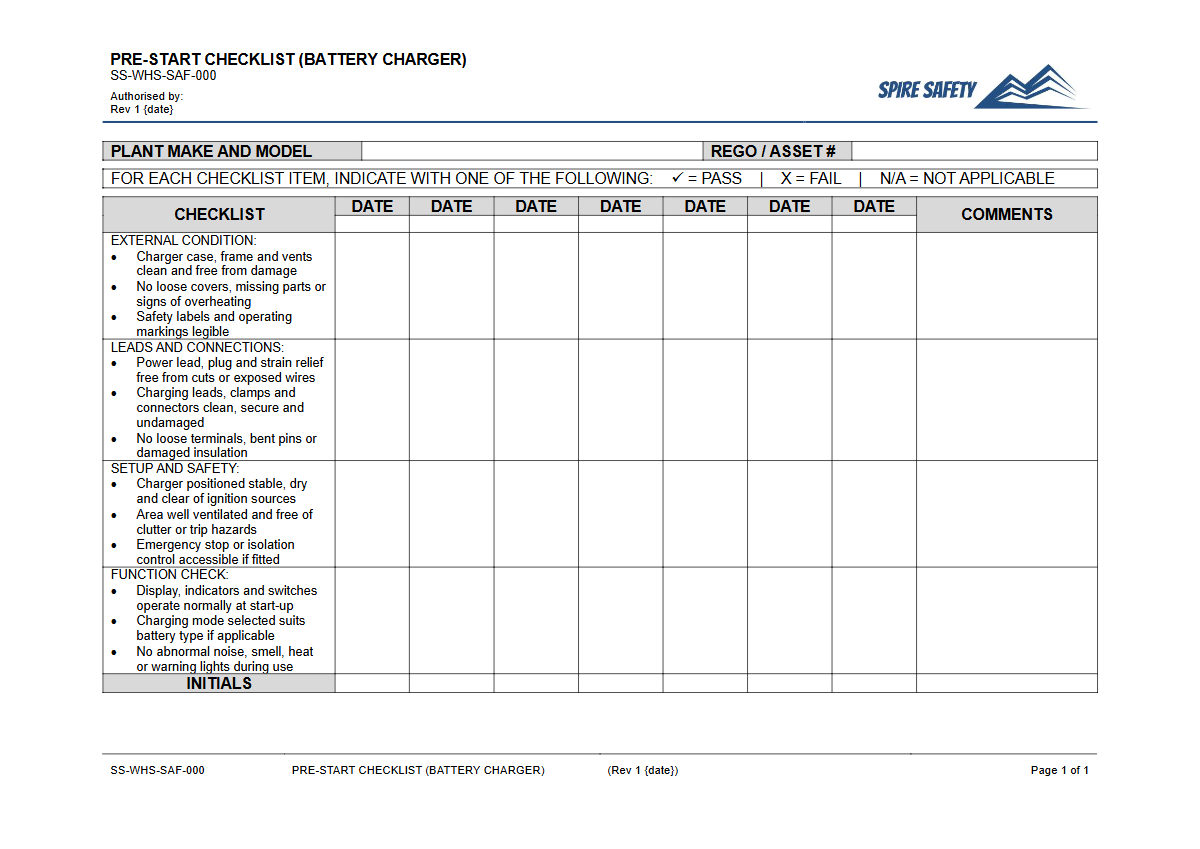
Formalise your daily equipment checks with our free Pre-Start Checklist (Battery Charger) Template. Aligned with Australian WHS practice. Download yours.
Free Pre-Start Checklist (Battery Charger) Template
DOCX • 125 KB + PDF
Updated Oct 2026
No signup required
Purpose of the Free Pre-Start Checklist (Battery Charger) Template
Using our Free Pre-Start Checklist (Battery Charger) Template helps your organisation formalise the daily safety inspections of battery charging equipment. This structured template provides a consistent framework for operators to verify that chargers are safe to use before operation, minimising the risk of electrical shock, fire, and equipment damage.
Regular, documented checks are a cornerstone of proactive safety management, helping to identify potential faults before they lead to an incident. This process supports your duty of care under Australian WHS laws by creating a clear record of due diligence and equipment condition.
A well-implemented pre-start process demonstrates a commitment to workplace safety and operational discipline. By systematically checking for issues like damaged cords, signs of overheating, or incorrect settings, you can prevent costly equipment failure and, more importantly, protect your workers from harm.
Integrating these checks into a broader WHS management system creates a robust process for managing plant and equipment risks across your organisation.
Video walkthrough
How to use the Free Pre-Start Checklist (Battery Charger) Template
Download the template in your preferred format—DOCX for easy editing or PDF for straightforward printing and immediate use. Before implementation, it is essential that you customise the checklist to suit the specific makes and models of battery chargers used in your workplace, as well as the unique environmental conditions and operational risks.
For example, checks for an industrial forklift charger in a busy warehouse will differ from those for charging small tool batteries in a workshop.
We provide this template as a starting point; you must adapt it to your specific needs to ensure it is effective. Add your company branding, specific check items relevant to your equipment (e.g., ventilation clearance, specific error codes), and any site-specific safety rules. The requirements for charging large industrial batteries will also differ from those for charging electric vehicles, which might be covered by a dedicated EV charger pre-start checklist.
When to use it
This checklist should be completed before the first use of the battery charger on any given day or shift. It is a quick but critical process that confirms the equipment was left in a safe state and has not developed any faults overnight or between shifts.
It is also essential to conduct a pre-start check after equipment has been relocated, returned from maintenance, or if it is being used for the first time after a long period of inactivity.
This principle of pre-use inspection applies to many types of workshop and industrial equipment. For instance, your procedures might also require a specific pre-start checklist for a bench grinder before any grinding work commences.
Consistent application of these checks across all relevant plant and equipment reinforces a strong safety culture.
Who should use it
The checklist is designed for any worker, operator, or team member tasked with using or overseeing the use of battery charging equipment. This includes warehouse staff, maintenance teams, workshop technicians, and employees in any industry that relies on battery-powered tools and machinery.
Providing clear instructions and training ensures that all users can competently perform the checks.
Supervisors and managers should also use the completed checklists to monitor compliance, track equipment condition, and identify trends that may indicate a need for preventative maintenance or replacement. These records can be an invaluable source of information during internal safety reviews or formal WHS compliance audits.
The responsibility for these checks often falls under a site's general safety protocols, which might also cover other powered equipment like that detailed in our pre-start checklist for a floor saw. For more tools to support your safety programs, you can browse our complete free WHS resources library for other relevant templates and guides.
Common mistakes
Common mistakes to avoid
- Ignoring frayed, cracked, or exposed wires on power cords and connector cables.
- Using the charger in a cluttered or poorly ventilated space, increasing fire risk.
- Failing to check for visible signs of damage to the charger casing, such as cracks or burn marks.
- Continuing to use a charger after a fault has been identified on the pre-start checklist.
Legal references
Legal considerations
The following legal requirements may be relevant to this type of work.
- Work Health and Safety Act (Harmonised) — Provides the primary duties for protecting workers and other people from work health and safety risks.
- Work Health and Safety Regulations (Harmonised) — Sets out requirements supporting the management of workplace hazards and risks.
The following codes may be relevant to this type of work.
- Managing WHS Risks Code of Practice — Provides practical guidance on identifying hazards, assessing risks and applying effective controls.
- Work Health and Safety Consultation, Cooperation and Coordination Code of Practice — Provides practical guidance on consulting workers and coordinating with other duty holders.
- Managing the Work Environment and Facilities Code of Practice — Provides practical guidance on safe work environments, workplace facilities and related controls.
Did you know
Explosive Gas
Charging lead-acid batteries produces hydrogen gas, which is colourless, odourless, and highly flammable. A single spark from a metal tool or static electricity can be enough to cause a powerful explosion in a poorly ventilated area.
Thermal Runaway
Lithium-ion batteries can experience 'thermal runaway,' a dangerous chain reaction where an increase in temperature causes further increases in temperature. This can result in the battery venting toxic gas, catching fire, or exploding.
FAQ
Frequently asked questions
01Why is a pre-start check for a battery charger important?
02What are the main hazards associated with industrial battery chargers?
03Can this template be used for all types of battery chargers?
04How often should a pre-start check for a battery charger be conducted?
Share this resource
Free Pre-Start Checklist (Battery Charger) Template
Browse Categories
How To Use It
- 1Download and open in Word or PDF.
- 2Replace the placeholders with your business details.
- 3Get it reviewed by a WHS specialist before rollout.
Need it customised?
Our WHS consultants can adapt this template to your site, run a gap analysis, or audit what you already have in place.
Book a Free Consultation WHS consulting servicesor call 1300 156 382