
Free Pre-Start Checklist (Bar Cutter) Template
Download our Free Pre-Start Checklist (Bar Cutter) Template to formalise daily equipment inspections and manage WHS risks on site. DOCX and PDF formats.
Free Pre-Start Checklist (Bar Cutter) Template
DOCX • 125 KB + PDF
Updated Oct 2026
No signup required
Purpose of the Free Pre-Start Checklist (Bar Cutter) Template
Operating a bar cutter without proper safety checks can lead to serious incidents, including severe lacerations, crushing injuries, or high-pressure fluid injection. Our Free Pre-Start Checklist (Bar Cutter) Template provides a structured framework for operators to conduct thorough, routine inspections before use.
Using this template helps formalise the process of identifying potential faults, mechanical failures, or hydraulic system issues before they escalate into a workplace hazard. It serves as a critical tool for proactive risk management, ensuring the equipment is fit for service at the start of every shift.
Integrating these daily checks is a fundamental component of a robust safety framework. A consistent inspection process not only protects workers but also creates a documented history of the equipment's condition, which is invaluable for maintenance planning and demonstrating due diligence.
This systematic approach is a cornerstone of effective WHS management systems, helping your organisation meet its safety obligations.
Video walkthrough
How to use the Free Pre-Start Checklist (Bar Cutter) Template
This checklist is designed to be a practical and user-friendly starting point. After downloading the DOCX or PDF file, you should adapt it to your specific operational needs.
The process is straightforward: first, add your company name and logo. Second, and most importantly, review and modify the checklist items to align with the specific make and model of your bar cutter, your site-specific risks, and any unique operational procedures.
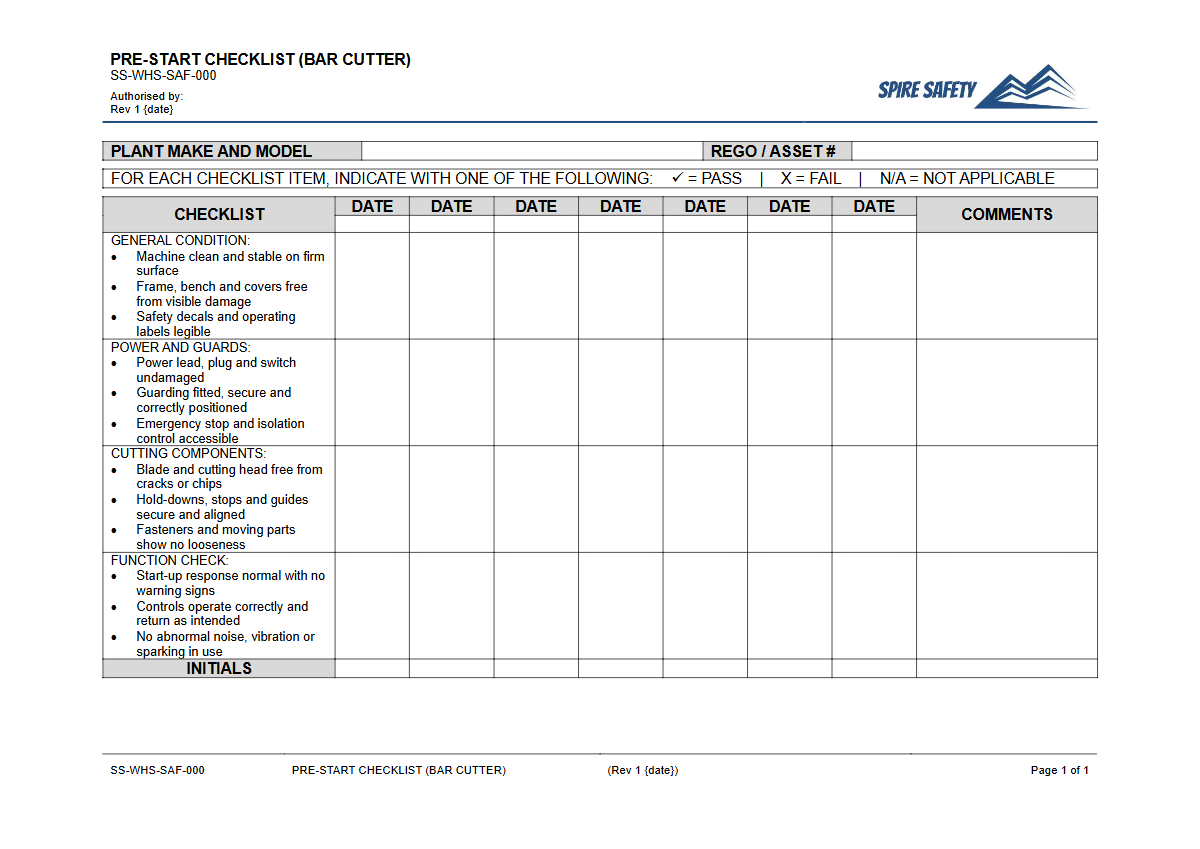
The template covers key inspection points including:
- Guards and safety covers
- Blade condition (checking for cracks, chips, and secure mounting)
- Hydraulic system (hoses, connections, and fluid levels)
- Emergency stop functionality
- Electrical components (cords, plugs, and switches)
- General structural integrity and cleanliness
Please note: This document is a template and must be customised to suit the specific equipment and risks present in your workplace. We provide this as a starting point; your organisation is responsible for ensuring its own WHS compliance.
Just as you would tailor checks for different equipment, such as with a Bench Grinder pre-start checklist, customisation is essential for effectiveness.
When to use it
A pre-start check should be completed before the first use of the bar cutter on any given day or at the beginning of each work shift. This routine ensures that the equipment's condition is verified before any cutting operations commence.
It is also best practice to conduct a check after the equipment has been moved to a new location on site, after any maintenance or repair work, or if there is a change of operator during a shift. The goal is to catch any issues at the earliest possible moment, preventing use of unsafe plant.
This principle of daily or pre-shift inspection applies to many types of high-risk plant used in construction and industrial settings. For instance, a similar routine is vital when using a Pre-Start Checklist for Floor Saws to ensure blade integrity and guard function before cutting concrete.
Who should use it
The pre-start checklist should be completed by a competent person who is trained and authorised to operate the bar cutter. This is typically the operator assigned to the equipment for that shift.
They are best placed to identify any abnormalities or changes in the machine's condition compared to its previous use. Supervisors or line managers also have a role in ensuring these checks are consistently performed and in reviewing the completed forms.
Regular review of these documents helps identify recurring faults, which may indicate a need for more comprehensive maintenance or replacement of components.
Completed checklists form part of your safety records, which are often examined during a WHS compliance audit to verify that safety procedures are being followed. Proper documentation provides clear evidence that your organisation is actively managing plant safety.
The same logic applies to other industrial equipment, where a dedicated Granulator Pre-Start Checklist would be used by its specific operator.
By implementing this structured checklist, you empower operators to take ownership of safety, creating a more resilient and safety-conscious work environment. To explore more tools that can support your safety management framework, browse our complete free WHS resources library.
Common mistakes
Common mistakes to avoid
- Failing to check the cutting blade for chips, cracks, or dullness.
- Ignoring small hydraulic fluid leaks, which can indicate a future hose failure.
- Performing a 'tick and flick' without physically testing guards and emergency stops.
- Using a generic checklist that doesn't match the specific bar cutter model in use.
Legal references
Legal considerations
The following legal requirements may be relevant to this type of work.
- Work Health and Safety Act (Harmonised) — Provides the primary duties for protecting workers and other people from work health and safety risks.
- Work Health and Safety Regulations (Harmonised) — Sets out requirements supporting the management of workplace hazards and risks.
The following codes may be relevant to this type of work.
- Managing WHS Risks Code of Practice — Provides practical guidance on identifying hazards, assessing risks and applying effective controls.
- Work Health and Safety Consultation, Cooperation and Coordination Code of Practice — Provides practical guidance on consulting workers and coordinating with other duty holders.
- Managing the Work Environment and Facilities Code of Practice — Provides practical guidance on safe work environments, workplace facilities and related controls.
Did you know
Hydraulic Power
Hydraulic bar cutters operate with immense force, often generating tens of tons of pressure to shear through reinforced steel. A pinhole leak in a hydraulic hose can inject fluid into the skin at pressures high enough to cause severe injury and tissue damage.
FAQ
Frequently asked questions
01How often should a bar cutter pre-start checklist be completed?
02Who is responsible for checking the bar cutter?
03What is the most important check on a bar cutter?
04Can I use this template for any brand of bar cutter?
Share this resource
Free Pre-Start Checklist (Bar Cutter) Template
Browse Categories
How To Use It
- 1Download and open in Word or PDF.
- 2Replace the placeholders with your business details.
- 3Get it reviewed by a WHS specialist before rollout.
Need it customised?
Our WHS consultants can adapt this template to your site, run a gap analysis, or audit what you already have in place.
Book a Free Consultation WHS consulting servicesor call 1300 156 382