
Free Pre-Start Checklist (Baler) Template
Download our free Pre-Start Checklist (Baler) Template to formalise equipment inspections and manage WHS risks. Get your customisable DOCX and PDF now.
Free Pre-Start Checklist (Baler) Template
DOCX • 125 KB + PDF
Updated Oct 2026
No signup required
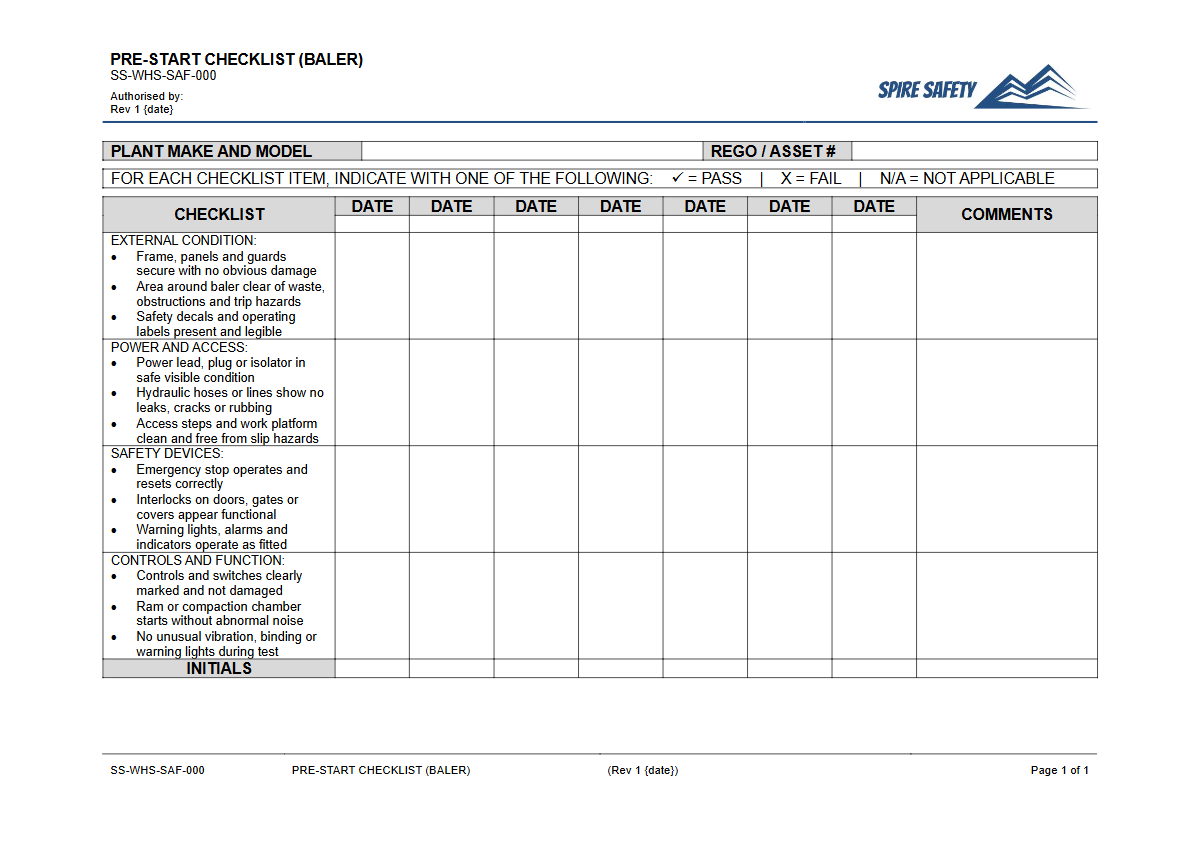
Purpose of the Free Pre-Start Checklist (Baler) Template
Our free Pre-Start Checklist (Baler) Template provides a structured starting point for formalising daily safety inspections of your baling equipment. Operating a baler, whether for cardboard, plastic, hay, or other materials, involves significant risks from crushing, entanglement, and hydraulic energy.
This checklist helps operators systematically identify potential hazards before they use the equipment, ensuring all critical safety components are in place and functioning correctly.
Using this template helps create a documented record of safety diligence, which is a key part of managing your Work Health and Safety (WHS) obligations. It encourages a proactive safety culture by empowering operators to take ownership of equipment safety.
For organisations handling specific materials like cardboard, our Free Pre-Start Checklist (Cardboard Baler) Template offers a more targeted starting point. Regular, documented checks are fundamental to preventing incidents and demonstrating compliance during safety audits.
Video walkthrough
How to use the Free Pre-Start Checklist (Baler) Template
Integrating this checklist into your operations is a straightforward process designed to enhance workplace safety. First, download the template in the format that suits you best; the DOCX file is ideal for customisation, while the PDF is ready for immediate printing and use.
The most important step is customisation. It is crucial to adapt this template for your specific workplace. We have no way of knowing your site's specific baler model, operational context, or unique hazards, so you must review and modify this document by adding or removing checks to ensure it is fit for purpose. In agricultural settings, for example, the risks are different; for those, our Free Pre-Start Checklist (Hay Baler) Template is more suitable.
Once customised, train all operators on how to complete the checklist correctly, what each check involves, and the procedure for reporting faults. Finally, implement the checklist as a mandatory part of your pre-operational procedure and schedule periodic reviews to ensure it remains current and effective.
When to use it
A pre-start checklist for a baler should be completed before the first use of the equipment on every shift. This ensures that the machine's condition is verified before any work commences, capturing any faults that may have developed overnight or during a previous shift.
The check should be performed by the person who will be operating the machine.
Additionally, a full check is recommended if the baler has been idle for an extended period, or immediately after any maintenance or repair work has been carried out. Integrating these checks is a key component of building robust WHS management systems, as they provide real-time data on the condition and safety of critical plant and equipment.
Who should use it
This checklist is designed to be used by trained, competent, and authorised operators of the baler. These individuals are best placed to assess the equipment they are about to use.
Supervisors and managers should also use the completed checklists to verify that inspections are being performed correctly and to monitor the overall condition of the machinery. They can use the records to identify recurring faults, which may indicate a need for more comprehensive maintenance or operator retraining.
These documented checks are also essential records for safety committees, maintenance personnel, and WHS professionals. The records are invaluable during safety reviews and incident investigations.
Regular independent reviews can ensure the system is working as intended, a service often provided through professional WHS compliance auditing to verify procedural adherence and effectiveness.
Key Areas Covered by the Baler Checklist
A comprehensive baler checklist should cover several critical safety and operational areas to be effective. Our template provides a foundation covering the following categories, which you should adapt to your specific machine.
Emergency and Safety Features
This is arguably the most critical section. It includes checks for emergency stop buttons, safety interlock switches on all access doors and gates, and the physical condition of machine guarding.
These systems are the primary defence against serious crushing and entanglement injuries.
Structural and Mechanical Integrity
This involves visually inspecting the baler's frame, compaction chamber, ram, and tying mechanism for signs of stress, cracks, or damage. It also includes checking that all bolts are secure and that there are no signs of excessive wear on moving parts.
Hydraulic and Electrical Systems
Operators should check for hydraulic fluid leaks, inspect hoses for signs of wear or damage, and verify that fluid levels are correct. Electrical checks include inspecting power cords for damage and ensuring control panels are clean and legible. The principles are similar for other processing machinery, as detailed in our Free Pre-Start Checklist (Granulator) Template.
If you need assistance in identifying risks or customising documents for your specific equipment and operational needs, our WHS consulting team can provide expert guidance. The goal is to create a tool that is both practical and effective in preventing incidents. For more templates and safety tools, browse our complete free WHS resources library.
Common mistakes
Common mistakes to avoid
- Using a generic checklist that hasn't been customised for the specific baler model and its use.
- Failing to properly train operators on what to look for, leading to a 'tick and flick' mentality.
- Not immediately removing faulty equipment from service and failing to action reported defects.
- Incomplete record-keeping, which undermines traceability and safety auditing efforts.
Legal references
Legal considerations
The following legal requirements may be relevant to this type of work.
- Work Health and Safety Act (Harmonised) — Provides the primary duties for protecting workers and other people from work health and safety risks.
- Work Health and Safety Regulations (Harmonised) — Sets out requirements supporting the management of workplace hazards and risks.
The following codes may be relevant to this type of work.
- Managing WHS Risks Code of Practice — Provides practical guidance on identifying hazards, assessing risks and applying effective controls.
- Work Health and Safety Consultation, Cooperation and Coordination Code of Practice — Provides practical guidance on consulting workers and coordinating with other duty holders.
- Managing the Work Environment and Facilities Code of Practice — Provides practical guidance on safe work environments, workplace facilities and related controls.
Did you know
Compaction Force
Industrial balers can generate immense compaction forces, often exceeding 50 tonnes, which is more than enough to crush a small car. This power is what makes effective guarding and safety interlocks non-negotiable.
Machine Guarding
According to Safe Work Australia, contact with moving parts of machinery is a leading cause of serious workplace injury. A thorough pre-start check of machine guarding is one of the most effective controls to prevent this.
FAQ
Frequently asked questions
01What should be included in a baler pre-start checklist?
02Why are pre-start checks for balers important for WHS?
03How often should baler pre-start checks be performed?
04Can this template be used for any type of baler?
Share this resource
Free Pre-Start Checklist (Baler) Template
Browse Categories
How To Use It
- 1Download and open in Word or PDF.
- 2Replace the placeholders with your business details.
- 3Get it reviewed by a WHS specialist before rollout.
Need it customised?
Our WHS consultants can adapt this template to your site, run a gap analysis, or audit what you already have in place.
Book a Free Consultation WHS consulting servicesor call 1300 156 382