
Free Pre-Start Checklist (Hay Baler) Template
Download our free Pre-Start Checklist (Hay Baler) Template in DOCX and PDF.
Free Pre-Start Checklist (Hay Baler) Template
DOCX • 125 KB + PDF
Updated Oct 2026
No signup required
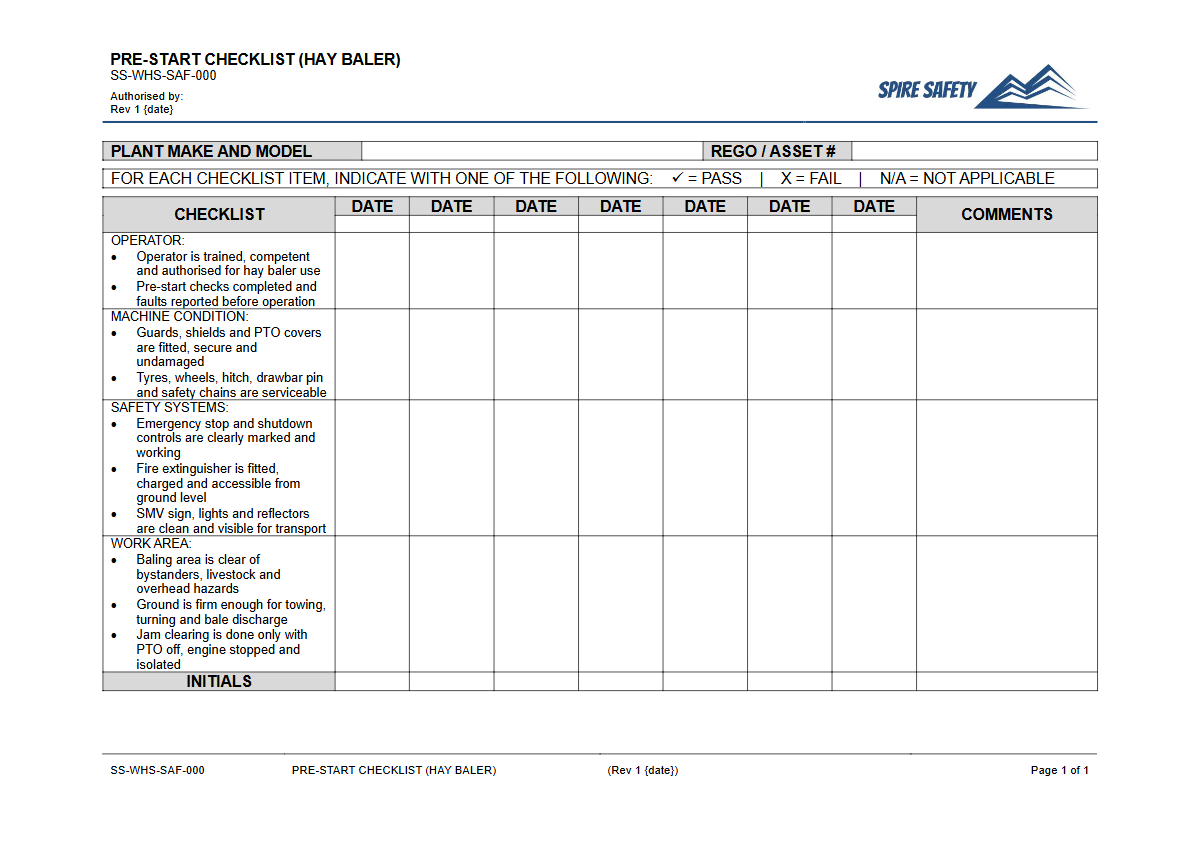
Formalising your daily equipment inspections is a critical step in managing safety risks in agricultural settings. This free Pre-Start Checklist (Hay Baler) Template provides a structured starting point for operators to verify that a hay baler is safe to use before each shift.
By systematically checking key safety components, you can significantly reduce the risk of incidents involving entanglement, crushing, or other serious injuries commonly associated with agricultural plant.
This downloadable template is designed to be straightforward and practical, helping your organisation document its safety procedures and demonstrate due diligence. It is aligned with the principles of the model WHS framework and promotes a proactive approach to farm safety.
Integrating this check into your daily routine helps build a stronger safety culture and protect your workers.
Video walkthrough
Purpose of the Free Pre-Start Checklist (Hay Baler) Template
The primary purpose of this hay baler pre-start checklist is to guide operators through a consistent, documented inspection process before using the machinery. It prompts the user to examine critical safety features and mechanical components to identify any damage, wear, or malfunction that could lead to an accident.
Regular use helps ensure that all safety guards are in place, emergency stop mechanisms are functional, and that the Power Take-Off (PTO) shaft is correctly guarded and secured.
Using a standardised checklist ensures that no critical checks are forgotten, creating a reliable record of the machine's condition over time. This documentation is invaluable during safety investigations or WHS compliance audits. It forms a key part of a preventative maintenance program, helping to identify minor issues before they escalate into major failures that cause costly downtime and pose a serious risk to operators.
How to use the Free Pre-Start Checklist (Hay Baler) Template
Using this template is a simple, three-step process. First, download the document in your preferred format (DOCX for easy editing or PDF for straightforward printing).
Second, you must adapt the checklist to suit the specific make and model of the hay baler used at your workplace. This step is essential for ensuring the checklist is relevant and effective.
You should add, remove, or modify check items based on the manufacturer's instructions and your own risk assessment.
Important: This document is a template and not a complete solution. We recommend you customise it to address the unique hazards of your specific equipment, tasks, and operating environment.
Finally, integrate the finalised checklist into your daily operational procedures. Train all operators on how to complete it correctly and what actions to take if they identify a fault. This process is a fundamental part of any robust WHS management system.
When to use it
A pre-start checklist for a hay baler should be completed before the start of every shift or before the first use of the day. It is a brief, visual, and functional inspection designed to catch obvious faults that may have developed since the last use or during storage.
It is not a substitute for the detailed, periodic maintenance recommended by the equipment manufacturer.
These routine checks are an essential part of a broader safety strategy. For further reinforcement of these principles, you might find our Pre-Start Checks and Plant Maintenance Toolbox Talk a useful resource for team safety meetings.
This helps keep safety at the forefront of everyone's mind.
Who should use it
The pre-start checklist should be completed by the person operating the hay baler. This individual must be deemed competent, meaning they have received the necessary training and instruction to operate the machine safely.
They are in the best position to notice any changes in the equipment's condition or performance.
Supervisors and farm managers also have a role to play. They are responsible for ensuring that operators are completing the checks correctly and for reviewing the completed checklists.
This oversight helps confirm that any reported faults are addressed promptly and that the safety system is functioning as intended. For complex safety challenges, engaging with specialist WHS consulting can provide valuable external expertise.
What's in the Hay Baler Pre-Start Checklist?
This template is structured to cover the most common safety-critical areas of a hay baler. It includes sections for:
- Operator details, date, and plant identification.
- Checks for all guards, particularly over the PTO shaft, drive belts, and chains.
- Inspection of the hitch, safety chains, and drawbar pin.
- Verification of hydraulic hoses and connections for leaks or damage.
- Checks for the condition of belts, chains, and bale-tying mechanisms.
- Confirmation that a suitable fire extinguisher is present and serviceable.
- A sign-off section to confirm the machine is either fit or unfit for use.
- Space for comments and to detail required corrective actions.
While this checklist is comprehensive, it should be compared against the manufacturer's manual. You can also review similar resources like our pre-start checklist for an aerator to see how checks can be structured for different types of agricultural plant.
Benefits of Regular Equipment Checks
Implementing a formal pre-start check process delivers significant benefits beyond just safety. It helps create an organised and professional approach to plant management, reduces the likelihood of unexpected breakdowns during critical baling periods, and extends the operational life of your machinery.
These records also serve as tangible proof of your commitment to workplace health and safety.
Explore our entire collection of templates and guides in our free WHS resources library to further strengthen your safety framework. By adopting these tools, you are taking a positive step towards a safer and more productive workplace.
Common mistakes
Common mistakes to avoid
- Using a generic checklist without customising it for the specific baler model.
- Completing the checklist from memory or 'pencil-whipping' it without physically inspecting each item.
- Failing to tag out and report faulty equipment, allowing it to remain in service.
- Not retaining completed checklists as a record of due diligence and for maintenance planning.
Legal references
Legal considerations
The following legal requirements may be relevant to this type of work.
- Work Health and Safety Act (Harmonised) — Provides the primary duties for protecting workers and other people from work health and safety risks.
- Work Health and Safety Regulations (Harmonised) — Sets out requirements supporting the management of workplace hazards and risks.
The following codes may be relevant to this type of work.
- Managing WHS Risks Code of Practice — Provides practical guidance on identifying hazards, assessing risks and applying effective controls.
- Work Health and Safety Consultation, Cooperation and Coordination Code of Practice — Provides practical guidance on consulting workers and coordinating with other duty holders.
- Managing the Work Environment and Facilities Code of Practice — Provides practical guidance on safe work environments, workplace facilities and related controls.
Did you know
PTO Shaft Danger
A Power Take-Off (PTO) shaft on a tractor can rotate at speeds up to 1,000 rpm. At this speed, it can wrap a person's limb or clothing around it in less than a second, making proper guarding absolutely critical.
Agricultural Injury Statistics
According to Safe Work Australia, the agriculture, forestry, and fishing industry consistently has one of the highest rates of worker fatalities and serious injuries, with machinery-related incidents being a major cause.
FAQ
Frequently asked questions
01What is the difference between a pre-start check and scheduled maintenance?
02Is this hay baler checklist suitable for all makes and models?
03Who is responsible for ensuring pre-start checks are completed?
04What should an operator do if a fault is found during a pre-start check?
Share this resource
Free Pre-Start Checklist (Hay Baler) Template
Browse Categories
How To Use It
- 1Download and open in Word or PDF.
- 2Replace the placeholders with your business details.
- 3Get it reviewed by a WHS specialist before rollout.
Need it customised?
Our WHS consultants can adapt this template to your site, run a gap analysis, or audit what you already have in place.
Book a Free Consultation WHS consulting servicesor call 1300 156 382