
Free Pre-Start Checklist (Header) Template
Download our free Pre-Start Checklist (Header) Template. A customisable DOCX & PDF to standardise equipment checks across your Australian workplace.
Free Pre-Start Checklist (Header) Template
DOCX • 125 KB + PDF
Updated Oct 2026
No signup required
Purpose of the Free Pre-Start Checklist (Header) Template
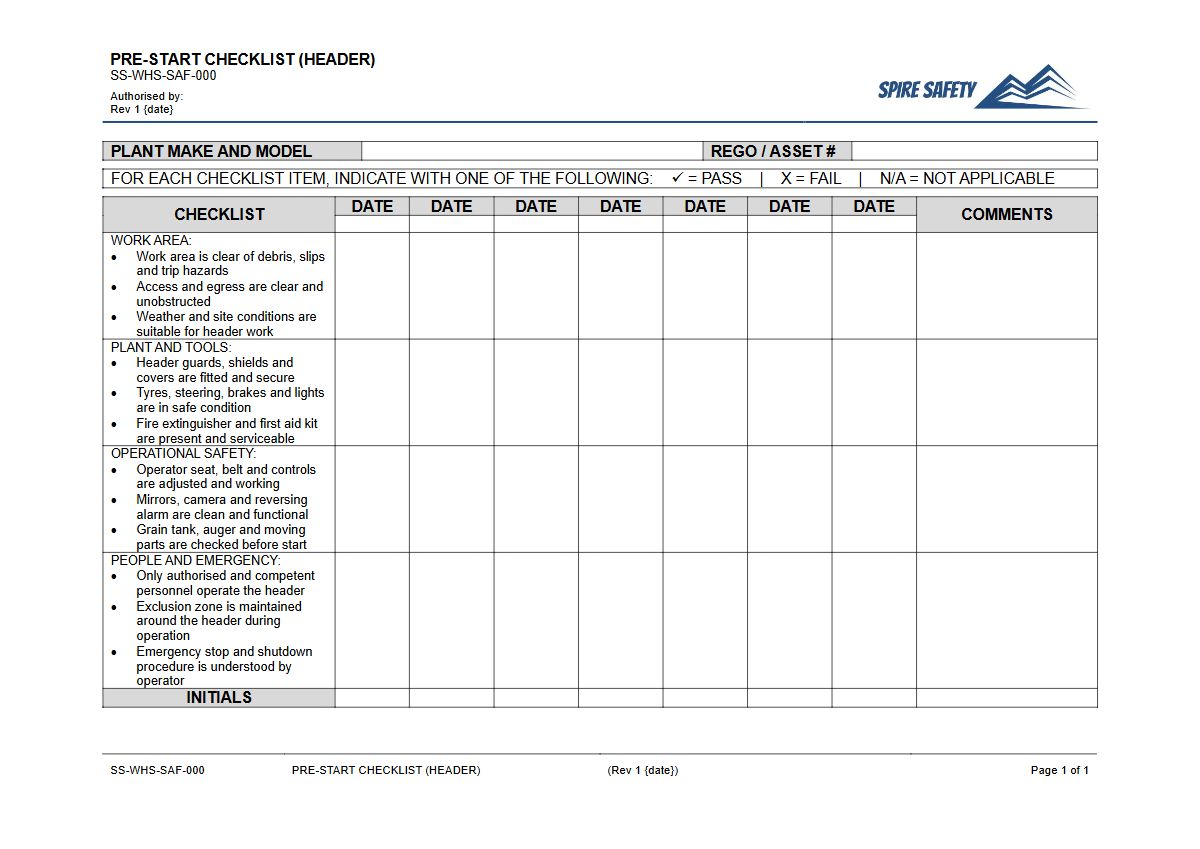
This free Pre-Start Checklist (Header) Template provides a standardised framework for creating equipment-specific safety checklists for your organisation. Its primary purpose is to establish a consistent format and capture essential information—like the date, operator, plant details, and supervisor sign-off—that applies to all pre-start checks, regardless of the specific machine. By using a header template, you ensure that fundamental administrative and safety data is recorded every time, forming a crucial part of your broader WHS management systems.
A robust pre-start process helps workers systematically verify that equipment is safe to use before commencing work. It's a practical way to identify damage, wear and tear, missing guards, or other faults that could lead to an incident.
Implementing consistent checks based on this template helps meet your duty of care obligations by formalising the process of plant inspection and maintenance verification. It provides a documented record that the necessary safety checks have been performed.
Video walkthrough
How to use the Free Pre-Start Checklist (Header) Template
To use this Pre-Start Checklist Header Template effectively, you must add specific inspection items relevant to the particular piece of plant or equipment. The downloaded file provides the header section and a blank table; your task is to populate this table with checklist items tailored to the machinery in question.
For example, the checks for a forklift will be completely different from the checks required for a piece of kitchen equipment.
Important Note: This document is a template and must be customised to your specific workplace, plant, and operational risks. We have provided the general structure; you need to consult manufacturer's guidelines, relevant Codes of Practice, and conduct a risk assessment to determine the specific items that need to be checked for each piece of equipment.
For example, you would use this header to create a specific checklist for a CNC Router by adding items like checking the condition of the tooling, emergency stop function, and dust extraction system.
Example Customisation Steps:
- Identify a piece of equipment (e.g., a pressure washer).
- Consult the operator's manual for recommended daily checks.
- Review any relevant risk assessments or safe work procedures.
- List specific check-points, such as 'Check for fuel/oil leaks', 'Inspect hose and connections for damage', 'Confirm safety nozzle lock is functional', 'Check water inlet filter'.
- Add these items to the body of the template.
- Save this new document as your 'Pressure Washer Pre-Start Checklist'.
When to use a Pre-Start Checklist
A pre-start checklist should be completed before a piece of plant or equipment is used for the first time each day or at the beginning of each shift. This frequency ensures that any faults that may have developed overnight or between shifts are identified before the equipment is put into operation.
This routine is a cornerstone of proactive safety management.
In addition to daily checks, they are also essential after maintenance or repairs to verify the equipment is safe for return to service. Communicating the importance of this routine can be effectively done through a targeted Pre-Start Checks and Plant Maintenance Toolbox Talk, ensuring all workers understand the process and its significance.
Who should use it
The primary user of a pre-start checklist is the equipment operator. They are the person most familiar with the day-to-day function of the machinery and are best placed to notice subtle changes or developing issues.
They are responsible for physically conducting the checks and accurately recording their findings before starting work.
Supervisors and managers also have a key role. They are responsible for ensuring that operators are trained and competent to perform the checks, that the system is being followed correctly, and that records are being kept.
They must also establish a clear process for what happens when a fault is found, such as tagging the equipment out of service and arranging for repairs. Periodically reviewing completed checklists is a vital supervisory task, often scrutinised during a formal WHS compliance auditing process to verify procedural adherence.
Ultimately, a pre-start check system is a shared responsibility that is fundamental to maintaining a safe workplace. It helps verify that the controls documented in a Safe Work Method Statement (SWMS) for Concrete Truck Operation or other risk assessments are in place and functioning correctly before work begins.
Common mistakes
Common mistakes to avoid
- Using a generic checklist for all equipment without customising it with machine-specific inspection points.
- Workers performing a 'tick and flick' without physically inspecting the items listed.
- Failing to have a clear 'do not operate' and reporting procedure for when a fault is found.
- Poor record-keeping, such as filing checklists incorrectly or not retaining them for the required period.
Legal references
Legal considerations
The following legal requirements may be relevant to this type of work.
- Work Health and Safety Act (Harmonised) — Provides the primary duties for protecting workers and other people from work health and safety risks.
- Work Health and Safety Regulations (Harmonised) — Sets out requirements supporting the management of workplace hazards and risks.
The following codes may be relevant to this type of work.
- Managing WHS Risks Code of Practice — Provides practical guidance on identifying hazards, assessing risks and applying effective controls.
- Work Health and Safety Consultation, Cooperation and Coordination Code of Practice — Provides practical guidance on consulting workers and coordinating with other duty holders.
- Managing the Work Environment and Facilities Code of Practice — Provides practical guidance on safe work environments, workplace facilities and related controls.
Did you know
Record Keeping
Completed pre-start checklists are a legal record. Australian WHS regulations require Persons Conducting a Business or Undertaking (PCBUs) to keep records of plant maintenance and inspection.
A Practical Control
Pre-start checks are considered an 'administrative control' in the Hierarchy of Control. They are a formal procedure designed to manage risks that cannot be eliminated or engineered out.
FAQ
Frequently asked questions
01What is the difference between a header template and a specific pre-start checklist?
02How often should pre-start checks be completed in Australia?
03Who is responsible for ensuring pre-start checks are done?
04What should happen if a fault is found during a pre-start check?
Share this resource
Free Pre-Start Checklist (Header) Template
Browse Categories
How To Use It
- 1Download and open in Word or PDF.
- 2Replace the placeholders with your business details.
- 3Get it reviewed by a WHS specialist before rollout.
Need it customised?
Our WHS consultants can adapt this template to your site, run a gap analysis, or audit what you already have in place.
Book a Free Consultation WHS consulting servicesor call 1300 156 382