
Free Pre-Start Checklist (Heat Exchanger) Template
Formalise your equipment safety checks with our free Pre-Start Checklist (Heat Exchanger) Template. Available in DOCX and PDF. Download your template today.
Free Pre-Start Checklist (Heat Exchanger) Template
DOCX • 125 KB + PDF
Updated Oct 2026
No signup required
Purpose of the Free Pre-Start Checklist (Heat Exchanger) Template
Operating industrial equipment like a heat exchanger introduces significant thermal and pressure-related hazards. A systematic pre-start inspection is a critical control measure to ensure the equipment is safe to operate before each use.
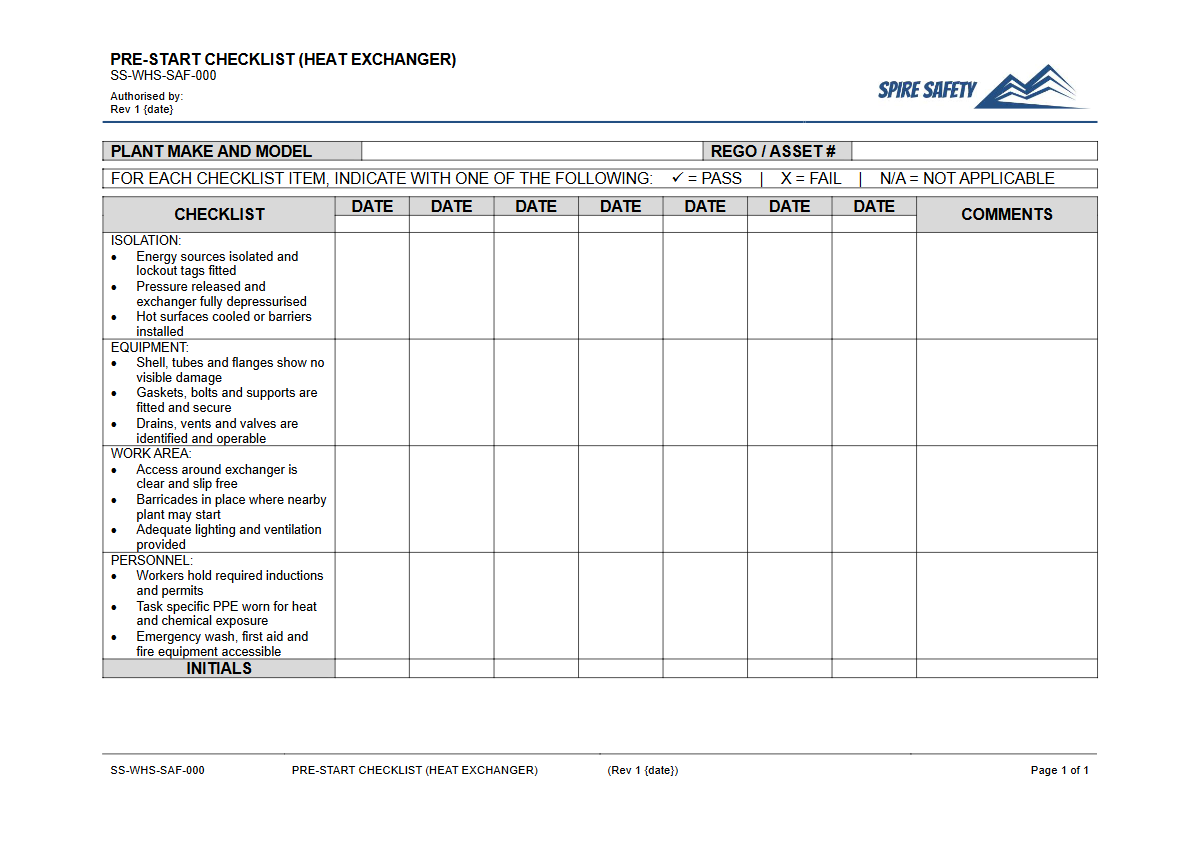
This Free Pre-Start Checklist (Heat Exchanger) Template provides a structured framework for operators and maintenance staff to verify the condition of the unit, identify potential faults, and prevent incidents. Regular checks help detect issues like leaks, blockages, corrosion, or instrumentation failures early, minimising the risk of equipment failure, unplanned downtime, and serious harm to workers.
Integrating this checklist into daily operations supports a proactive safety culture. It creates a documented record of equipment condition, which is vital for maintenance planning, incident investigation, and demonstrating due diligence.
Formalising these inspections can be effectively communicated to your team through a targeted Pre-Start Checks and Plant Maintenance Toolbox Talk, reinforcing the importance of the procedure.
Video walkthrough
How to use the Free Pre-Start Checklist (Heat Exchanger) Template
This template is provided in both DOCX and PDF formats. The DOCX version is fully editable, allowing you to tailor the checklist items to the specific make, model, and operational context of your heat exchanger.
The PDF version is ready for immediate printing and use. Before implementation, it is essential to conduct a risk assessment to identify all relevant hazards and control measures for your specific equipment and workplace.
The checklist should be completed by a competent person before starting the heat exchanger for a shift or new process. The operator should work through each item, marking it as satisfactory or identifying a defect.
Any identified faults must be reported immediately to a supervisor according to your organisation's procedures, and the equipment should not be used until it is cleared as safe by an authorised person. Regularly reviewing these completed checklists helps identify recurring issues, guiding preventative maintenance strategies and potential updates to your WHS management systems.
Customisation is Essential
Please note: this template provides a solid foundation, but we haven't seen your specific heat exchanger, workplace, or operational context. You must customise this document to align with your equipment manufacturer's instructions, relevant Australian Standards, and your site-specific risk assessments.
It is your responsibility to ensure the final document is comprehensive and suitable for your needs.
When to use a Heat Exchanger Pre-Start Checklist
A pre-start check should be conducted at the beginning of every shift or before the equipment is first energised for a day's work. It should also be used if the equipment has been idle for an extended period, has undergone maintenance or repair, or if operational parameters have changed.
The goal is to confirm its safe state before introducing energy, pressure, or thermal loads. This routine forms a key part of an effective preventative maintenance program.
Who should use it
This Pre-Start Checklist should be completed by personnel who are trained and authorised to operate the specific heat exchanger. This includes plant operators, process technicians, and maintenance staff.
Supervisors have a responsibility to ensure these checks are being completed correctly and that any reported issues are addressed promptly. It is crucial that anyone operating the equipment has their skills and knowledge verified; for some industrial equipment, a formal process using a tool like a Verification of Competency (Pipe Threader) Template can be adapted to document this.
Key Inspection Areas for a Heat Exchanger
While your customised checklist will be more detailed, it should cover several key areas to ensure a thorough inspection. These areas form the basis of a safe system of work and can be detailed further in your standard operating procedures.
Visual and Physical Checks
- Inspect for any signs of external corrosion, cracks, or physical damage to the shell, tubes, and end caps.
- Check all gaskets and seals for signs of leakage, perishing, or damage.
- Ensure all supporting structures, bolts, and foundations are secure and in good condition.
- Confirm the area around the heat exchanger is clear of obstructions, flammable materials, and trip hazards.
Developing robust safety documentation, such as a Free Heat Gun SOP (Safe Operating Procedure) Template for other thermal equipment, establishes clear expectations for how tasks should be performed safely, complementing the pre-start process.
Instrumentation and Controls
- Verify that pressure gauges and temperature sensors are functioning correctly and providing plausible readings.
- Check that all control and isolation valves are in their correct pre-start positions (open/closed) and are not seized or leaking.
- Ensure safety devices, such as pressure relief valves, are unobstructed and show no signs of tampering or corrosion.
Periodically confirming that your safety procedures are being followed and remain effective is a core part of safety management. This can be achieved through internal reviews or more formal WHS compliance auditing activities.
Common mistakes
Common mistakes to avoid
- Using a generic checklist that misses specific hazards of the heat exchanger model.
- Ignoring minor leaks or 'weeps' from seals, which can indicate a developing failure.
- Failing to properly isolate the unit before conducting any physical checks.
- Not documenting findings or failing to escalate identified defects to supervisors, rendering the check ineffective.
Legal references
Legal considerations
The following legal requirements may be relevant to this type of work.
- Work Health and Safety Act (Harmonised) — Provides the primary duties for protecting workers and other people from work health and safety risks.
- Work Health and Safety Regulations (Harmonised) — Sets out requirements supporting the management of workplace hazards and risks.
The following codes may be relevant to this type of work.
- Managing WHS Risks Code of Practice — Provides practical guidance on identifying hazards, assessing risks and applying effective controls.
- Work Health and Safety Consultation, Cooperation and Coordination Code of Practice — Provides practical guidance on consulting workers and coordinating with other duty holders.
- Managing the Work Environment and Facilities Code of Practice — Provides practical guidance on safe work environments, workplace facilities and related controls.
Did you know
The Dangers of Fouling
Fouling, the accumulation of unwanted material on heat transfer surfaces, is a major issue in heat exchangers. It not only reduces thermal efficiency but can also increase pressure drop, leading to blockages and potential over-pressurisation events if not managed.
Thermal Stress
Rapid changes in temperature can induce significant thermal stress in the materials of a heat exchanger. This can lead to fatigue, cracking, and eventual failure, which is why controlled start-up and shutdown procedures are critical.
FAQ
Frequently asked questions
01What's the difference between a pre-start check and regular maintenance?
02Why is a specific checklist for a heat exchanger necessary?
03How often should a heat exchanger pre-start check be performed?
04Can this template be used for all types of heat exchangers?
Share this resource
Free Pre-Start Checklist (Heat Exchanger) Template
Browse Categories
How To Use It
- 1Download and open in Word or PDF.
- 2Replace the placeholders with your business details.
- 3Get it reviewed by a WHS specialist before rollout.
Need it customised?
Our WHS consultants can adapt this template to your site, run a gap analysis, or audit what you already have in place.
Book a Free Consultation WHS consulting servicesor call 1300 156 382