
Free Pre-Start Checklist (Homogeniser) Template
Download our free Pre-Start Checklist (Homogeniser) Template (DOCX & PDF). A structured starting point to formalise equipment safety inspections.
Free Pre-Start Checklist (Homogeniser) Template
DOCX • 125 KB + PDF
Updated Oct 2026
No signup required
Purpose of the Free Pre-Start Checklist (Homogeniser) Template
Homogenisers are powerful pieces of machinery, operating at extremely high pressures to process liquids. Ensuring their safe operation is critical to prevent catastrophic failures, product contamination, and serious injuries to personnel.
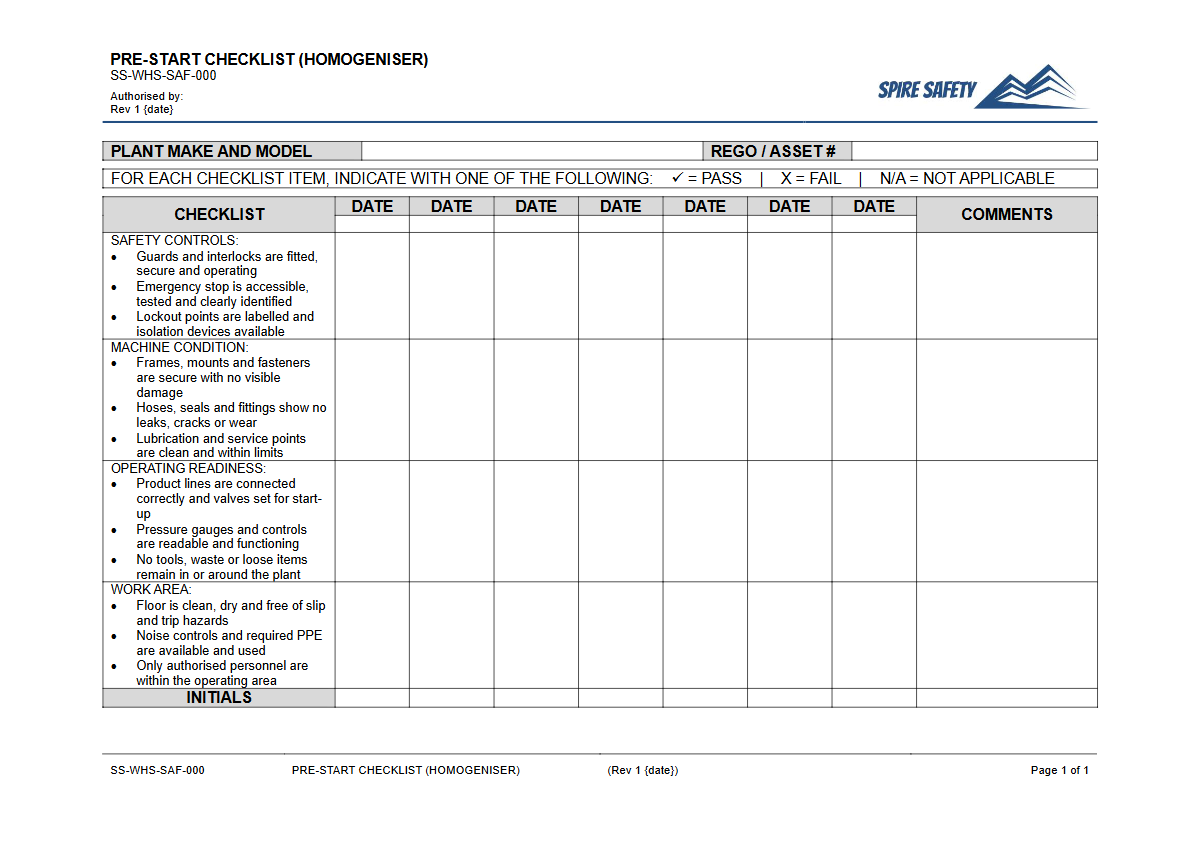
This Free Pre-Start Checklist (Homogeniser) Template provides a structured framework for conducting essential daily inspections. Using a formal checklist helps operators systematically identify potential hazards—such as worn seals, malfunctioning gauges, or compromised safety guards—before starting the equipment.
This proactive approach to safety helps maintain operational integrity, reduces the risk of unplanned downtime, and demonstrates a commitment to workplace health and safety obligations.
Formalising this process moves your organisation beyond ad-hoc checks, creating a documented record of due diligence. Consistent use of pre-start checks is a fundamental component of plant safety, helping to build a stronger safety culture.
To further reinforce these habits, you can incorporate our Pre-Start Checks and Plant Maintenance Toolbox Talk Template into your regular safety meetings.
Video walkthrough
How to use the Free Pre-Start Checklist (Homogeniser) Template
This template is designed to be a practical tool that can be easily integrated into your daily operations. To get started, download the document in your preferred format (DOCX or PDF).
The DOCX version is fully editable, allowing for comprehensive customisation.
Important: This document is a template and must be customised to your specific workplace. We are not familiar with your operational specifics, the make and model of your equipment, or the unique hazards present.
You must review and amend the checklist to include items relevant to your particular homogeniser, site procedures, and the products being processed. This may involve adding checks for specific pressure ratings, seal materials, interlock systems, and cleaning-in-place (CIP) connections.
Once customised, train all relevant operators and supervisors on how to complete the checklist correctly and what actions to take if a fault is identified. The checklist should become a non-negotiable step before any operation begins.
Integrating this procedure is a key part of building robust WHS management systems that effectively control risks associated with plant and equipment. For a related example, see our Free Pre-Start Checklist (Agitator) Template, which covers similar processing equipment.
When to use it
The Pre-Start Checklist for a homogeniser should be completed at the beginning of every shift or before the equipment is used for the first time on any given day. It is also crucial to perform a thorough check after any maintenance or repair work has been carried out to ensure the equipment has been returned to a safe operational state.
If there is a change of operator during a shift, the incoming operator should also review the checklist or perform their own check to verify the machine's condition. These checks can be discussed and documented as part of your daily pre-start meetings, which you can formalise using a free Pre-Start Meeting Template.
Who should use it
This checklist should be completed by a person who is trained, competent, and authorised to operate the specific homogeniser. This is typically the machine operator responsible for the production run.
Supervisors or team leaders should also be familiar with the checklist so they can verify its completion and ensure any identified issues are addressed promptly. WHS personnel and maintenance managers may also use the completed checklists during safety audits and to inform preventative maintenance schedules.
Regular reviews of these records are a core activity during WHS compliance auditing to confirm that safety procedures are being followed consistently.
Integrating the Checklist into Your Safety Framework
A pre-start checklist is not a standalone document; it is one part of a comprehensive safety framework. The information gathered should feed into other systems to ensure a holistic approach to risk management. For instance, if a pre-start check identifies a significant hazard, this may trigger a review of the associated Safe Work Method Statement (SWMS) or a work order for the maintenance team. Completed checklists serve as valuable records that can be used for incident investigations, maintenance planning, and demonstrating procedural compliance. Effective integration across all safety processes is key, and seeking expert advice from WHS consulting professionals can help ensure your systems are connected and effective. You can find more templates to support your safety system in our extensive free WHS resources library.
Common mistakes
Common mistakes to avoid
- Using a generic checklist without tailoring it to the specific make and model of the homogeniser.
- "Pencil-whipping" or ticking boxes without physically and carefully inspecting each item.
- Failing to immediately report and take corrective action when a fault or defect is found.
- Not retaining completed checklists as a record for maintenance planning and safety audits.
Legal references
Legal considerations
The following legal requirements may be relevant to this type of work.
- Work Health and Safety Act (Harmonised) — Provides the primary duties for protecting workers and other people from work health and safety risks.
- Work Health and Safety Regulations (Harmonised) — Sets out requirements supporting the management of workplace hazards and risks.
The following codes may be relevant to this type of work.
- Managing WHS Risks Code of Practice — Provides practical guidance on identifying hazards, assessing risks and applying effective controls.
- Work Health and Safety Consultation, Cooperation and Coordination Code of Practice — Provides practical guidance on consulting workers and coordinating with other duty holders.
- Managing the Work Environment and Facilities Code of Practice — Provides practical guidance on safe work environments, workplace facilities and related controls.
Did you know
Extreme Pressure
Industrial homogenisers operate at immense pressures, often between 2,000 and 15,000 PSI (pounds per square inch), to force liquids through a tiny valve. This is what creates the stable emulsion in products like milk, cream, and sauces.
Acoustic Cavitation
The intense process inside a homogeniser creates a phenomenon called cavitation, where tiny vapour bubbles form and collapse rapidly. This generates powerful shockwaves that break down fat globules and particles, but it can also cause wear on machine components over time.
FAQ
Frequently asked questions
01What should be included in a homogeniser pre-start checklist?
02Why is a pre-start check important for a homogeniser?
03How often should a homogeniser pre-start check be performed?
04Is this pre-start checklist a legal requirement in Australia?
Share this resource
Free Pre-Start Checklist (Homogeniser) Template
Browse Categories
How To Use It
- 1Download and open in Word or PDF.
- 2Replace the placeholders with your business details.
- 3Get it reviewed by a WHS specialist before rollout.
Need it customised?
Our WHS consultants can adapt this template to your site, run a gap analysis, or audit what you already have in place.
Book a Free Consultation WHS consulting servicesor call 1300 156 382