
Free Pre-Start Checklist (Hospital Bed) Template
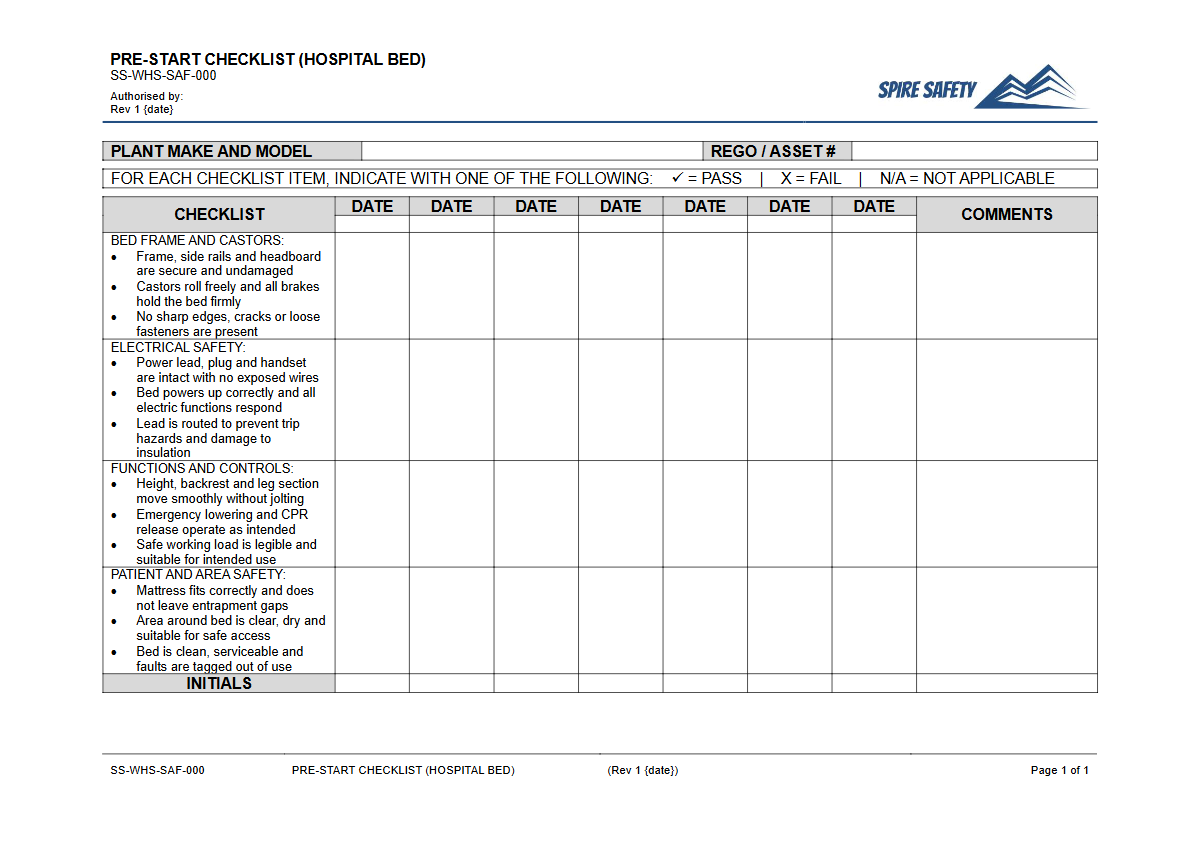
Download our Free Pre-Start Checklist for Hospital Beds. This customisable template helps formalise safety checks in aged care and healthcare settings.
Free Pre-Start Checklist (Hospital Bed) Template
DOCX • 125 KB + PDF
Updated Oct 2026
No signup required
Purpose of the Free Pre-Start Checklist (Hospital Bed) Template
Regularly inspecting hospital beds is a critical safety measure in any healthcare or aged care facility. This Free Pre-Start Checklist (Hospital Bed) Template provides a structured method for staff to verify that beds are safe, clean, and fully operational before patient use.
Using a formal checklist helps identify potential mechanical or electrical faults, damage, or contamination early, preventing incidents that could lead to injury for patients or healthcare workers. It transforms an informal visual scan into a documented, repeatable safety process.
Implementing this checklist helps a Person Conducting a Business or Undertaking (PCBU) meet their primary duty of care under WHS law. It serves as a practical tool within broader WHS management systems, creating a clear record that demonstrates due diligence in equipment maintenance and risk management.
This systematic approach ensures that every bed in service meets a consistent safety standard, supporting a safer environment for everyone.
Video walkthrough
How to use the Free Pre-Start Checklist (Hospital Bed) Template
This resource is available for download as a customisable DOCX file and a print-ready PDF. The checklist is designed as a comprehensive starting point aligned with Australian WHS principles.
It covers key inspection points including the frame, mattress, side rails, castors, brakes, and electrical components like the control pendant and power cord.
To get the most value from this template, it must be adapted to your specific operational needs. We strongly advise you to customise this document to align with the particular makes and models of hospital beds at your site, your facility's procedures, and any unique environmental hazards. Key steps for implementation include:
- Review and Customise: Add or remove checklist items to match the features of your specific beds. For example, you may need to add checks for bariatric bed functions or specific bed exit alarm systems.
- Train Your Team: Ensure all relevant staff, such as nurses and patient care assistants, understand how to complete the checklist correctly and what to do if they find a fault. This training can be reinforced through practical demonstrations and regular safety meetings, such as an Aged Care Manual Handling Toolbox Talk.
- Integrate and Document: Incorporate the checklist into your daily shift handover or room preparation procedures. Establish a clear process for filing completed checklists and escalating reports of damaged or faulty equipment for repair.
When to use a Hospital Bed Pre-Start Checklist
A pre-start check should be performed at regular intervals to ensure the ongoing safety of the equipment. The ideal frequency is before the first use of the bed on any given day or shift.
This ensures the bed is verified as safe before a patient is placed in it.
Additional situations that call for a pre-start check include:
- After the bed has been moved between rooms, wards, or facilities.
- Following any servicing, maintenance, or repair work.
- If there is any reason to suspect the bed may have been damaged.
Embedding these checks into daily operations promotes a proactive safety culture. Much like a daily Pre-Start Checks and Plant Maintenance Toolbox Talk for industrial equipment, this practice reinforces that safety is a shared responsibility and that equipment must be verified before use, not after an incident occurs.
Who should use this checklist
This Pre-Start Checklist is designed for use by the frontline staff who interact with and operate hospital beds daily. This typically includes:
- Registered Nurses (RNs)
- Enrolled Nurses (ENs)
- Assistants in Nursing (AINs)
- Patient Care Assistants (PCAs)
- Orderlies and other support staff
Supervisors, such as Nurse Unit Managers, should be responsible for overseeing the process, ensuring checks are completed consistently and that corrective actions are taken when faults are identified. The completed checklists provide valuable data for managers and can be reviewed during WHS compliance auditing to verify that safety procedures are being followed effectively.
Maintenance and biomedical engineering staff may also use the checklist to confirm a bed is ready to return to service after a repair.
By equipping your team with a clear and simple tool, you empower them to take an active role in maintaining a safe care environment. To discover more tools to support your safety management, browse our complete free WHS resources library.
Common mistakes
Common mistakes to avoid
- Using a generic checklist without customising it for specific bed makes and models.
- Forgetting to inspect and test electrical components like power cords, plugs, and control pendants.
- Failing to physically test all bed functions, including height adjustment, head/foot articulation, and side rail locking mechanisms.
- Not immediately removing a faulty bed from service and clearly tagging it as 'Do Not Use' until repaired.
Legal references
Legal considerations
The following legal requirements may be relevant to this type of work.
- Work Health and Safety Act (Harmonised) — Provides the primary duties for protecting workers and other people from work health and safety risks.
- Work Health and Safety Regulations (Harmonised) — Sets out requirements supporting the management of workplace hazards and risks.
The following codes may be relevant to this type of work.
- Managing WHS Risks Code of Practice — Provides practical guidance on identifying hazards, assessing risks and applying effective controls.
- Work Health and Safety Consultation, Cooperation and Coordination Code of Practice — Provides practical guidance on consulting workers and coordinating with other duty holders.
- Managing the Work Environment and Facilities Code of Practice — Provides practical guidance on safe work environments, workplace facilities and related controls.
Did you know
Patient Entrapment
A significant risk associated with hospital beds is patient entrapment, where a patient gets caught in gaps between bed rails, the mattress, and the head/footboard. Regular equipment checks help mitigate this hazard.
Ergonomic Design
Modern hospital beds are complex machines designed to reduce manual handling risks for healthcare workers, but these ergonomic benefits are only realised when all powered functions are fully operational.
FAQ
Frequently asked questions
01Why are pre-start checks for hospital beds important?
02What are the risks of not inspecting a hospital bed?
03How often should a hospital bed pre-start check be performed?
04Can this template be used for all types of hospital beds?
Share this resource
Free Pre-Start Checklist (Hospital Bed) Template
Browse Categories
How To Use It
- 1Download and open in Word or PDF.
- 2Replace the placeholders with your business details.
- 3Get it reviewed by a WHS specialist before rollout.
Need it customised?
Our WHS consultants can adapt this template to your site, run a gap analysis, or audit what you already have in place.
Book a Free Consultation WHS consulting servicesor call 1300 156 382