
Free Pre-Start Checklist (Hay Tedder) Template
Formalise your agricultural machinery inspections with our Free Pre-Start Checklist (Hay Tedder) Template. Available in DOCX and PDF. Download today.
Free Pre-Start Checklist (Hay Tedder) Template
DOCX • 125 KB + PDF
Updated Oct 2026
No signup required
Purpose of the Free Pre-Start Checklist (Hay Tedder) Template
Operating agricultural machinery like hay tedders introduces significant workplace hazards, including mechanical entanglement, hydraulic fluid injection, and rollover. This Free Pre-Start Checklist (Hay Tedder) Template provides a structured starting point for operators to conduct thorough, documented inspections before each use.
A consistent pre-start process helps identify potential defects, damage, or missing guards before they can lead to an incident or breakdown. Formalising these checks is a key component of a proactive safety culture, ensuring equipment is maintained in safe working order.
By creating a routine, you shift from a reactive to a preventative maintenance mindset. These documented checks form a critical part of your overall safety framework, demonstrating due diligence and contributing to more effective WHS management systems. They provide a record that inspections are occurring and create a channel for operators to report issues promptly.
Video walkthrough
How to use the Free Pre-Start Checklist (Hay Tedder) Template
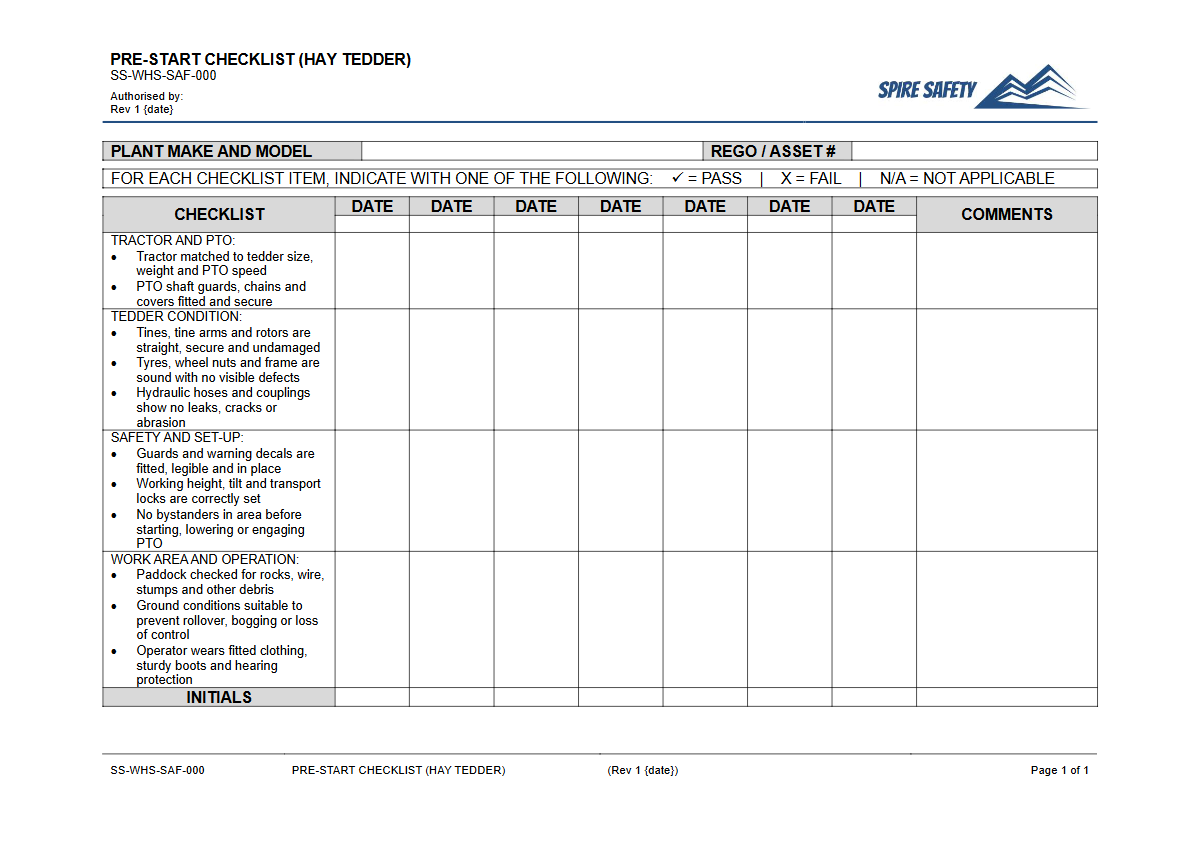
This template is provided as a downloadable DOCX file for easy customisation, as well as a print-ready PDF. The checklist guides the operator through a logical inspection sequence, covering critical components from guards and hydraulics to tyres and hitches.
To implement it effectively:
- Download and Customise: Open the DOCX file and modify the checklist items to match the specific make and model of your hay tedder(s). Add or remove checks based on your machine's features, manufacturer's recommendations, and site-specific risks.
- Train Your Workers: Ensure all operators are trained on how to properly conduct the inspection. They must understand what each checkpoint means and what constitutes a 'pass' or 'fail'.
- Implement and Monitor: Integrate the checklist into your daily pre-operational routine. Supervisors should periodically review completed forms to ensure checks are being done diligently and to follow up on any reported defects.
Important: This document is a template, not a finished procedure. It is crucial that you customise it to reflect the specific equipment, environment, and tasks at your workplace.
We have provided a general framework based on common industry practice, but you must take responsibility for ensuring it is comprehensive and suitable for your operation.
Reinforcing these habits is essential for long-term safety improvements. You can support this process by running regular safety sessions using resources like our Pre-Start Checks and Plant Maintenance Toolbox Talk to keep the importance of these inspections front of mind for all team members.
When to use a Hay Tedder Pre-Start Checklist
A pre-start checklist should be completed before the hay tedder is used for the first time each day or at the beginning of every shift. This frequency ensures that any issues that may have developed overnight, during transport, or from the previous operation are caught before work commences.
If operators change during a shift, the incoming operator should also perform a check to verify the equipment's condition.
These checks are often a core part of a broader daily startup process. Many teams conduct them immediately following a pre-start meeting where the day's tasks and hazards are discussed, which can be documented using a Pre-Start Meeting Template.
Who should use this Pre-Start Checklist
The primary user of this checklist should be the person operating the hay tedder. The operator has the most hands-on interaction with the machine and is best placed to notice subtle changes in its condition or performance.
Empowering operators to take ownership of equipment safety is a fundamental aspect of a strong safety culture.
Supervisors and managers also have a role. They are responsible for ensuring the pre-start system is working, reviewing the completed checklists, and taking prompt action to address any reported faults. Verifying that safety processes like pre-starts are being followed correctly is a key part of ensuring workplace safety, a process which can be formalised through WHS compliance auditing.
For more guidance on developing robust safety documentation and processes for your agricultural business, explore the wide range of templates in our free WHS resources library.
Common mistakes
Common mistakes to avoid
- "Pencil-whipping" or "tick and flick" the checklist without performing a thorough physical inspection.
- Using a generic checklist that doesn't cover the specific make, model, and hazards of the hay tedder in use.
- Failing to report, isolate, or repair defects identified during the check, rendering the process ineffective.
- Not providing operators with adequate training on how to conduct the inspection and what to look for.
Legal references
Legal considerations
The following legal requirements may be relevant to this type of work.
- Work Health and Safety Act (Harmonised) — Provides the primary duties for protecting workers and other people from work health and safety risks.
- Work Health and Safety Regulations (Harmonised) — Sets out requirements supporting the management of workplace hazards and risks.
The following codes may be relevant to this type of work.
- Managing WHS Risks Code of Practice — Provides practical guidance on identifying hazards, assessing risks and applying effective controls.
- Work Health and Safety Consultation, Cooperation and Coordination Code of Practice — Provides practical guidance on consulting workers and coordinating with other duty holders.
- Managing the Work Environment and Facilities Code of Practice — Provides practical guidance on safe work environments, workplace facilities and related controls.
Did you know
Entanglement Hazard
The Power Take-Off (PTO) shaft on a hay tedder can rotate at speeds up to 1000 RPM. A person's limb can be wrapped around an unguarded shaft in less than a second, making PTO guarding one of the most critical safety checks.
FAQ
Frequently asked questions
01What is a hay tedder pre-start checklist for?
02Are pre-start checks legally required for hay tedders in Australia?
03Who is responsible for completing the hay tedder pre-start check?
04How often should a hay tedder pre-start check be done?
Share this resource
Free Pre-Start Checklist (Hay Tedder) Template
Browse Categories
How To Use It
- 1Download and open in Word or PDF.
- 2Replace the placeholders with your business details.
- 3Get it reviewed by a WHS specialist before rollout.
Need it customised?
Our WHS consultants can adapt this template to your site, run a gap analysis, or audit what you already have in place.
Book a Free Consultation WHS consulting servicesor call 1300 156 382