
Free Pre-Start Checklist (Bale Clamp) Template
Download our free Pre-Start Checklist (Bale Clamp) Template to ensure your equipment is safe before use.
Free Pre-Start Checklist (Bale Clamp) Template
DOCX • 125 KB + PDF
Updated Oct 2026
No signup required
Purpose of the Free Pre-Start Checklist (Bale Clamp) Template
Operating machinery fitted with a bale clamp attachment requires diligence. This attachment, common in agriculture, recycling, and manufacturing, introduces specific hazards that a standard forklift or loader check may overlook.
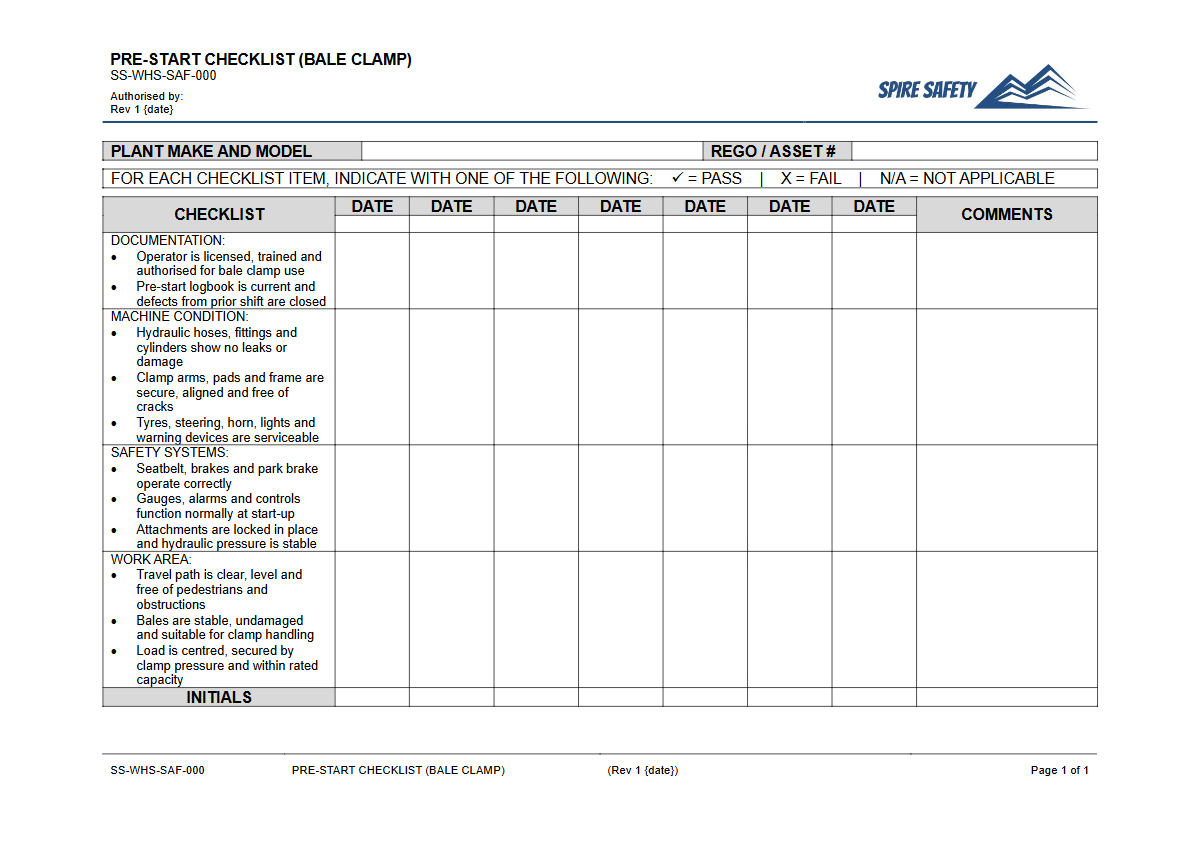
Our free Pre-Start Checklist (Bale Clamp) Template provides a structured framework to guide operators through a thorough inspection before they begin work. Using a formal checklist helps identify potential faults like hydraulic leaks, structural damage, or control malfunctions before they can lead to an incident.
It formalises the inspection process, creates a documented record of safety checks, and demonstrates a proactive approach to risk management in the workplace.
Regular pre-start inspections are a fundamental component of plant safety. They are crucial for maintaining equipment in a safe operating condition and fulfilling duties under Australian WHS laws.
Integrating this check into your daily routine is a critical step in preventing equipment failure, property damage, and serious injuries. A well-maintained safety system also involves training; our Pre-Start Checks and Plant Maintenance Toolbox Talk can help reinforce the importance of these daily inspections with your team.
Video walkthrough
How to use the Free Pre-Start Checklist (Bale Clamp) Template
This template is a comprehensive starting point designed for easy adoption into your safety procedures. First, download the resource in your preferred format (DOCX for easy editing or PDF).
The next step is crucial: customisation. You must adapt the checklist to the specific makes and models of bale clamps and associated plant (like forklifts or loaders) used in your workplace.
Consider the unique operating environment, the types of bales being handled (e.g., hay, cotton, paper), and any site-specific hazards.
Once customised, ensure all relevant operators are trained on how to use the checklist correctly. This training should cover what each checkpoint means and the procedure for reporting defects.
The checklist should be completed at the start of each shift, with the operator signing off on the inspection. If any faults are identified that pose a safety risk, the equipment must be immediately taken out of service, tagged out, and reported to a supervisor for repair.
These documented checks form an important part of your overall safety records. Similar principles apply to other specialised equipment, such as when using our Free Pre-Start Checklist (Artic Loader) Template for articulated loaders.
A Note on Customisation
Please note: This document is a template. We have designed it to be a comprehensive starting point aligned with good WHS practice, but you must customise it to reflect the specific bale clamp models, host machinery, work environment, and operational risks at your site.
A generic document cannot account for all variables.
When to use it
A bale clamp pre-start checklist should be completed before the equipment is used for the first time on any given day or at the beginning of every operator's shift. This ensures that the equipment's condition is verified before any work task commences.
It should not be treated as a weekly or monthly task. The frequency of use creates a consistent safety habit and increases the likelihood of catching developing faults before they escalate into major failures or safety incidents.
These daily checks are a core part of proactive maintenance and are distinct from periodic servicing or comprehensive inspections. Establishing this routine is a key part of building robust WHS management systems within your organisation, helping to create a culture where safety is a shared responsibility.
Who should use it
The pre-start checklist is designed to be completed by the person operating the equipment—a trained and competent forklift or loader operator who holds the relevant high-risk work licence if required. The operator has the most immediate interaction with the equipment and is best placed to notice changes in its condition or performance.
Supervisors and managers also have a role; they are responsible for ensuring that operators are supplied with the correct checklists, are trained to use them, and are completing them consistently and correctly. They must also act on any reported defects in a timely manner.
For other specialised plant, like industrial mixers, a dedicated checklist such as our Free Pre-Start Checklist (Agitator) Template should be used by the relevant operator.
Ultimately, ensuring plant safety is a team effort. These checklists provide the tools for workers on the ground to play their part effectively.
For businesses looking for other ways to improve their safety documentation, our free WHS resources library offers a wide range of templates and guides.
Common mistakes
Common mistakes to avoid
- Using a generic forklift checklist that doesn't cover bale clamp specific components.
- "Pencil-whipping" or ticking boxes on the form without physically inspecting the items.
- Failing to tag out and report faulty equipment identified during the inspection.
- Not customising the checklist template for the specific models of bale clamps in use at the workplace.
Legal references
Legal considerations
The following legal requirements may be relevant to this type of work.
- Work Health and Safety Act (Harmonised) — Provides the primary duties for protecting workers and other people from work health and safety risks.
- Work Health and Safety Regulations (Harmonised) — Sets out requirements supporting the management of workplace hazards and risks.
The following codes may be relevant to this type of work.
- Managing WHS Risks Code of Practice — Provides practical guidance on identifying hazards, assessing risks and applying effective controls.
- Work Health and Safety Consultation, Cooperation and Coordination Code of Practice — Provides practical guidance on consulting workers and coordinating with other duty holders.
- Managing the Work Environment and Facilities Code of Practice — Provides practical guidance on safe work environments, workplace facilities and related controls.
Did you know
Hydraulic Hazards
A pinhole leak in a high-pressure hydraulic line can eject fluid at a velocity high enough to penetrate skin, causing serious injection injuries. This makes checking all hoses and connections a critical part of any pre-start inspection.
Attachments and Stability
Adding a heavy attachment like a bale clamp significantly changes a forklift's centre of gravity and safe load capacity. The machine's rating plate must be accurate and reflect the specifications of the machine *with* the attachment fitted.
FAQ
Frequently asked questions
01What should be checked on a bale clamp during a pre-start inspection?
02Is a digital pre-start checklist better than a paper one?
03How often should a bale clamp pre-start check be completed?
04Who is responsible for ensuring bale clamp pre-starts are done correctly?
Share this resource
Free Pre-Start Checklist (Bale Clamp) Template
Browse Categories
How To Use It
- 1Download and open in Word or PDF.
- 2Replace the placeholders with your business details.
- 3Get it reviewed by a WHS specialist before rollout.
Need it customised?
Our WHS consultants can adapt this template to your site, run a gap analysis, or audit what you already have in place.
Book a Free Consultation WHS consulting servicesor call 1300 156 382