
Free Pre-Start Checklist (Backhoe) Template
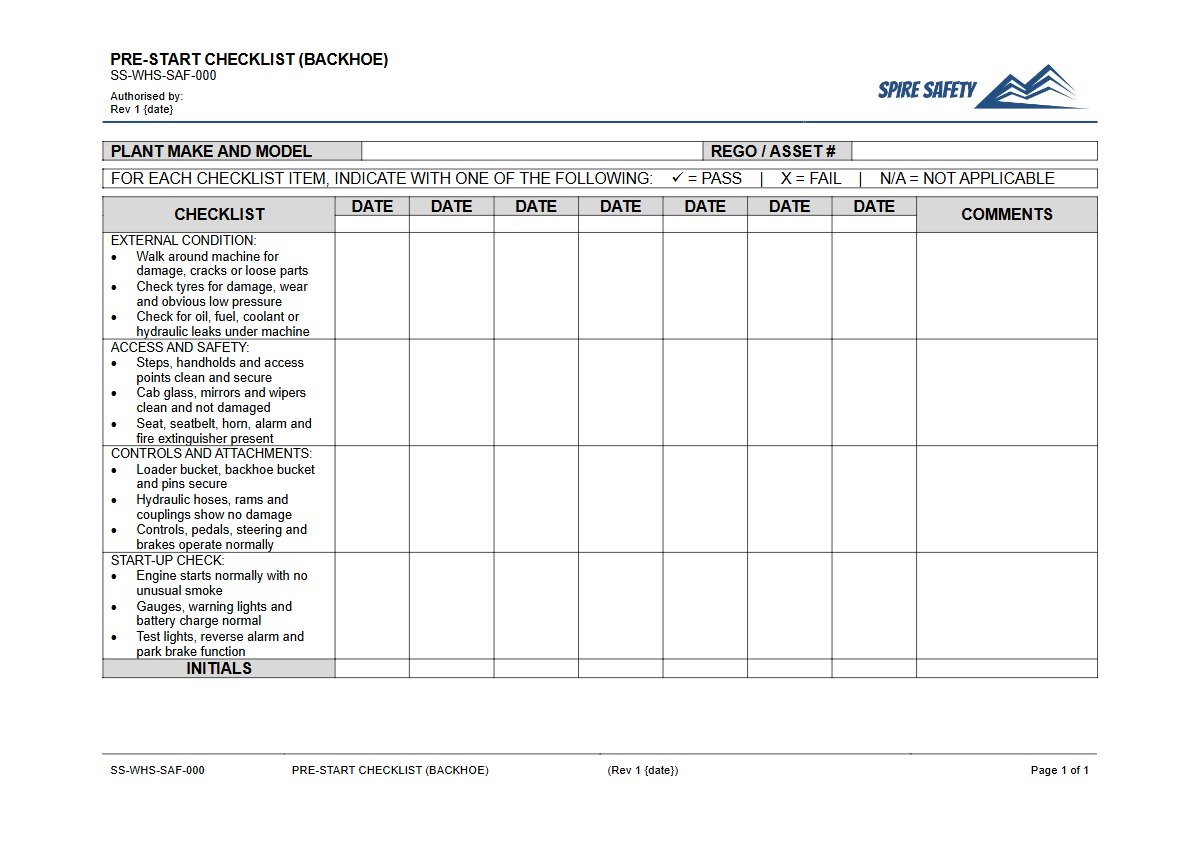
Download our free Pre-Start Checklist (Backhoe) Template in DOCX and PDF. This structured document helps formalise daily equipment safety inspections.
Free Pre-Start Checklist (Backhoe) Template
DOCX • 125 KB + PDF
Updated Oct 2026
No signup required
Purpose of the Free Pre-Start Checklist (Backhoe) Template
Operating a backhoe loader involves significant risks. A thorough pre-start inspection is a fundamental safety control measure to ensure the equipment is in safe working order before each use.
This free Pre-Start Checklist (Backhoe) Template provides a structured framework for operators to conduct and record daily checks, helping to identify mechanical faults, fluid leaks, or damage that could lead to an incident. Systematically identifying and addressing these issues before they escalate is a key duty for any Person Conducting a Business or Undertaking (PCBU).
Formalising this process helps create a reliable record of due diligence, demonstrating a commitment to plant safety. Integrating such checklists is a cornerstone of building effective WHS management systems, as it provides tangible evidence of proactive risk management and supports preventative maintenance schedules.
Video walkthrough
How to use the Free Pre-Start Checklist (Backhoe) Template
This document is provided as a starting point in both DOCX and PDF formats. While it is aligned with Australian WHS principles for plant safety, it must be adapted to your specific operational context.
Download the template and customise it to include checks relevant to the make and model of your backhoe(s), the specific attachments used (e.g., buckets, augers, hammers), and the environmental conditions of your worksite.
Important: We are not a law firm. This template is a starting point, not a complete solution.
You must customise it to suit the specific hazards and risks present in your workplace and with your equipment. You should also ensure operators are trained not only on how to operate the backhoe but also on the importance and procedure of completing this checklist accurately. The process of verifying these procedures are followed correctly is often a key finding in WHS compliance audits.
When to use it
A backhoe pre-start inspection should be completed before the start of every shift or before the first use of the day. If multiple operators use the same machine during a single shift, a new check should be conducted at handover.
This frequency ensures that any damage or faults that may have occurred during operation, overnight, or due to tampering are identified before the next operator begins work. The principle is universal for heavy machinery, whether it's this backhoe checklist or a pre-start checklist for a forwarder in a forestry setting.
Who should use it
The primary person responsible for completing the checklist is the backhoe operator. They have the most hands-on interaction with the machine and are best placed to notice subtle changes in its performance or condition.
However, the responsibility does not end with them. Supervisors or site managers should periodically review completed checklists to ensure they are being filled out correctly and to identify recurring maintenance issues.
Maintenance personnel will also use the information from these checklists to schedule repairs and preventative work. This process applies across all types of mobile plant, just as an operator would use a specific template for a floor saw before cutting concrete.
Beyond this template, a comprehensive approach to safety may involve developing Safe Work Method Statements (SWMS) for high-risk construction work involving the backhoe, conducting operator competency assessments, and establishing clear tag-out procedures for faulty equipment. For guidance on developing these broader safety frameworks, consider engaging specialist WHS consulting to ensure your systems are robust and practical for your business.
By consistently using this pre-start checklist, your organisation can foster a stronger safety culture where equipment safety is a shared responsibility. For more tools to support your safety management program, explore our complete free WHS resources library, which includes a wide range of templates, forms, and guides.
Common mistakes
Common mistakes to avoid
- "Pencil-whipping" the checklist without physically inspecting the items.
- Using a generic heavy vehicle checklist that misses backhoe-specific components like the boom, dipper, and stabilisers.
- Failing to top up critical fluids like engine oil or hydraulic fluid when they are found to be low.
- Continuing to operate the machine with a "minor" fault that could escalate into a major failure or safety incident.
Legal references
Legal considerations
The following legal requirements may be relevant to this type of work.
- Work Health and Safety Act (Harmonised) — Provides the primary duties for protecting workers and other people from work health and safety risks.
- Work Health and Safety Regulations (Harmonised) — Sets out requirements supporting the management of workplace hazards and risks.
The following codes may be relevant to this type of work.
- Managing WHS Risks Code of Practice — Provides practical guidance on identifying hazards, assessing risks and applying effective controls.
- Work Health and Safety Consultation, Cooperation and Coordination Code of Practice — Provides practical guidance on consulting workers and coordinating with other duty holders.
- Managing the Work Environment and Facilities Code of Practice — Provides practical guidance on safe work environments, workplace facilities and related controls.
Did you know
High-Pressure Hazard
A pinhole leak in a backhoe's hydraulic hose can release fluid at a pressure over 2,000 PSI, which is powerful enough to penetrate skin and cause a severe fluid injection injury that requires immediate, specialised medical treatment.
Invention of the Backhoe
The world's first backhoe loader was created in 1953 by Joseph Cyril Bamford (founder of JCB) in the UK. He integrated an excavator arm and a front loader onto a single tractor chassis, creating the versatile machine seen on worksites today.
FAQ
Frequently asked questions
01What are the most critical checks on a backhoe pre-start checklist?
02Is a digital pre-start checklist better than a paper one?
03How long should a backhoe pre-start inspection take?
04What must an operator do if a fault is found during a backhoe pre-start?
Share this resource
Free Pre-Start Checklist (Backhoe) Template
Browse Categories
How To Use It
- 1Download and open in Word or PDF.
- 2Replace the placeholders with your business details.
- 3Get it reviewed by a WHS specialist before rollout.
Need it customised?
Our WHS consultants can adapt this template to your site, run a gap analysis, or audit what you already have in place.
Book a Free Consultation WHS consulting servicesor call 1300 156 382