
Free Pre-Start Checklist (Baghouse) Template
Download our Free Pre-Start Checklist (Baghouse) Template to enhance safety protocols for your dust collection systems.
Free Pre-Start Checklist (Baghouse) Template
DOCX • 125 KB + PDF
Updated Oct 2026
No signup required
Purpose of the Free Pre-Start Checklist (Baghouse) Template
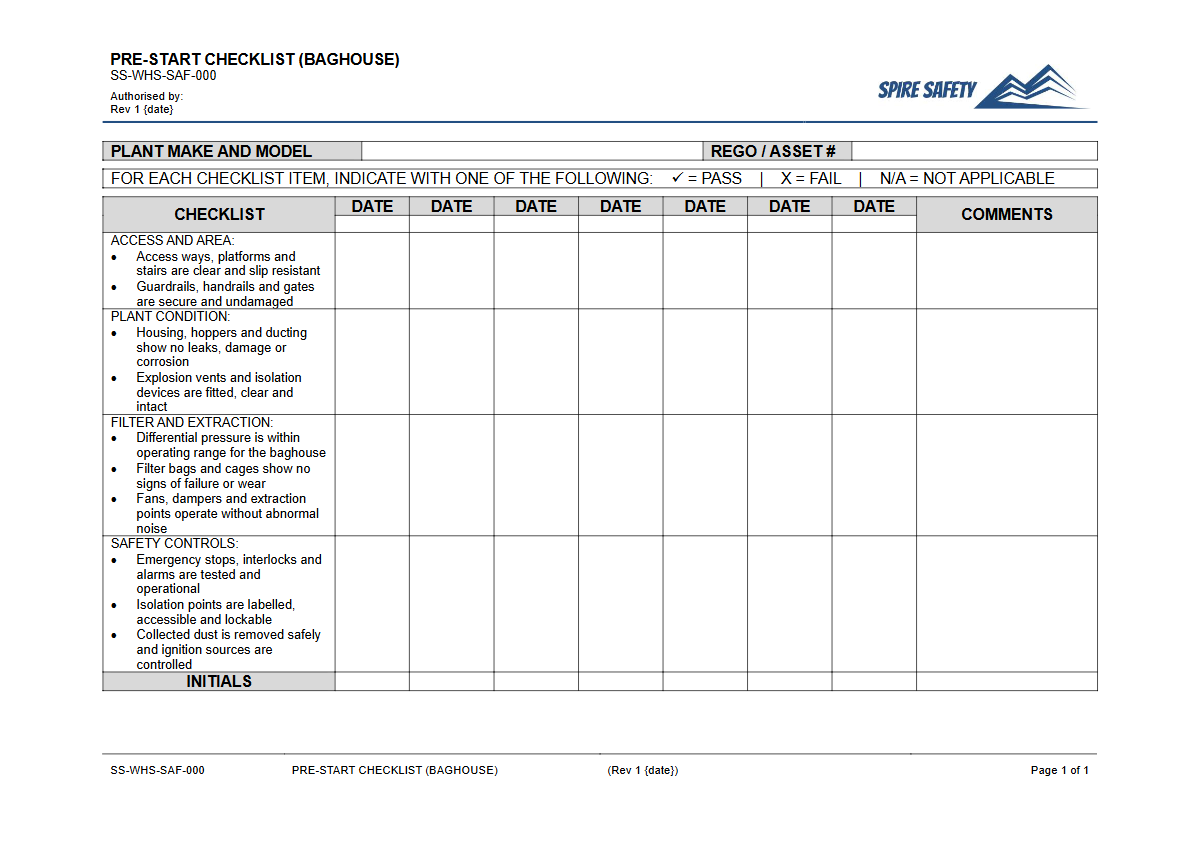
This Free Pre-Start Checklist (Baghouse) Template provides a structured framework for operators to conduct thorough safety and operational inspections of industrial dust collection systems before use. A baghouse is a critical piece of engineering control designed to capture airborne dust, fumes, and particulates, protecting workers from respiratory hazards and preventing contamination of the work environment.
Regularly using this checklist helps ensure the unit is functioning correctly, identifying potential faults like filter blockages, leaks, or mechanical failures before they lead to hazardous exposures or costly downtime.
Integrating these daily checks is a practical step in fulfilling your duties under Australian WHS law. It forms a key part of your site's safety protocols, demonstrating due diligence and providing a clear record of equipment condition.
Formalising this process contributes to more robust WHS management systems by embedding a proactive approach to plant and equipment safety.
Video walkthrough
How to use the Free Pre-Start Checklist (Baghouse) Template
This checklist is available for download as a fully editable DOCX file and a print-ready PDF. The DOCX version allows for complete customisation to align with your specific operational needs and equipment.
Important: It's essential to customise this template to your specific workplace. We've provided a solid foundation, but you must adapt it to reflect the make, model, and configuration of your baghouse system, the specific materials it handles (e.g., wood dust, metal fines, chemical powders), and your site-specific safe work procedures.
A generic checklist cannot account for all unique variables and risks.
The template guides the user through key inspection points, including:
- Visual Checks: Inspecting the housing, hopper, ductwork, and access doors for damage, corrosion, or leaks.
- Filter Condition: Checking for visible tears, holes, or signs of 'blinding' in the filter bags or cartridges.
- Cleaning System: Verifying the function of the pulse-jet, shaker, or reverse-air cleaning mechanism.
- Discharge System: Ensuring rotary airlocks or screw conveyors are clear and operational.
- Instrumentation: Checking gauges, particularly the differential pressure monitor, for correct readings.
To ensure your team understands the principles behind these inspections, consider running a session using our Pre-Start Checks and Plant Maintenance Toolbox Talk. This reinforces the importance of not just ticking boxes, but actively identifying hazards.
When to use it
A baghouse pre-start inspection should be completed at the beginning of every shift or before the equipment is operated for the first time each day. This routine establishes a baseline for the equipment's condition.
Additionally, a full check should be conducted after any significant maintenance, repair, or modification to the system to verify it has been returned to service in a safe condition.
This disciplined approach to pre-use checks is a fundamental safety principle applicable to many types of fixed and mobile plant. The same logic of daily inspections applies whether using this baghouse checklist or a different one, such as our Pre-Start Checklist (Agitator) Template for mixing equipment.
Who should use it
This checklist should be used by personnel who are trained, competent, and authorised to operate the specific baghouse system. This typically includes plant operators and maintenance technicians.
Supervisors and managers also have a role in reviewing completed checklists to monitor for recurring issues, ensure checks are being completed properly, and sign off on any required corrective actions.
Completed checklists become valuable records for safety analysis and can be reviewed during formal safety reviews or WHS compliance auditing to verify that safety procedures are being consistently followed. Proper use helps manage risks from a variety of airborne contaminants, which is equally important in processes like welding, as covered in our Pre-Start Checklist (Air Arc) Template.
By formalising your equipment inspection process, you improve safety, reduce operational risk, and contribute to a stronger safety culture. Explore our full free WHS resources library for more templates and tools to support your safety management efforts.
Common mistakes
Common mistakes to avoid
- "Pencil-whipping" the checklist without physically performing the checks.
- Failing to report and tag out faulty equipment identified during the inspection.
- Using a generic checklist that doesn't match the specific baghouse model or risks.
- Ignoring gradual increases in differential pressure readings over time.
Legal references
Legal considerations
The following legal requirements may be relevant to this type of work.
- Work Health and Safety Act (Harmonised) — Provides the primary duties for protecting workers and other people from work health and safety risks.
- Work Health and Safety Regulations (Harmonised) — Sets out requirements supporting the management of workplace hazards and risks.
The following codes may be relevant to this type of work.
- Managing WHS Risks Code of Practice — Provides practical guidance on identifying hazards, assessing risks and applying effective controls.
- Work Health and Safety Consultation, Cooperation and Coordination Code of Practice — Provides practical guidance on consulting workers and coordinating with other duty holders.
- Managing the Work Environment and Facilities Code of Practice — Provides practical guidance on safe work environments, workplace facilities and related controls.
Did you know
Dust Explosion Risk
Many types of industrial dust, including wood, flour, and metal dust, can be combustible. A faulty baghouse can contribute to the conditions for a dangerous dust explosion if ignition sources are present.
Filter Technology
Modern baghouse filters can be made from a wide range of materials, including felted fabrics and even membrane laminates, to capture extremely fine particles down to the sub-micron level.
FAQ
Frequently asked questions
01What is a baghouse pre-start checklist?
02Why is checking differential pressure important on a baghouse?
03Are pre-start checklists a legal requirement in Australia?
04How often should baghouse filters be replaced?
Share this resource
Free Pre-Start Checklist (Baghouse) Template
Browse Categories
How To Use It
- 1Download and open in Word or PDF.
- 2Replace the placeholders with your business details.
- 3Get it reviewed by a WHS specialist before rollout.
Need it customised?
Our WHS consultants can adapt this template to your site, run a gap analysis, or audit what you already have in place.
Book a Free Consultation WHS consulting servicesor call 1300 156 382