
Free Pre-Start Checklist (Backup Generator) Template
Download our Free Pre-Start Checklist for Backup Generators. This DOCX & PDF resource helps formalise pre-operational safety checks. Get your free template.
Free Pre-Start Checklist (Backup Generator) Template
DOCX • 125 KB + PDF
Updated Oct 2026
No signup required
Purpose of the Free Pre-Start Checklist (Backup Generator) Template
Regularly inspecting backup generators is a critical part of ensuring they are safe, reliable, and ready to perform during a power outage. Using a structured checklist moves this process from an informal glance to a formal, recordable safety procedure.
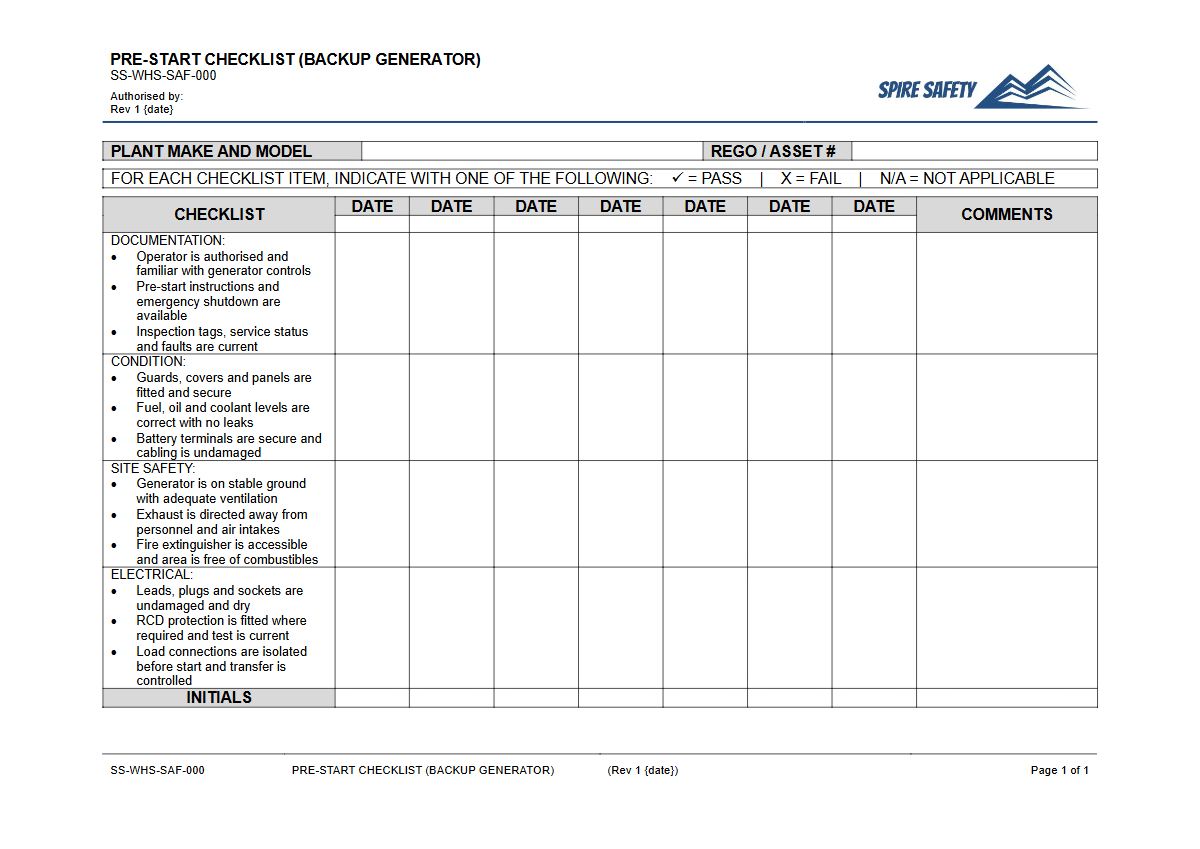
This Free Pre-Start Checklist (Backup Generator) Template provides a systematic framework for operators to verify that the equipment is in safe working order before it's started, whether for testing or for emergency use.
The primary purpose of this pre-start checklist is to proactively identify mechanical issues, fluid leaks, damaged components, or other potential hazards before they escalate into equipment failure, property damage, or injury. Consistent checks help minimise unexpected downtime and costly repairs, ensuring the generator is dependable when you need it most.
It also forms a key part of your risk management process, complementing a comprehensive generator risk assessment by providing a practical tool for ongoing safety verification.
Video walkthrough
How to use the Free Pre-Start Checklist (Backup Generator) Template
This template is designed for practical, on-the-ground use by competent personnel. Before starting the generator for any reason, the operator should take a copy of the checklist and physically inspect each item listed.
This includes checking fluid levels (fuel, oil, coolant), inspecting the battery and terminals, looking for signs of leaks, checking that guards are in place, and ensuring the surrounding area is clear of combustible materials and obstructions. The operator records their findings, noting any defects or issues that require attention from maintenance personnel.
Important: This document is a template designed as a starting point. We cannot guarantee it covers every hazard or control measure for your specific circumstances.
You must customise this checklist to suit the makes and models of generators at your workplace, your site-specific risks, manufacturer's instructions, and internal procedures. Integrating it with a detailed Generator Safe Operating Procedure (SOP) will create a more robust safety system.
Completed checklists should be signed, dated, and stored as part of your organisation's safety records. These records demonstrate due diligence and can be reviewed to identify recurring faults or maintenance trends.
For this process to be effective, operators must be trained not only on how to complete the checklist but also on the generator's specific operational and safety features. You can confirm this knowledge by using a Verification of Competency for diesel generators.
When to use it
A pre-start checklist for a backup generator should be completed before it is started for the first time each day or shift. It is also essential to conduct these checks before planned test runs, which are often performed weekly or monthly to ensure reliability.
Furthermore, an inspection should be carried out after any significant maintenance or repair work has been completed to verify the generator is ready for service. It is also wise practice to perform a check before a known high-risk event, such as an approaching severe storm that could lead to power disruption.
The principles outlined in the checklist are also valuable for safety training. You can reinforce the importance of these inspections by using a toolbox talk on pre-start checks to remind teams of their responsibilities.
Who should use it
This checklist is intended for use by any person deemed competent to operate the backup generator. This typically includes trained operators, maintenance staff, facilities managers, or other authorised personnel.
Supervisors and managers should also use the system to verify that pre-start inspections are being completed correctly and consistently. They are responsible for ensuring that any faults identified on the checklists are promptly addressed and rectified before the equipment is used.
Ultimately, the responsibility for implementation falls to the Person Conducting a Business or Undertaking (PCBU). Management must ensure that such safety procedures are embedded within the organisation's broader WHS management systems. Reviewing completed checklists can also be a valuable input for maintenance planning and provide evidence of proactive safety management during formal WHS compliance auditing.
Common mistakes
Common mistakes to avoid
- Treating the checklist as a 'tick and flick' exercise without physically verifying each item.
- Failing to report or action identified defects, rendering the check useless.
- Using a generic checklist that doesn't match the specific generator model on site.
- Not keeping the area around the generator clear of combustible materials or obstructions.
Legal references
Legal considerations
The following legal requirements may be relevant to this type of work.
- Work Health and Safety Act (Harmonised) — Provides the primary duties for protecting workers and other people from work health and safety risks.
- Work Health and Safety Regulations (Harmonised) — Sets out requirements supporting the management of workplace hazards and risks.
The following codes may be relevant to this type of work.
- Managing WHS Risks Code of Practice — Provides practical guidance on identifying hazards, assessing risks and applying effective controls.
- Work Health and Safety Consultation, Cooperation and Coordination Code of Practice — Provides practical guidance on consulting workers and coordinating with other duty holders.
- Managing the Work Environment and Facilities Code of Practice — Provides practical guidance on safe work environments, workplace facilities and related controls.
Did you know
Carbon Monoxide Risk
A running generator produces deadly, odourless carbon monoxide (CO). It must always be operated in a well-ventilated area, never inside a building, garage, or near windows and vents.
Wet Stacking
Regularly running a diesel generator on a light load can cause unburnt fuel and soot to build up in the exhaust system, a condition known as 'wet stacking'. This reduces efficiency and can create a fire hazard.
FAQ
Frequently asked questions
01What should be included in a backup generator pre-start checklist?
02How often should a backup generator be tested?
03Is a pre-start checklist a legal requirement in Australia?
04Can I use a digital pre-start checklist for a generator?
Share this resource
Free Pre-Start Checklist (Backup Generator) Template
Browse Categories
How To Use It
- 1Download and open in Word or PDF.
- 2Replace the placeholders with your business details.
- 3Get it reviewed by a WHS specialist before rollout.
Need it customised?
Our WHS consultants can adapt this template to your site, run a gap analysis, or audit what you already have in place.
Book a Free Consultation WHS consulting servicesor call 1300 156 382