
Free Pre-Start Checklist (Baby Cot) Template
Download our Free Pre-Start Checklist (Baby Cot) Template in DOCX and PDF. A structured starting point for childcare and healthcare providers in Australia.
Free Pre-Start Checklist (Baby Cot) Template
DOCX • 125 KB + PDF
Updated Oct 2026
No signup required
Purpose of the Free Pre-Start Checklist (Baby Cot) Template
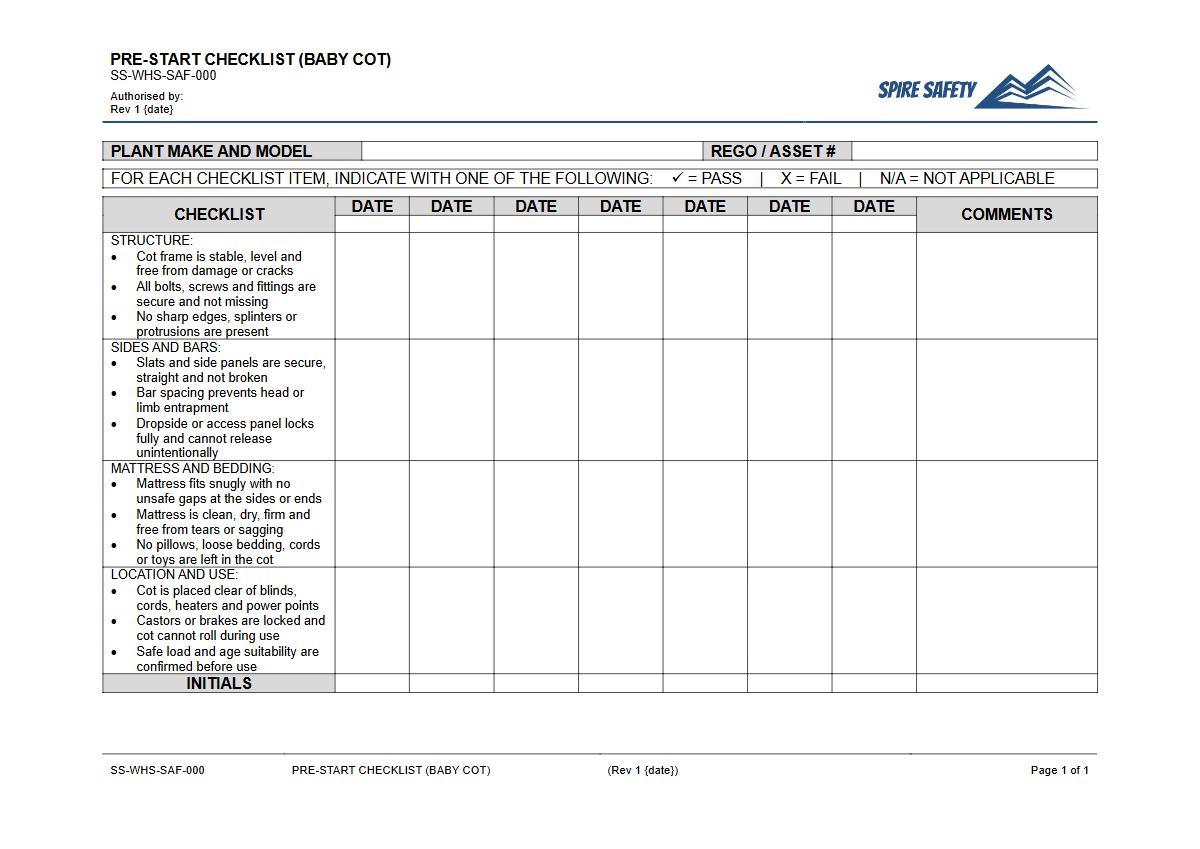
Ensuring the safety of infants is a paramount responsibility for any organisation providing care, accommodation, or services to families. This Free Pre-Start Checklist (Baby Cot) Template provides a structured framework for systematically inspecting baby cots before use.
Using this checklist helps identify potential hazards such as structural failures, entrapment risks, or instability. Regular, documented checks are a fundamental part of demonstrating due diligence and maintaining a safe environment for children.
By formalising this process, you create a consistent safety standard across your team and embed a proactive safety culture.
This document supports the critical task of hazard identification in environments where vulnerable people are present. A similar focus on procedure and care is reflected in resources like our Aged Care Manual Handling Toolbox Talk Template, which also aims to protect vulnerable individuals through structured safety practices.
Video walkthrough
How to Use the Free Pre-Start Checklist (Baby Cot) Template
This Pre-Start Checklist for a baby cot is provided as a user-friendly DOCX file that can be easily edited in Microsoft Word or other compatible software, as well as a print-ready PDF. Simply download the template and integrate it into your daily safety procedures.
You can print multiple copies for manual completion or use the digital version as part of a paperless workflow.
Important: This document is a template, not a finished safety tool. We strongly recommend you customise it to align with the specific cot models you use, your operational environment, and the unique risks identified in your workplace risk assessments.
Effective safety documentation should be part of a comprehensive safety framework. Integrating customised checklists into your broader WHS management systems ensures a holistic approach to risk management.
When to Use the Pre-Start Checklist
A pre-start check should be conducted at several key moments to ensure ongoing safety. It is essential to perform the check:
- Daily, before the cot is first used for an infant.
- After a cot has been newly assembled or installed.
- Following any period of maintenance or repair.
- Any time a cot has been moved to a new location.
This routine helps catch issues that may arise from daily wear and tear, movement, or incorrect assembly. The principles of regular equipment inspection are universal in WHS, as highlighted in our Pre-Start Checks and Plant Maintenance Toolbox Talk Template.
Who Should Use It
This checklist is designed for any person responsible for the safety and supervision of infants in a commercial or organisational setting. This includes:
- Childcare educators and assistants in early learning centres.
- Nurses and healthcare staff in maternity and paediatric wards.
- Accommodation managers and housekeeping staff in hotels and resorts.
- Maintenance personnel responsible for assembling and repairing cots.
All users should be trained on how to properly conduct each check and understand the procedure for reporting and isolating faulty equipment. If you need assistance developing training or implementation strategies, consider engaging professional WHS consulting services.
Key Checks for a Baby Cot Pre-Start
While your customised checklist will be more detailed, it should always cover these core safety areas:
- Structural Integrity: Check for any cracks, splinters, loose joints, or signs of stress on the frame, base, and legs.
- Bars and Panels: Ensure all bars are securely in place and that the spacing between them presents no entrapment hazard.
- Mattress Fit: Verify there are no significant gaps (e.g., more than 20mm) between the mattress and the cot sides or ends where a baby could become trapped.
- Moving Parts: If the cot has a drop-side, test the locking mechanism to ensure it is secure and cannot be accidentally lowered by a child. Check that any castors or wheels are lockable and functioning correctly.
- Hazard-Free Surfaces: Inspect for sharp edges, protruding screws or bolts, and peeling paint or finishes.
A completed checklist serves as a valuable record of your safety activities. Maintaining these records helps create a robust safety system and demonstrates your commitment to WHS compliance.
Explore our complete free WHS resources library for more templates to support your safety goals.
Common mistakes
Common mistakes to avoid
- Forgetting to check the mattress fit, creating dangerous entrapment gaps.
- Using the checklist as a one-off task instead of a daily routine before use.
- Failing to immediately remove a faulty or damaged cot from service.
- Not customising the generic template for the specific cot models used in the facility.
Legal references
Legal considerations
The following legal requirements may be relevant to this type of work.
- Work Health and Safety Act (Harmonised) — Provides the primary duties for protecting workers and other people from work health and safety risks.
- Work Health and Safety Regulations (Harmonised) — Sets out requirements supporting the management of workplace hazards and risks.
The following codes may be relevant to this type of work.
- Managing WHS Risks Code of Practice — Provides practical guidance on identifying hazards, assessing risks and applying effective controls.
- Work Health and Safety Consultation, Cooperation and Coordination Code of Practice — Provides practical guidance on consulting workers and coordinating with other duty holders.
- Managing the Work Environment and Facilities Code of Practice — Provides practical guidance on safe work environments, workplace facilities and related controls.
Did you know
Australian Cot Standard
The Australian Standard for cots (AS/NZS 2172) specifies critical safety dimensions, including a bar spacing between 50mm and 95mm to prevent a baby's head from becoming trapped.
Mattress Fit is Key
A poorly fitting mattress can create dangerous gaps. The standard requires that the gap between the mattress and the cot sides and ends is no more than 20mm when the mattress is centred.
FAQ
Frequently asked questions
01Is this baby cot checklist compliant with Australian Standards?
02How often should a baby cot pre-start check be performed?
03Who is responsible for completing the cot checklist?
04What should I do if I find a fault during a pre-start check?
Share this resource
Free Pre-Start Checklist (Baby Cot) Template
Browse Categories
How To Use It
- 1Download and open in Word or PDF.
- 2Replace the placeholders with your business details.
- 3Get it reviewed by a WHS specialist before rollout.
Need it customised?
Our WHS consultants can adapt this template to your site, run a gap analysis, or audit what you already have in place.
Book a Free Consultation WHS consulting servicesor call 1300 156 382