
Free Pre-Start Checklist (Auger) Template
Formalise auger safety checks with our free template. This Pre-Start Checklist (Auger) helps identify hazards and manage risks. Download the DOCX and PDF now.
Free Pre-Start Checklist (Auger) Template
DOCX • 125 KB + PDF
Updated Oct 2026
No signup required
Purpose of the Free Pre-Start Checklist (Auger) Template
Operating an auger, whether handheld, tractor-mounted, or part of larger machinery, involves significant WHS risks. Entanglement with the rotating screw, mechanical failure, and hydraulic system faults can lead to severe injuries.
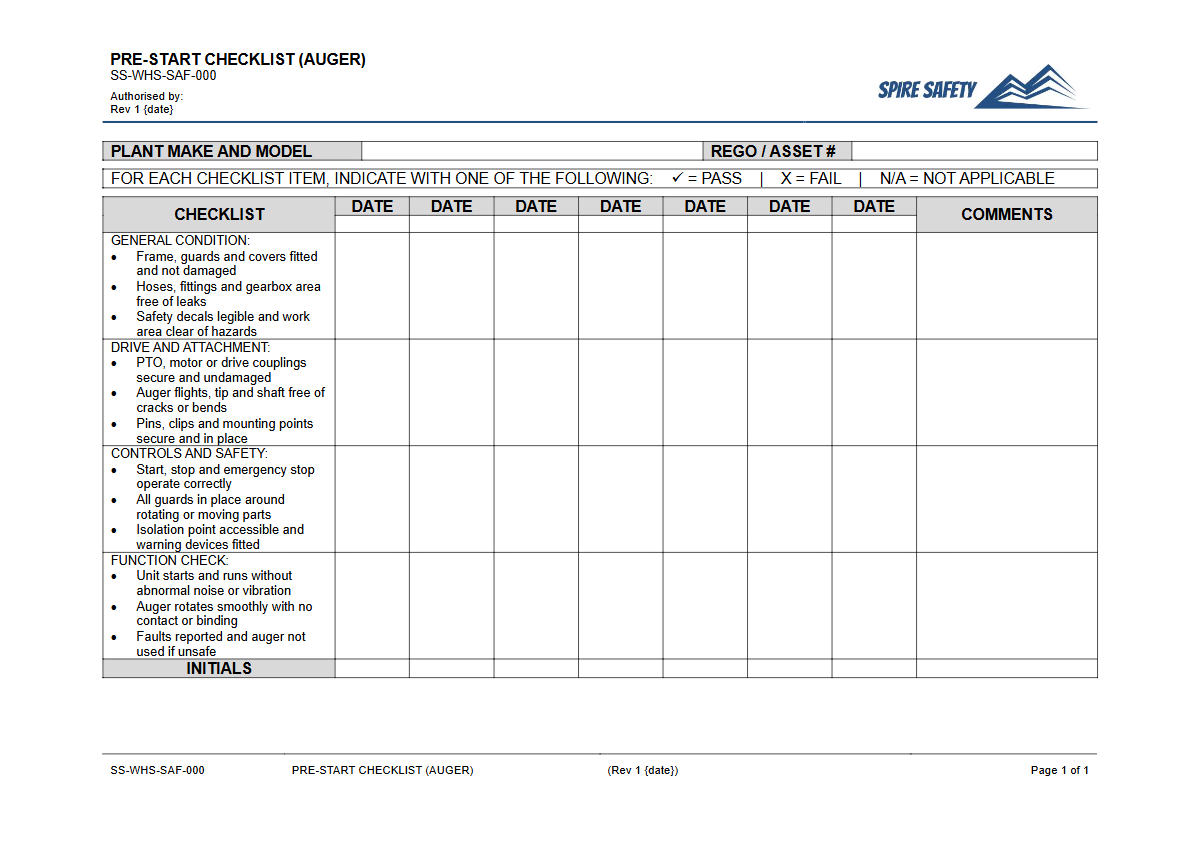
This Free Pre-Start Checklist (Auger) Template provides a structured framework for operators to conduct thorough pre-operational inspections. Regular use helps identify potential hazards before they cause an incident, ensuring equipment is fit for purpose and safe to use.
Formalising these checks creates a consistent record of due diligence, which is a key component of a robust safety management system.
This template is a proactive tool designed to systematically verify the condition of critical safety components, controls, and guarding. By integrating this checklist into your daily routine, you can reduce the likelihood of equipment-related accidents and demonstrate a commitment to workplace health and safety.
It also supports compliance with duties under Australian WHS legislation, which requires Persons Conducting a Business or Undertaking (PCBUs) to ensure, so far as is reasonably practicable, that plant and structures are safe to use. Implementing comprehensive WHS management systems that include regular equipment checks is a fundamental step in achieving this.
Video walkthrough
How to use the Free Pre-Start Checklist (Auger) Template
This checklist is designed to be a versatile starting point for your organisation. Download the resource in your preferred format: DOCX for easy customisation or PDF for immediate printing and use.
The DOCX file allows you to add or remove items to align with the specific makes and models of augers used in your workplace, as well as any unique environmental or operational risks present on your site.
It is crucial to remember that this document is a template. We have designed it as a starting point, but you must customise it to reflect your specific auger models, work environment, and organisational procedures.
Once customised, the checklist should be integrated into your standard operating procedures. Operators should be trained on how to complete it correctly, including the importance of not using the equipment if a fault is identified.
For complex sites with varied equipment, you might also require a pre-start checklist for floor saws or other specific plant.
When to use an Auger Pre-Start Checklist
A pre-start check should be completed before the first use of the auger at the beginning of each shift or day. If the equipment is used by multiple operators during a single shift, a new check or handover inspection is recommended at the change of operator.
The check should also be performed if the auger has been idle for an extended period or after any maintenance or repair work has been carried out to ensure it has been returned to service in a safe condition.
Consistent, documented checks provide valuable data over time. Trends in wear and tear or recurring faults can highlight the need for a review of maintenance schedules or operator training.
Regular WHS compliance auditing can help verify that these procedures are being followed correctly and are effective in managing risk.
Who should use it
The auger pre-start checklist should be completed by a competent person who is trained and authorised to operate the specific type of auger. This is typically the operator assigned to use the machine for the shift.
They possess the immediate hands-on knowledge to identify abnormalities in the equipment's condition or performance. Supervisors also have a role in ensuring the checks are being performed diligently and that any reported issues are addressed promptly.
They are responsible for making sure that operators do not use equipment that has been deemed unsafe or 'tagged out'.
Management's role is to provide the resources and systems—like this checklist—to enable safe work. This includes providing adequate training, scheduling time for checks to be completed without pressure, and establishing clear procedures for reporting and rectifying defects.
For broader safety system improvements or complex risk assessments, engaging our general WHS consulting services can provide expert guidance. You can also explore our free WHS resources library for other useful templates and guides.
Common mistakes
Common mistakes to avoid
- Skipping the check entirely to 'save time', significantly increasing risk.
- Using a generic checklist that doesn't cover the specific model or configuration of the auger.
- 'Pencil-whipping' the form – ticking boxes without physically inspecting the items.
- Failing to remove faulty equipment from service by not reporting, isolating, and tagging it correctly.
Legal references
Legal considerations
The following legal requirements may be relevant to this type of work.
- Work Health and Safety Act (Harmonised) — Provides the primary duties for protecting workers and other people from work health and safety risks.
- Work Health and Safety Regulations (Harmonised) — Sets out requirements supporting the management of workplace hazards and risks.
The following codes may be relevant to this type of work.
- Managing WHS Risks Code of Practice — Provides practical guidance on identifying hazards, assessing risks and applying effective controls.
- Work Health and Safety Consultation, Cooperation and Coordination Code of Practice — Provides practical guidance on consulting workers and coordinating with other duty holders.
- Managing the Work Environment and Facilities Code of Practice — Provides practical guidance on safe work environments, workplace facilities and related controls.
Did you know
Entanglement Hazard
The rotating shaft of an auger is a major entanglement hazard. According to Safe Work Australia, incidents involving being trapped by moving machinery are a leading cause of serious injuries and fatalities in agriculture and construction.
Ancient Origins
The principle behind the auger, the Archimedes' screw, is an ancient invention attributed to the Greek mathematician Archimedes of Syracuse in the 3rd century BC. It was originally used for transferring water from a low-lying body of water into irrigation ditches.
FAQ
Frequently asked questions
01What should be included in an auger pre-start checklist?
02How often should an auger pre-start check be completed?
03Is a digital pre-start checklist better than a paper one?
04What happens if I find a fault during a pre-start check?
Share this resource
Free Pre-Start Checklist (Auger) Template
Browse Categories
How To Use It
- 1Download and open in Word or PDF.
- 2Replace the placeholders with your business details.
- 3Get it reviewed by a WHS specialist before rollout.
Need it customised?
Our WHS consultants can adapt this template to your site, run a gap analysis, or audit what you already have in place.
Book a Free Consultation WHS consulting servicesor call 1300 156 382