
Free Pre-Start Checklist (Angle Grinder) Template
Download our Free Pre-Start Checklist (Angle Grinder) Template to formalise daily equipment inspections. This DOCX & PDF helps manage WHS risks.
Free Pre-Start Checklist (Angle Grinder) Template
DOCX • 125 KB + PDF
Updated Oct 2026
No signup required
Purpose of the Free Pre-Start Checklist (Angle Grinder) Template
Operating an angle grinder comes with significant health and safety risks, including cuts, burns, projectiles, and electrocution. A systematic pre-start inspection is a critical control measure to ensure the equipment is safe to use before any work begins.
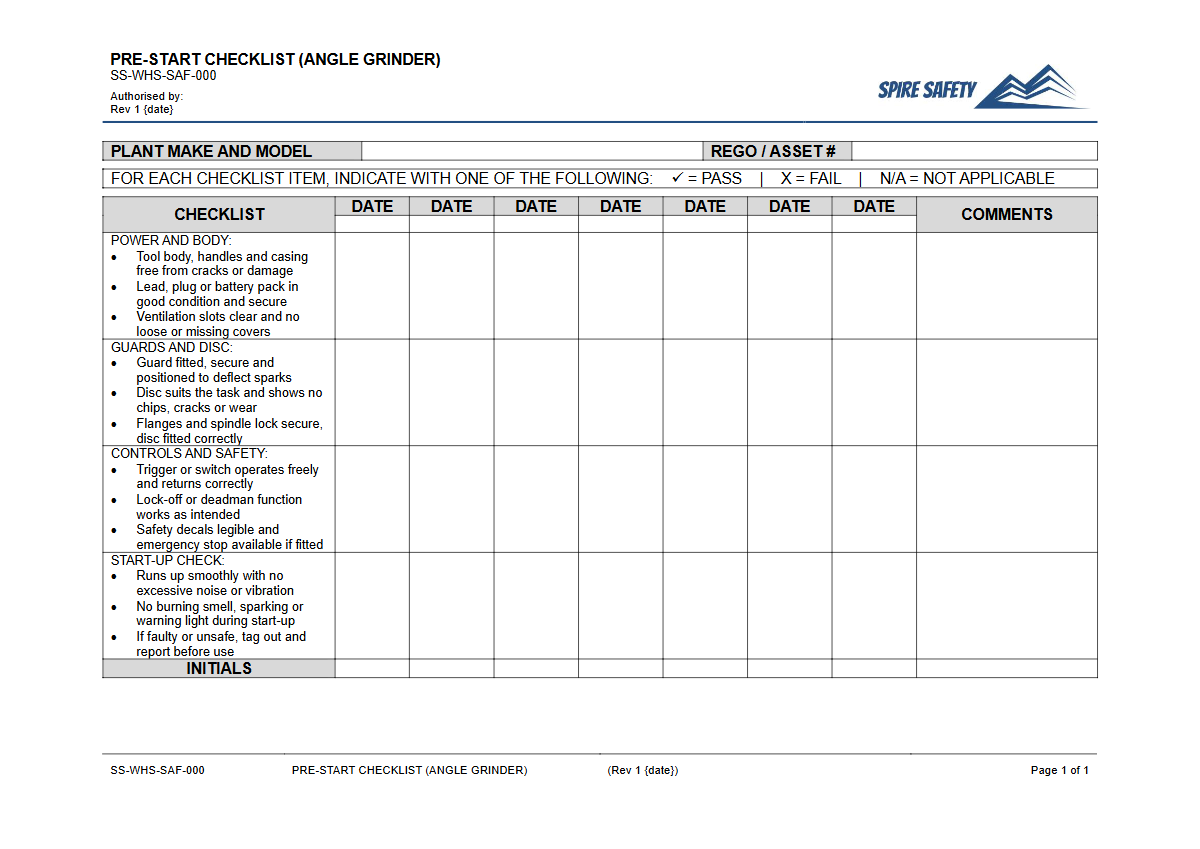
This Free Pre-Start Checklist (Angle Grinder) Template provides a structured starting point for formalising these essential safety checks.
The purpose of this checklist is to guide operators through a consistent inspection process, helping to identify potential defects, damage, or missing safety components before the grinder is energised. It prompts checks of key items such as the safety guard, handles, power cord, and the condition of the cutting or grinding disc.
Formalising this process helps create a documented record of inspections, which is a key component of a robust safety management framework. It forms part of a broader set of procedures within your organisation’s WHS management systems.
Video walkthrough
How to use the Free Pre-Start Checklist (Angle Grinder) Template
This template is provided in both DOCX and PDF formats for ease of use. The DOCX file is fully editable, allowing you to tailor the checklist to the specific models of angle grinders used in your workplace and the unique hazards associated with your tasks.
Integrating this checklist into your daily operations is straightforward.
To implement it effectively:
- Download the template and add your company branding and specific site details.
- Review the checklist items and add or remove checks to align with your equipment's user manual and your risk assessments. For instance, you might add checks for specific battery conditions on cordless models.
- Train all operators on how to properly complete the checklist and what actions to take if a fault is identified (e.g., tag out of service, report to supervisor).
- Ensure completed checklists are stored as a WHS record.
Please note: This document is a template and is not a complete solution. We recommend you customise it to address the specific angle grinders, tasks, and hazards present in your workplace. While this checklist is for angle grinders, its principles can be adapted for other high-risk cutting equipment; for instance, the structure could inform the checks needed in our Pre-Start Checklist for Floor Saws.
When to use an Angle Grinder Pre-Start Checklist
A pre-start checklist for an angle grinder should be completed by the operator before each period of use. At a minimum, this means conducting the check at the start of every shift where the grinder is expected to be used.
If the operator changes during a shift, the incoming operator should also perform their own pre-start check.
This frequency is vital because the condition of the equipment can change rapidly. A disc can become cracked, a guard can be loosened, or a power cord can be damaged between uses.
Conducting the check immediately before operation is the most effective way to catch these issues before they can cause an incident. For similar equipment that poses different risks, such as a stationary grinder, our Free Pre-Start Checklist (Bench Grinder) Template offers a comparable daily process.
Who should use this Pre-Start Checklist
The primary user of this checklist is the worker or operator who will be using the angle grinder. They must be trained and competent not only in the safe operation of the tool but also in how to conduct a thorough pre-start inspection.
They are the first line of defence against equipment-related incidents.
Supervisors and managers also have a role. They are responsible for ensuring that operators are completing the checklists correctly and consistently. They must also follow up on any faults or defects that are reported, ensuring that unsafe equipment is removed from service and repaired. These completed records are often reviewed during formal safety reviews and WHS compliance auditing to verify that safety procedures are being followed. You can find more templates and guides to support your safety processes in our free WHS resources library.
Common mistakes
Common mistakes to avoid
- Using the angle grinder with the safety guard removed or improperly adjusted.
- Fitting a cutting or grinding disc that is cracked, chipped, or has an RPM rating lower than the tool's maximum speed.
- Failing to wear appropriate Personal Protective Equipment (PPE), especially a face shield over safety glasses.
- Applying excessive force to the grinder, instead of letting the disc do the work, which can lead to kickback or disc failure.
Legal references
Legal considerations
The following legal requirements may be relevant to this type of work.
- Work Health and Safety Act (Harmonised) — Provides the primary duties for protecting workers and other people from work health and safety risks.
- Work Health and Safety Regulations (Harmonised) — Sets out requirements supporting the management of workplace hazards and risks.
The following codes may be relevant to this type of work.
- Managing WHS Risks Code of Practice — Provides practical guidance on identifying hazards, assessing risks and applying effective controls.
- Work Health and Safety Consultation, Cooperation and Coordination Code of Practice — Provides practical guidance on consulting workers and coordinating with other duty holders.
- Managing the Work Environment and Facilities Code of Practice — Provides practical guidance on safe work environments, workplace facilities and related controls.
Did you know
Kickback Risk
Angle grinder kickback occurs when the disc jams on the workpiece, forcing the tool violently back towards the operator. It is a leading cause of severe lacerations and other traumatic injuries associated with grinder use.
Projectile Speeds
Fragments from a shattered grinding disc can travel at speeds over 300 km/h. This is why a properly fitted guard and appropriate face and eye protection are non-negotiable safety requirements.
FAQ
Frequently asked questions
01What are the most critical checks on an angle grinder pre-start checklist?
02How often should an angle grinder pre-start check be done?
03Who is responsible for completing the angle grinder pre-start checklist?
04Why is it important to check the RPM rating of the grinding disc?
Share this resource
Free Pre-Start Checklist (Angle Grinder) Template
Browse Categories
How To Use It
- 1Download and open in Word or PDF.
- 2Replace the placeholders with your business details.
- 3Get it reviewed by a WHS specialist before rollout.
Need it customised?
Our WHS consultants can adapt this template to your site, run a gap analysis, or audit what you already have in place.
Book a Free Consultation WHS consulting servicesor call 1300 156 382