
Free Pre-Start Checklist (Air Dryer) Template
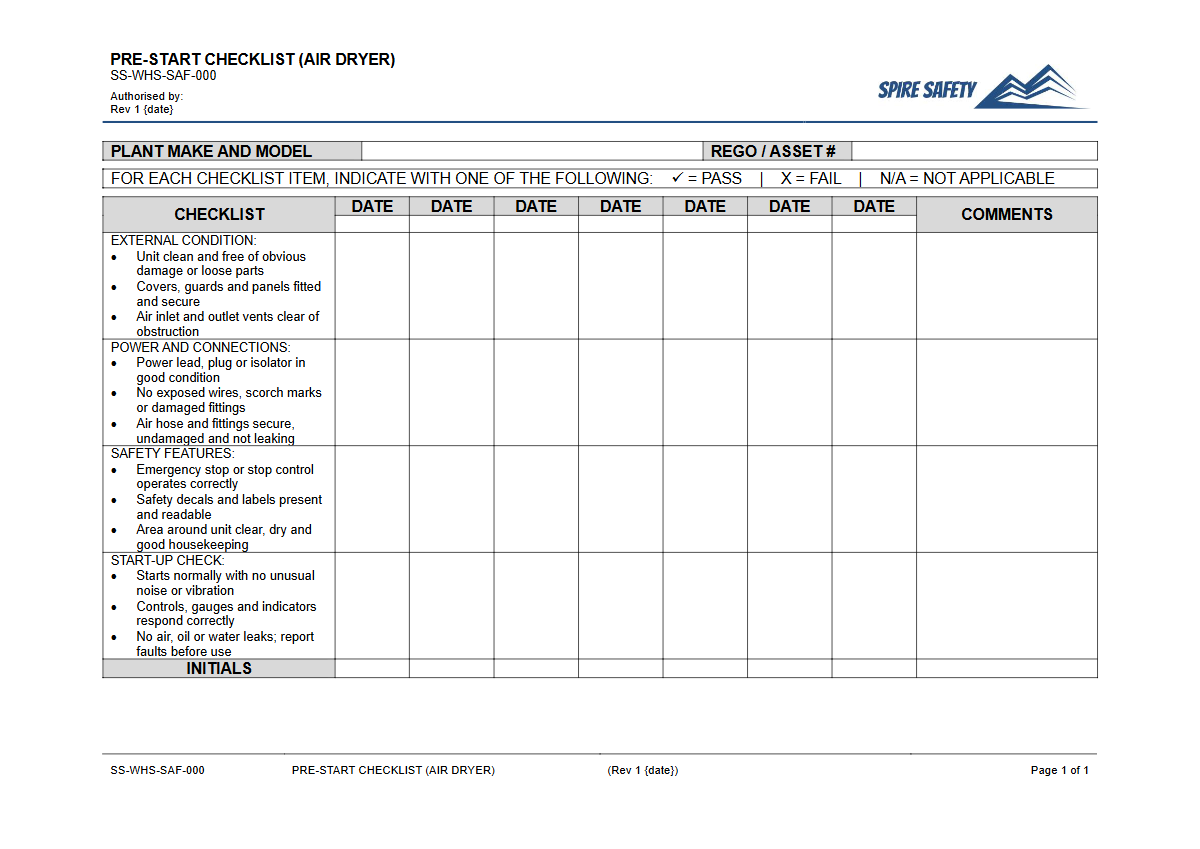
Formalise your equipment safety checks with our free Pre-Start Checklist (Air Dryer) Template. Download a structured DOCX & PDF to improve WHS.
Free Pre-Start Checklist (Air Dryer) Template
DOCX • 125 KB + PDF
Updated Oct 2026
No signup required
Purpose of the Free Pre-Start Checklist (Air Dryer) Template
An industrial air dryer is essential for many operations, but it also presents significant hazards if not properly maintained. This Free Pre-Start Checklist (Air Dryer) Template provides a structured framework for operators to conduct consistent, documented safety inspections before use.
Regular pre-start checks help identify potential faults, prevent unexpected equipment failure, and protect workers from risks such as electrical shock, high-pressure air release, or contact with moving parts. By formalising this process, your organisation can demonstrate proactive risk management and take a critical step towards meeting its duty of care under Australian WHS legislation.
Implementing routine checks is a fundamental element of plant and equipment safety. It ensures the air dryer operates as intended, maintains air quality for downstream processes, and minimises costly operational downtime.
Integrating tools like this checklist is a practical way to support your broader WHS management systems and foster a stronger safety culture.
Video walkthrough
How to use the Free Pre-Start Checklist (Air Dryer) Template
This resource is provided in both DOCX and PDF formats. The PDF is ready for immediate printing and use, while the Word document is fully editable, allowing you to tailor it to your specific operational needs.
You can add your company logo, site details, and equipment-specific check items relevant to the make and model of your air dryer. This might include checks for specific filter types, desiccant levels, or electronic control panel readouts.
It is crucial to remember that this is a template. We provide it as a starting point, but you must customise it to reflect the specific make, model, and operating environment of your air dryer, as well as your site-specific procedures and risks. For other workshop equipment, you might adapt a similar process, like that outlined in our free Pre-Start Checklist (Bench Grinder) Template.
When to use it
A Pre-Start Checklist should be completed by the operator before the air dryer is used for the first time each day or at the beginning of every shift. This routine ensures that the equipment's condition is verified before it is energised and put into service.
The checklist should also be used after any maintenance, repair, or if the unit has been moved, to confirm it is safe for reinstatement.
Consistent use of the checklist creates a valuable data trail. These records can be reviewed during safety meetings and are essential documents for any internal or external WHS compliance auditing, providing clear evidence of your organisation's safety protocols in action.
Who should use it
Only workers who have been properly trained and deemed competent on the specific air dryer model should be authorised to perform the pre-start inspection and operate the equipment. The checklist is a tool to guide a competent person; it is not a substitute for comprehensive training, which should cover safe operation, hazard identification, and emergency shutdown procedures.
Supervisors also play a key role in reviewing completed checklists to ensure they are being filled out correctly and that any reported defects are addressed promptly.
The principles of competency and structured checks apply to all complex machinery. A similar level of rigour is necessary for operators using equipment covered by our free Pre-Start Checklist (Granulator) Template, ensuring safety standards are maintained across all plant and equipment.
Integrating Checklists into Your Safety Framework
A pre-start checklist is most effective when it is part of a comprehensive safety system. The findings from this check should inform other processes, such as your Safe Work Method Statements (SWMS) for tasks involving the air dryer.
If your organisation needs assistance developing or refining these integrated safety documents, engaging professional WHS consulting services can provide expert guidance and ensure your systems are robust and practical.
Record Keeping and Defect Reporting
Completed checklists are important legal documents that form part of your safety records. They must be stored securely and be accessible for review.
Your procedure should clearly state what an operator must do if a fault or defect is identified. The process must include immediately taking the equipment out of service, applying a "Do Not Operate" tag, and reporting the issue to a supervisor or the maintenance department for corrective action. This systematic approach is vital for all specialised workplace equipment, including items like those covered in our free Pre-Start Checklist (Fume Cabinet) Template.
Common mistakes
Common mistakes to avoid
- Skipping checks on seemingly 'minor' items like hoses, filter indicators, or drain traps.
- Failing to physically verify each item on the list ('pencil-whipping').
- Not taking the equipment out of service immediately when a defect is found.
- Forgetting to check that condensate auto-drains are functioning correctly.
Legal references
Legal considerations
The following legal requirements may be relevant to this type of work.
- Work Health and Safety Act (Harmonised) — Provides the primary duties for protecting workers and other people from work health and safety risks.
- Work Health and Safety Regulations (Harmonised) — Sets out requirements supporting the management of workplace hazards and risks.
The following codes may be relevant to this type of work.
- Managing WHS Risks Code of Practice — Provides practical guidance on identifying hazards, assessing risks and applying effective controls.
- Work Health and Safety Consultation, Cooperation and Coordination Code of Practice — Provides practical guidance on consulting workers and coordinating with other duty holders.
- Managing the Work Environment and Facilities Code of Practice — Provides practical guidance on safe work environments, workplace facilities and related controls.
Did you know
The Cost of Moisture
A poorly maintained air dryer can allow moisture into compressed air lines, causing corrosion in pneumatic tools, contaminating products, and leading to expensive equipment failures.
Energy Consumption
Compressed air systems, including dryers, can account for 10% or more of an industrial facility's total electricity usage. Regular checks and maintenance ensure they operate efficiently, reducing energy waste.
FAQ
Frequently asked questions
01What key items should be on an air dryer pre-start checklist?
02Why is a daily check for an industrial air dryer important?
03Is this Pre-Start Checklist a legal document?
04How often should an air dryer be serviced?
Share this resource
Free Pre-Start Checklist (Air Dryer) Template
Browse Categories
How To Use It
- 1Download and open in Word or PDF.
- 2Replace the placeholders with your business details.
- 3Get it reviewed by a WHS specialist before rollout.
Need it customised?
Our WHS consultants can adapt this template to your site, run a gap analysis, or audit what you already have in place.
Book a Free Consultation WHS consulting servicesor call 1300 156 382