
Free Pre-Start Checklist (Brush Cutter) Template
Formalise brush cutter safety inspections with our free Pre-Start Checklist Template. Aligned with Australian WHS practice. Download in DOCX and PDF.
Free Pre-Start Checklist (Brush Cutter) Template
DOCX • 125 KB + PDF
Updated Oct 2026
No signup required
Purpose of the Free Pre-Start Checklist (Brush Cutter) Template
Using a brush cutter, also known as a whipper snipper or line trimmer, introduces significant workplace hazards including high-speed projectiles, sharp cutting blades, vibration, and noise. A systematic inspection before each use is a critical control measure to manage these risks.
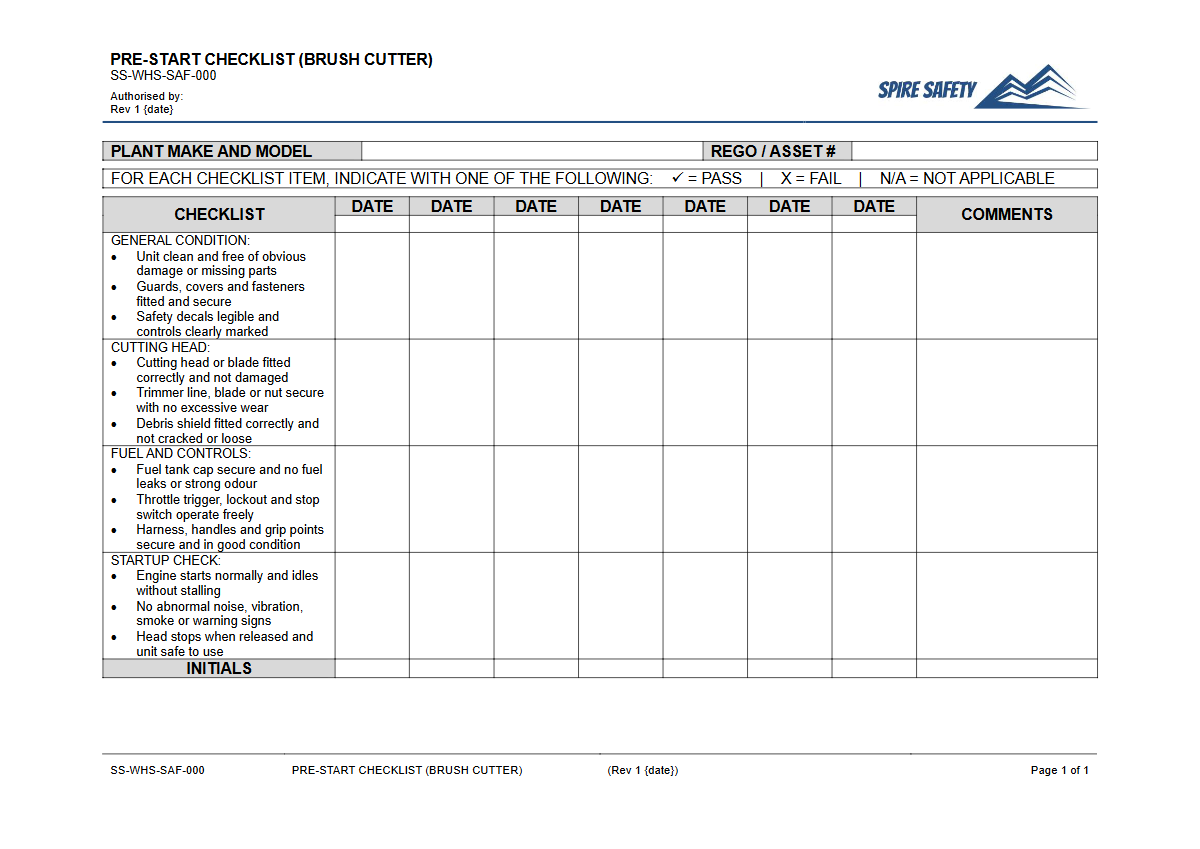
This free Pre-Start Checklist (Brush Cutter) Template provides a structured framework to guide operators through these essential safety checks, helping to identify mechanical faults, damage, or missing components before they can cause an incident. Formalising this process helps a Person Conducting a Business or Undertaking (PCBU) meet their primary duty of care under Australian WHS laws.
By documenting daily checks, your organisation creates a clear record of due diligence and promotes a proactive safety culture. It ensures that equipment like guards, harnesses, and emergency stops are functioning correctly, and that the cutting attachment is secure and appropriate for the task.
This simple yet effective tool helps prevent injuries and equipment failure, ensuring the brush cutter is safe to start. Similar principles apply to other outdoor power equipment, as detailed in our free Pre-Start Checklist for lawn tractors.
Video walkthrough
How to use the Free Pre-Start Checklist (Brush Cutter) Template
This resource is available for immediate download in both DOCX for easy customisation and PDF for straightforward printing. The template is designed as a comprehensive starting point aligned with good WHS practice.
It covers key inspection areas including the engine, fuel system, cutting head, guards, and personal protective equipment (PPE). Integrating this checklist into your operational procedures is a key step in building robust WHS management systems.
Important Customisation Note
You must adapt this template to suit your specific circumstances. We have provided a general outline, but you need to review and modify it to reflect the exact models of brush cutters you use, the specific tasks they are used for, and the unique environment of your workplace.
Your final checklist should be a practical tool that accurately addresses your operational risks.
When to use it
The Pre-Start Checklist for a brush cutter should be completed by the operator before the first use on every shift. It should also be completed after any maintenance or repair work has been performed on the unit to verify its safe operational status.
The checklist is not a substitute for scheduled maintenance but a supplementary daily check. Consistent use helps track the condition of the equipment over time, allowing for the early detection of developing faults that might otherwise go unnoticed until they cause a breakdown or an accident. This proactive approach is essential for all high-risk cutting equipment, including those covered by our Pre-Start Checklist (Floor Saw) Template.
Who should use it
This checklist is designed for use by any worker or contractor tasked with operating a brush cutter. The operator holds the primary responsibility for completing the check before they start work.
Supervisors and managers should also be familiar with the checklist to ensure it is being completed correctly and consistently. They are responsible for ensuring operators are trained and competent not just in using the brush cutter, but also in performing the pre-start inspection itself.
Records of these checks should be stored and periodically reviewed by safety officers or managers as part of a broader WHS compliance auditing program.
The principles of pre-start checks apply to a wide range of powered equipment found in workshops and maintenance sheds. For example, ensuring guards and rests are correctly adjusted is also a key part of our Pre-Start Checklist for a bench grinder. For more templates and safety documents, browse our complete free WHS resources library.
Common mistakes
Common mistakes to avoid
- Using a damaged or incorrect cutting attachment for the task (e.g., using a grass blade to cut woody shrubs).
- Ignoring small fuel leaks from the cap or fuel lines, which can pose a serious fire risk.
- Failing to check the condition and fitment of the safety guard, or removing it entirely.
- Skipping the pre-start check altogether for 'just a quick job', which is often when incidents occur.
Legal references
Legal considerations
The following legal requirements may be relevant to this type of work.
- Work Health and Safety Act (Harmonised) — Provides the primary duties for protecting workers and other people from work health and safety risks.
- Work Health and Safety Regulations (Harmonised) — Sets out requirements supporting the management of workplace hazards and risks.
The following codes may be relevant to this type of work.
- Managing WHS Risks Code of Practice — Provides practical guidance on identifying hazards, assessing risks and applying effective controls.
- Work Health and Safety Consultation, Cooperation and Coordination Code of Practice — Provides practical guidance on consulting workers and coordinating with other duty holders.
- Managing the Work Environment and Facilities Code of Practice — Provides practical guidance on safe work environments, workplace facilities and related controls.
Did you know
Vibration Risk
Prolonged use of high-vibration tools like brush cutters can lead to Hand-Arm Vibration Syndrome (HAVS), a condition causing permanent damage to nerves and blood vessels. Regular breaks and anti-vibration gloves can help mitigate this risk.
Blade Kickback
Metal blades on brush cutters can experience violent kickback if they strike a hard object like a rock or tree stump. This is a leading cause of serious injuries and highlights the importance of correct technique and a secure harness.
FAQ
Frequently asked questions
01What are the most critical checks on a brush cutter pre-start checklist?
02How often should a brush cutter pre-start checklist be completed?
03What should an operator do if a fault is found during a pre-start check?
04Who is responsible for ensuring the pre-start check is done?
Share this resource
Free Pre-Start Checklist (Brush Cutter) Template
Browse Categories
How To Use It
- 1Download and open in Word or PDF.
- 2Replace the placeholders with your business details.
- 3Get it reviewed by a WHS specialist before rollout.
Need it customised?
Our WHS consultants can adapt this template to your site, run a gap analysis, or audit what you already have in place.
Book a Free Consultation WHS consulting servicesor call 1300 156 382