
Free Pre-Start Checklist (Brick Saw) Template
Download our free Pre-Start Checklist (Brick Saw) Template. This structured DOCX & PDF helps formalise safety checks for brick saws. Get your template.
Free Pre-Start Checklist (Brick Saw) Template
DOCX • 125 KB + PDF
Updated Oct 2026
No signup required
Purpose of the Free Pre-Start Checklist (Brick Saw) Template
Operating a brick saw exposes workers to significant risks, including severe cuts, entanglement, hazardous noise, and exposure to respirable crystalline silica (RCS) dust. A systematic pre-start inspection is a fundamental safety measure to ensure the equipment is in safe working order before use.
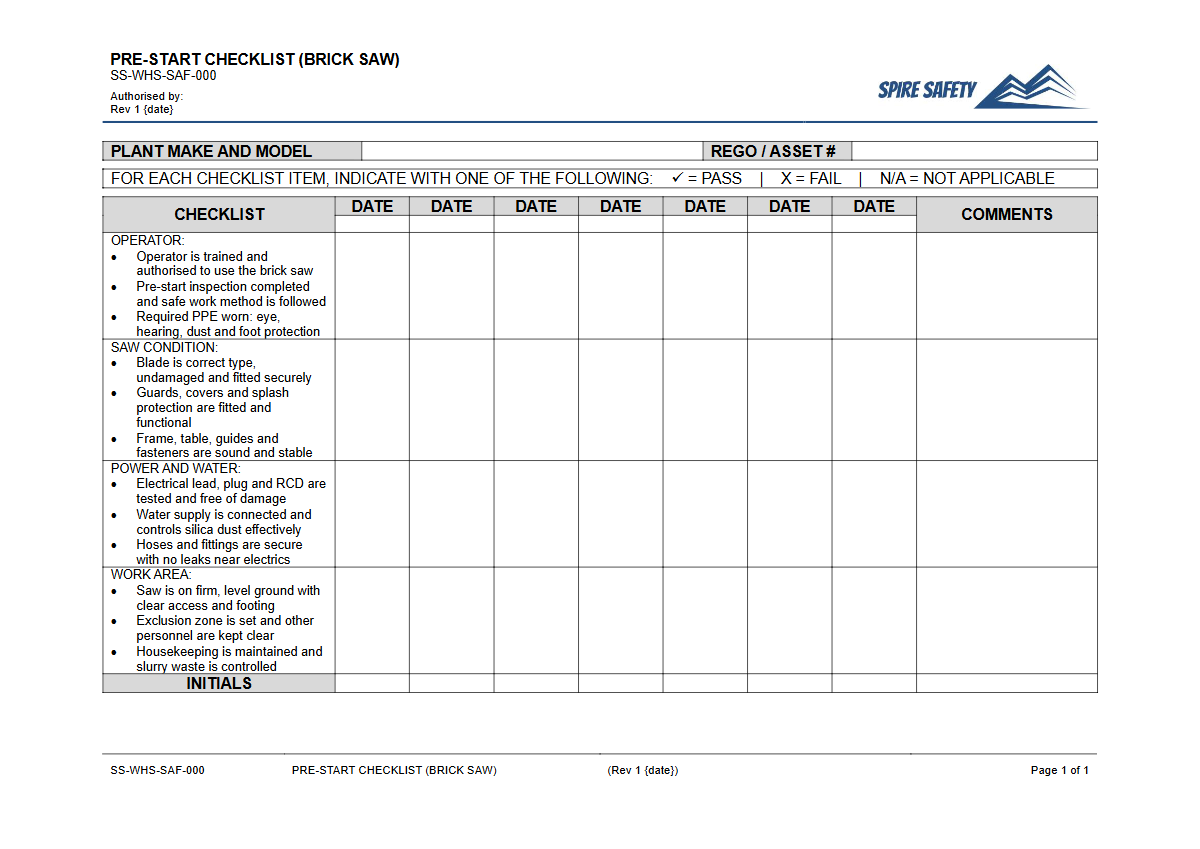
This Free Pre-Start Checklist (Brick Saw) Template provides a structured format for operators to conduct and record these critical checks, helping to identify and control potential hazards before they cause an incident. Formalising this process helps your organisation demonstrate due diligence and is a key component of effective WHS management systems.
Video walkthrough
How to use the Free Pre-Start Checklist (Brick Saw) Template
This template, available as a DOCX and PDF file, is designed for immediate use after a brief customisation process. First, download the document and add your company branding.
Most importantly, you must review and adapt the checklist items to suit the specific make and model of the brick saws used in your workplace, as well as the unique conditions of your work environment.
Note: This document is a template and not a complete solution. We provide it as a starting point.
It is your responsibility to ensure it is customised to accurately reflect your specific equipment, tasks, and worksite hazards before implementation.
Once customised, integrate the checklist into your daily pre-start routine. The operator should physically inspect each item on the list, marking it as satisfactory or identifying a fault.
Any identified defects must be reported immediately and the equipment must be tagged out of service until it is repaired by a competent person. Consistent use can be reinforced with regular team meetings, such as a dedicated pre-start checks and plant maintenance toolbox talk.
When to use it
A brick saw pre-start checklist should be completed by the operator before the saw is used for the first time each day or at the beginning of every shift. If multiple operators use the same saw during a single shift, it is good practice for each new operator to conduct their own pre-start check to verify its condition before they commence work.
Who should use it
This checklist should be completed by any worker who is trained, competent, and authorised to operate a brick saw. Supervisors also have a key role in ensuring the checks are being completed correctly and consistently.
They should periodically review completed checklists to verify that inspections are thorough and that corrective actions for identified faults are being managed effectively. This verification process can form part of a scheduled WHS compliance auditing program to ensure procedures are being followed.
Key Inspection Points for a Brick Saw
Your customised checklist should cover several critical areas to be effective. While your specific saw model may have unique features, the following points are generally applicable:
Guards and Safety Features
Ensure all guards are in place, secure, and functioning as intended. This includes the retractable blade guard, which should move freely and automatically cover the blade when not cutting, as well as any guards over belts and drive components.
Blade Condition
Visually inspect the diamond blade for any signs of damage such as cracks, warping, missing segments, or excessive wear. Confirm the blade is the correct type for the material being cut and is securely mounted with the correct flange and locking nut.
Water Delivery System
For wet-cutting saws, the water delivery system is a critical control for silica dust. Check that the water pump is working, hoses are not cracked or leaking, and nozzles are clear and directing an adequate flow of water to both sides of the blade.
Electrical Safety
Inspect all electrical cords for damage, cuts, or exposed wires. Ensure the plug is in good condition and that the saw is connected to a power source protected by a residual-current device (RCD) or safety switch.
Test the RCD before use.
Beyond the Checklist: Creating a Safe System of Work
While essential, a pre-start checklist is only one part of a comprehensive safe system of work for using brick saws. It must be supported by other critical WHS documents and processes, including a Safe Work Method Statement (SWMS) for high-risk construction work, a thorough risk assessment, and records of operator training and competency.
Developing and integrating these elements can be complex, and seeking expert advice from WHS consulting professionals can help ensure your safety framework is robust and aligned with legislative requirements. For more ready-to-use templates and guides, browse our complete free WHS resources library.
Common mistakes
Common mistakes to avoid
- Failing to check the water delivery system for blockages or insufficient flow before starting a job.
- Using a blade that is cracked, warped, missing segments, or not designed for the material being cut.
- Neglecting to ensure the blade guard is in place, undamaged, and moves freely.
- Performing the checklist as a paper exercise without physically inspecting each component on the saw.
Legal references
Legal considerations
The following legal requirements may be relevant to this type of work.
- Work Health and Safety Act (Harmonised) — Provides the primary duties for protecting workers and other people from work health and safety risks.
- Work Health and Safety Regulations (Harmonised) — Sets out requirements supporting the management of workplace hazards and risks.
The following codes may be relevant to this type of work.
- Managing WHS Risks Code of Practice — Provides practical guidance on identifying hazards, assessing risks and applying effective controls.
- Work Health and Safety Consultation, Cooperation and Coordination Code of Practice — Provides practical guidance on consulting workers and coordinating with other duty holders.
- Managing the Work Environment and Facilities Code of Practice — Provides practical guidance on safe work environments, workplace facilities and related controls.
Did you know
Silica Dust Danger
Cutting bricks, concrete, and stone generates respirable crystalline silica (RCS). Prolonged exposure to this hazardous dust can cause silicosis, a serious and incurable lung disease. Wet cutting is a primary and essential engineering control.
Blade Speed is Critical
Diamond blades are designed to operate within a specific RPM range. Using a blade on a saw that spins too fast or too slow can lead to poor performance, overheating, and catastrophic blade failure, creating a serious projectile hazard.
FAQ
Frequently asked questions
01What are the main hazards of using a brick saw?
02How often should a brick saw pre-start check be performed?
03Is a pre-start checklist a legal requirement in Australia?
04Can I use this template for a concrete saw or tile saw?
Share this resource
Free Pre-Start Checklist (Brick Saw) Template
Browse Categories
How To Use It
- 1Download and open in Word or PDF.
- 2Replace the placeholders with your business details.
- 3Get it reviewed by a WHS specialist before rollout.
Need it customised?
Our WHS consultants can adapt this template to your site, run a gap analysis, or audit what you already have in place.
Book a Free Consultation WHS consulting servicesor call 1300 156 382