
Free Pre-Start Checklist (Brake Lathe) Template
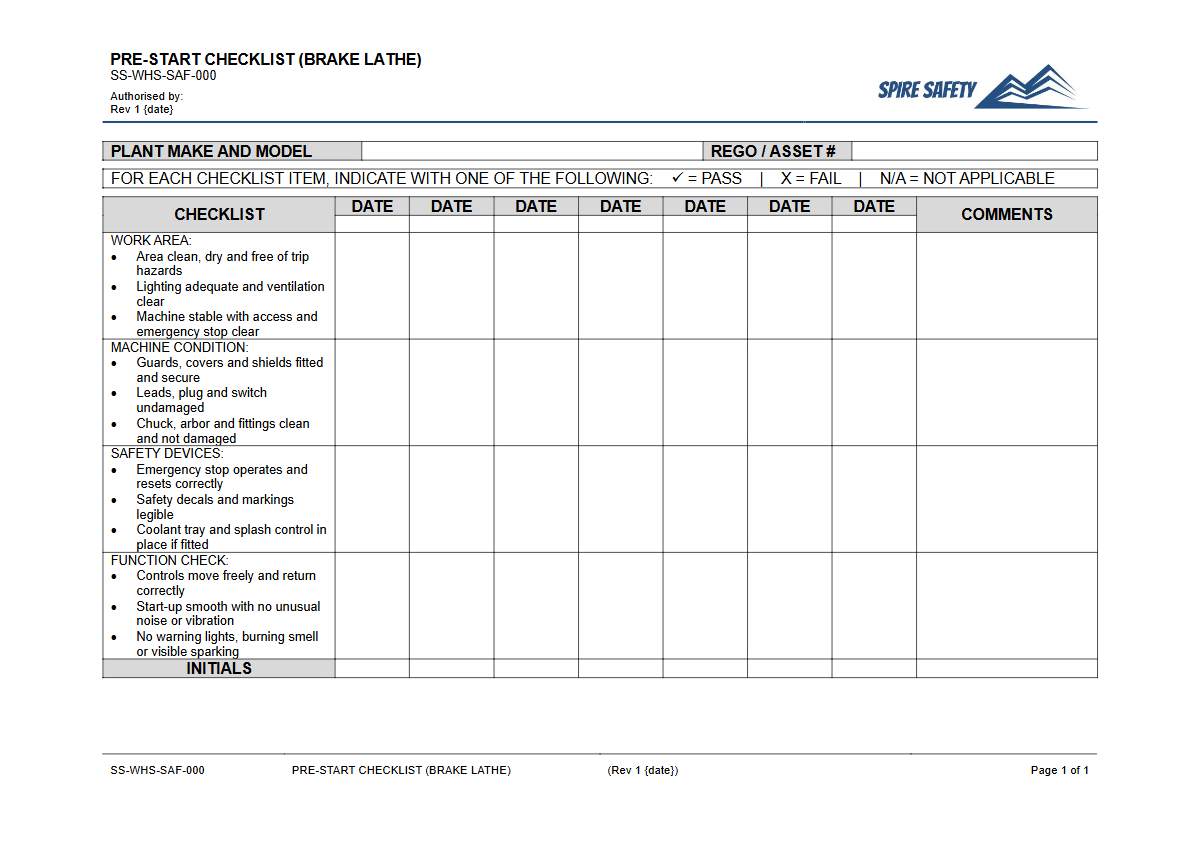
Formalise safety inspections in your workshop with our Free Pre-Start Checklist (Brake Lathe) Template.
Free Pre-Start Checklist (Brake Lathe) Template
DOCX • 125 KB + PDF
Updated Oct 2026
No signup required
Purpose of the Free Pre-Start Checklist (Brake Lathe) Template
Operating a brake lathe involves significant risks, including entanglement with moving parts, projectiles from incorrectly secured components, and electrical hazards. A systematic pre-start inspection is a critical control measure to ensure the equipment is safe to use before any work begins.
This Free Pre-Start Checklist (Brake Lathe) Template provides a structured framework for operators to verify the operational safety of the machine, helping to prevent equipment failure, reduce the risk of injury, and ensure the precision of the machining work. Consistent use of this checklist helps your business demonstrate its commitment to proactively managing workplace health and safety risks associated with workshop machinery.
Integrating these checks into your workshop's WHS management system ensures consistency and creates a reliable record of due diligence. By identifying potential faults such as damaged guards, worn cutting bits, or faulty emergency stops before they cause an incident, you create a safer environment for everyone in the workshop.
This proactive approach is fundamental to Australian WHS legislation, which requires a person conducting a business or undertaking (PCBU) to provide and maintain safe plant and equipment.
Video walkthrough
How to use the Free Pre-Start Checklist (Brake Lathe) Template
This resource is available for immediate download in both DOCX and PDF formats. The DOCX file is fully editable, allowing you to tailor the checklist to the specific make and model of the brake lathe used in your workshop, as well as your unique operational procedures and risk profile.
It is crucial that the checklist accurately reflects your equipment and environment.
Important: This document is a template and not a complete safety solution. We strongly recommend you customise it to fit the specific machinery, tasks, and risks in your workplace.
This may involve adding, removing, or modifying checklist items in consultation with operators and supervisors. Once customised, the checklist should be used by trained and competent operators before commencing their first job of the day or shift.
Completed checklists should be filed as a record of your safety management activities. These records are vital for incident investigations and demonstrating compliance.
Regular WHS compliance auditing often verifies that such safety checks are being consistently performed and documented.
When to use it
A brake lathe pre-start check should be conducted at the beginning of every shift or before the first use of the machine each day. It is a quick but essential process that should become a non-negotiable part of the daily routine for any operator.
The checklist should also be used if the machine has been idle for an extended period, has recently undergone maintenance or repair, or if there is any reason to suspect its condition may have changed.
This routine ensures that any issues that may have developed overnight or during a previous shift are identified and addressed immediately. The principle of regular inspection is not unique to brake lathes; it applies to a wide range of workshop plant, with similar processes recommended in resources like our bench grinder pre-start checklist.
Who should use it
This pre-start checklist is designed for use by any person who operates a brake lathe, regardless of their experience level. This includes qualified mechanics, apprentices, and any other workers tasked with machining brake discs or drums.
Supervisors and workshop managers are also responsible for ensuring these checks are completed correctly and that any identified faults are reported and rectified promptly. Effective implementation requires that all users are trained not only in the operation of the brake lathe but also in the importance and proper execution of the pre-start inspection process.
The checklist serves as a tool for operators and a record for management. It forms part of a broader vehicle maintenance safety program, which might also include checks on related equipment.
For workshops that service entire brake systems, a resource like our Free Pre-Start Checklist (Brake Tester) Template can complement this process. A consistent approach to pre-start checks across all equipment, from brake lathes to concrete floor saw pre-start checklists, reinforces a strong safety culture. For more tools to support your safety framework, you can browse our complete free WHS resources library.
Common mistakes
Common mistakes to avoid
- Using a generic checklist that doesn't match the specific brake lathe model in use.
- Skipping the check with the assumption that the machine was fine on the previous day.
- Failing to report and tag out the equipment for minor faults, leading to larger failures.
- Inadequate record-keeping, leaving no evidence that safety checks were performed.
Legal references
Legal considerations
The following legal requirements may be relevant to this type of work.
- Work Health and Safety Act (Harmonised) — Provides the primary duties for protecting workers and other people from work health and safety risks.
- Work Health and Safety Regulations (Harmonised) — Sets out requirements supporting the management of workplace hazards and risks.
The following codes may be relevant to this type of work.
- Managing WHS Risks Code of Practice — Provides practical guidance on identifying hazards, assessing risks and applying effective controls.
- Work Health and Safety Consultation, Cooperation and Coordination Code of Practice — Provides practical guidance on consulting workers and coordinating with other duty holders.
- Managing the Work Environment and Facilities Code of Practice — Provides practical guidance on safe work environments, workplace facilities and related controls.
Did you know
Hidden Dangers in Brake Dust
Brake components manufactured before 2004 may contain asbestos. Machining these brakes without proper controls can release harmful asbestos fibres, which is why modern workshops must use specific dust extraction systems and follow strict safety procedures.
High-Speed Risks
The chuck and workpiece on a brake lathe can spin at several hundred RPM. An improperly secured brake disc can become a dangerous projectile with enough force to cause severe injury or property damage.
FAQ
Frequently asked questions
01What are the main hazards when operating a brake lathe?
02How often should a brake lathe be formally inspected?
03Is this brake lathe checklist template a legal document?
04Who is responsible for training operators on brake lathe safety?
Share this resource
Free Pre-Start Checklist (Brake Lathe) Template
Browse Categories
How To Use It
- 1Download and open in Word or PDF.
- 2Replace the placeholders with your business details.
- 3Get it reviewed by a WHS specialist before rollout.
Need it customised?
Our WHS consultants can adapt this template to your site, run a gap analysis, or audit what you already have in place.
Book a Free Consultation WHS consulting servicesor call 1300 156 382