
Free Pre-Start Checklist (Bread Slicer) Template
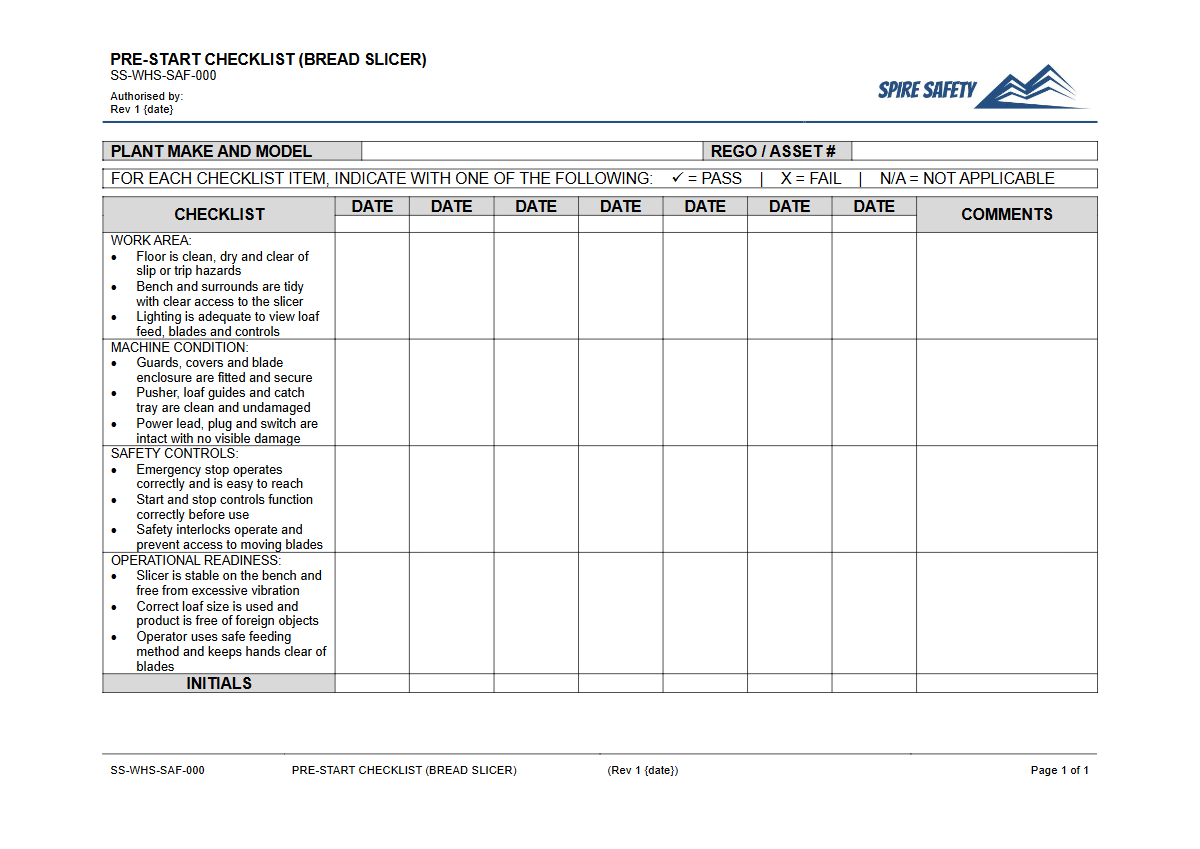
Download our free Pre-Start Checklist (Bread Slicer) Template.
Free Pre-Start Checklist (Bread Slicer) Template
DOCX • 125 KB + PDF
Updated Oct 2026
No signup required
Purpose of the Free Pre-Start Checklist (Bread Slicer) Template
Operating a commercial bread slicer involves significant risks, primarily from its sharp, fast-moving blades. A structured inspection before use is a critical control measure to prevent serious injuries like cuts and amputations.
This free Pre-Start Checklist (Bread Slicer) Template provides a systematic way to verify that the equipment is safe to operate before any work begins. Regular use of this checklist helps your business demonstrate proactive hazard management and contributes to a stronger safety culture.
By formalising these daily inspections, you create a consistent record of due diligence, which is a fundamental component of effective WHS management systems. It ensures that safety features like guards, emergency stops, and interlocks are functional, and that the slicer is clean and structurally sound before staff are exposed to potential harm.
Video walkthrough
How to use the Free Pre-Start Checklist (Bread Slicer) Template
This template is designed as a starting point for food service businesses, bakeries, and commercial kitchens. To implement it effectively, download the DOCX file and adapt it to the specific make and model of bread slicer used in your workplace.
Involve the workers who operate the equipment in the customisation process to ensure the checklist is practical and covers all relevant safety features.
Once customised, provide training to all operators on how to properly complete the checklist and what actions to take if a fault is identified. You can facilitate this training with a dedicated session, perhaps using our pre-start checks and plant maintenance toolbox talk to guide the discussion and reinforce the importance of these inspections.
A Note on Customisation
This document is a template and must be customised to suit the specific equipment, environment, and operational risks of your workplace. We are not responsible for the outcomes of any customisations or the use of this document.
It is your responsibility to ensure your safety documents and procedures are fit for purpose and align with your legal obligations.
When to use it
A pre-start checklist for a bread slicer should be completed before the equipment is used for the first time each day or at the beginning of each shift. This frequency ensures that any damage or faults that may have occurred overnight, during cleaning, or from previous use are identified before the machine is put back into service.
If the slicer is used infrequently, a check should still be performed before every use.
Who should use it
The pre-start check should be conducted by a worker who is trained, competent, and authorised to operate the bread slicer. Ideally, the operator for the shift performs the check, as they have the most immediate interest in ensuring the machine is safe.
This practice promotes a sense of ownership and responsibility for equipment safety among your team.
Supervisors and managers also have a role to play. They are responsible for ensuring the checks are being completed correctly, reviewing the submitted checklists, and taking prompt action to address any reported faults or defects.
If you need assistance developing competency frameworks or defining safety responsibilities, our WHS consulting services can provide expert guidance.
The Role of Supervisors
A supervisor's review is not just a box-ticking exercise. It closes the loop on the safety process.
By signing off on checklists, supervisors confirm that they are aware of the equipment's status. When a fault is noted, the supervisor must ensure the slicer is immediately tagged out of service and that arrangements are made for repair by a qualified person.
These documented actions are crucial evidence of a functioning safety system, a key focus during any WHS compliance auditing process.
In many workplaces where bread slicers are common, such as aged care facilities or large catering kitchens, other hazards like manual handling are also present. Integrating equipment checks with broader safety procedures is key; you might find our Aged Care Manual Handling Toolbox Talk useful for addressing these related risks. For more templates and safety documents, explore our complete free WHS resources library.
Common mistakes
Common mistakes to avoid
- Using a generic checklist that doesn't match the specific slicer model.
- Operators 'pencil-whipping' the form without physically inspecting the equipment.
- Failing to remove a faulty slicer from service immediately after a defect is found.
- Not retaining completed checklists as a record of inspection and maintenance history.
Legal references
Legal considerations
The following legal requirements may be relevant to this type of work.
- Work Health and Safety Act (Harmonised) — Provides the primary duties for protecting workers and other people from work health and safety risks.
- Work Health and Safety Regulations (Harmonised) — Sets out requirements supporting the management of workplace hazards and risks.
The following codes may be relevant to this type of work.
- Managing WHS Risks Code of Practice — Provides practical guidance on identifying hazards, assessing risks and applying effective controls.
- Work Health and Safety Consultation, Cooperation and Coordination Code of Practice — Provides practical guidance on consulting workers and coordinating with other duty holders.
- Managing the Work Environment and Facilities Code of Practice — Provides practical guidance on safe work environments, workplace facilities and related controls.
Did you know
Blade Guard Interlocks
Modern bread slicers are often equipped with magnetic or mechanical interlock switches. These switches are designed to automatically cut power to the motor if a guard is opened or removed, preventing the blades from operating while exposed.
Kitchen Hazards
According to Safe Work Australia, the food service industry has one of the highest rates of workplace injury, with cuts from knives and machinery being among the most common causes of claims.
FAQ
Frequently asked questions
01Are pre-start checklists a legal requirement in Australia?
02What should I do if a fault is found during a bread slicer pre-start check?
03What's the difference between a pre-start check and regular maintenance?
04How often should operators receive training on using the bread slicer?
Share this resource
Free Pre-Start Checklist (Bread Slicer) Template
Browse Categories
How To Use It
- 1Download and open in Word or PDF.
- 2Replace the placeholders with your business details.
- 3Get it reviewed by a WHS specialist before rollout.
Need it customised?
Our WHS consultants can adapt this template to your site, run a gap analysis, or audit what you already have in place.
Book a Free Consultation WHS consulting servicesor call 1300 156 382